Fluorite: The Gemstone That Captures Starlight
For centuries, “night pearls” have occupied a mystical space in Eastern lore—gemstones said to glow with their own celestial light. The reality behind these legendary objects proves equally fascinating, rooted not in magic but in the remarkable mineral fluorite and human visual perception.
The Encounter: Disappointment to Revelation
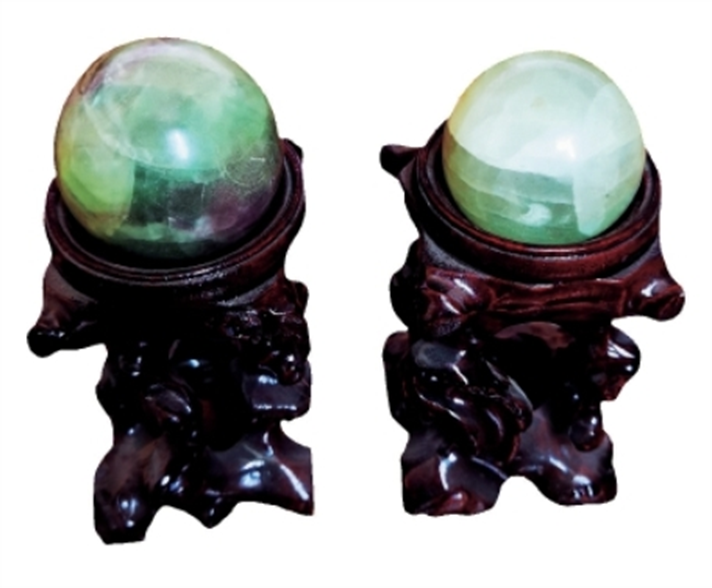
When first encountering Mr. Wang’s “Green Treasure,” initial impressions suggest an ordinary green glass sphere: 10cm in diameter, semi-transparent with smooth emerald-green surfaces. Under normal lighting, it shows no extraordinary properties. The transformation occurs only through specific preparation: complete darkness for 20 minutes allows human rod cells (specialized low-light photoreceptors) to reach maximum sensitivity.
Upon unveiling in darkness, the sphere reveals its secret—emitting a soft, milky luminescence resembling moonlight. This glow, neither garish nor dim, illuminates nearby objects while maintaining the stone’s cool temperature. Light instantly extinguishes the phenomenon, darkness restores it, demonstrating fluorite’s unique photoluminescent properties.
Scientific Basis: More Than Mythology
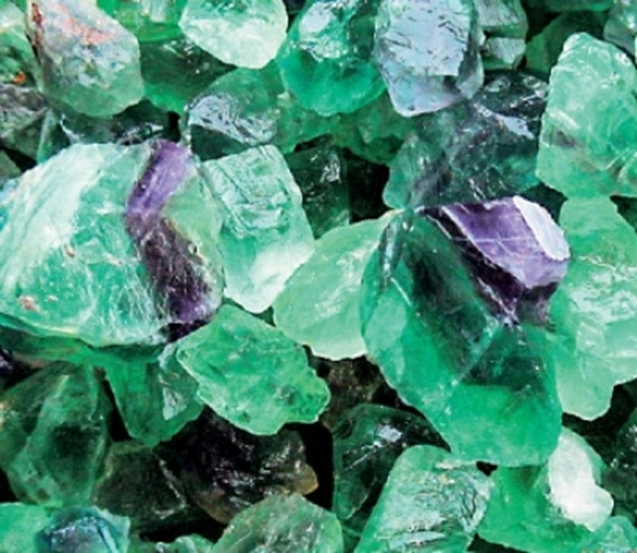
Fluorite (calcium fluoride, CaF₂) belongs to the halide mineral class, commonly forming in hydrothermal veins with lead, zinc, and tin deposits. What transforms ordinary fluorite into legendary “night pearls” involves rare geological conditions:
Activation Requirements:
- Rare Earth Impurities: Yttrium or europium atoms replacing calcium in the crystal lattice
- Energy Storage Capacity: Crystal structure defects that trap energy from ambient UV light
- Emission Efficiency: Precise impurity concentrations enabling visible light emission
- Crystal Quality: Gem-grade transparency without quenching inclusions
Only fluorite combining these characteristics emits visible light under ultraviolet radiation present even in moonlit environments.
Historical Context and Modern Rediscovery
Ancient Chinese texts reference “night pearls” as nocturnal jade discs and following pearls, often associated with royalty and spiritual practices. Zhejiang’s Hemudu culture (5000-3000 BCE) crafted fluorite ornaments, establishing its use millennia before scientific understanding.
Mr. Wang’s five-year quest mirrors modern rediscovery efforts:
- Initial skepticism at Beijing’s Panjiayuan Market
- Systematic study of luminescence mechanisms
- Multiple disappointments with imitations
- Ultimate acquisition through specialized lapidary assistance
His 2,426-gram specimen represents exceptional rarity—documented by Dr. Dong Zhenxin of China Geological Museum with certified properties:
- Refractive Index: 1.44
- Density: 3.18 g/cm³
- Luminescence: Clear nocturnal emission
- Size: 113.6mm diameter (nationally significant)
Modern Factors Increasing Discoveries
1. Advanced Mining Technology
Deep-shaft mining now accesses previously unreachable deposits where high-quality fluorite forms.
2. Sophisticated Detection
UV fluorescence testing instantly identifies luminescent specimens invisible under daylight.
3. Scientific Understanding
Knowledge of activation mechanisms guides targeted exploration.
4. Global Resources
China’s position as holder of 35% of world fluorite reserves (approximately 335 million tons) provides exceptional geological opportunities.
Collector Considerations
Authentic luminescent fluorite requires verification through:
- Dark Adaptation Testing: 20+ minutes in complete darkness
- UV Response: Blue/violet fluorescence under blacklight
- Expert Certification: Geological laboratory analysis
- Provenance Documentation: Mining and processing records
While “night pearls” have moved from legend to understood phenomenon, their allure persists. They represent perfect intersections of geological rarity, optical physics, and cultural history—gemstones that quite literally carry captured starlight within their crystalline structures, waiting only for darkness to reveal their hidden luminosity.
螢石:捕捉星光的寶石
幾個世紀以來,「夜明珠」在東方傳說中佔據了一個神秘的空間——據說能發出自身天體光芒的寶石。這些傳奇物體背後的現實證明同樣迷人,根源不在魔法,而在於非凡的礦物螢石和人類視覺感知。
遭遇:從失望到啟示
初次遇見王先生的「綠寶」時,最初印象暗示一顆普通的綠色玻璃球:直徑10釐米,半透明帶光滑的祖母綠表面。在正常照明下,它不顯示非凡特性。轉變僅通過特定準備發生:完全黑暗20分鐘允許人類視桿細胞(專門的低光感光細胞)達到最大敏感度。
在黑暗中揭開時,球體揭示其秘密——發出柔和、乳白色的發光,類似月光。這種光芒既不俗艷也不暗淡,照亮附近的物體,同時保持石頭的涼爽溫度。光瞬間熄滅現象,黑暗恢復它,展示螢石獨特的光致發光特性。
科學基礎:超越神話
螢石(氟化鈣,CaF₂)屬於鹵化物礦物類,通常在熱液脈中與鉛、鋅和錫礦床形成。將普通螢石轉變為傳奇「夜明珠」涉及罕見的地質條件:
激活要求:
- 稀土雜質:釔或銪原子取代晶格中的鈣
- 能量儲存能力:晶體結構缺陷捕獲環境紫外線能量
- 發射效率:精確的雜質濃度實現可見光發射
- 晶體質量:寶石級透明度無淬滅內含物
只有結合這些特徵的螢石在即使在月光環境中存在的微弱紫外線輻射下發射可見光。
歷史背景和現代重新發現
古代中國文獻將「夜明珠」稱為夜光璧(夜光玉碟)和隨珠(跟隨珍珠),通常與皇室和精神實踐相關。浙江的河姆渡文化(公元前5000-3000年)製作螢石裝飾品,在科學理解前幾千年確立其用途。
王先生的五年探索反映了現代重新發現的努力:
- 最初在北京潘家園市場的懷疑
- 系統研究發光機制
- 多次仿製品失望
- 通過專業寶石切割協助最終收購
他的2,426克樣本代表非凡的稀有性——由中國地質博物館董振信博士記錄認證特性:
- 折射率:1.44
- 密度:3.18 g/cm³
- 發光:清晰的夜間發射
- 尺寸:113.6毫米直徑(全國重要)
增加發現的現代因素
1. 先進採礦技術
深井採礦現在訪問以前無法到達的高品質螢石形成的礦床。
2. 複雜檢測
紫外線熒光測試立即識別在日光下不可見的發光樣本。
3. 科學理解
激活機制知識指導有針對性的勘探。
4. 全球資源
中國作為世界螢石儲量35%的持有者(約3.35億噸)提供了特殊的地質機會。
收藏家考慮因素
真正的發光螢石需要通過以下方式驗證:
- 暗適應測試:完全黑暗20+分鐘
- 紫外線響應:在黑光下藍色/紫色熒光
- 專家認證:地質實驗室分析
- 來源文件:採礦和加工記錄
雖然「夜明珠」已從傳說轉變為理解的現象,但它們的吸引力持續存在。它們代表了地質稀有性、光学物理和文化歷史的完美交叉點——寶石在其晶體結構中 literally 攜帶捕獲的星光,只等待黑暗揭示其隱藏的發光。