The Eastward Journey of Jade: Hetian Jade’s Path to the Qing Imperial Court
This article continues our series exploring the “Jade from the Kunlun Mountains” exhibition at the Beijing Palace Museum, which delves into the culture of Hetian (also spelled Hotan) jade within the Qing Dynasty Imperial Court. In the Chinese cultural consciousness, Hetian jade is synonymous with fine jade itself. Since the Warring States and Han dynasties, the vast majority of exquisite jade carvings have been crafted from this revered material.
Hetian is located in the southern region of China’s Xinjiang Uygur Autonomous Region. Historically known as “Yutian” or “Hetian,” its name means “the place where jade is produced.” It stands as the most significant source of jade material in Chinese history. To explore authentic examples, visit our antique jade collection.
Scientifically, Hetian jade refers to a mineral aggregate primarily composed of tremolite-actinolite minerals. It possesses a typical fibrous interlocking structure and meets the quality standard to be classified as true nephrite jade.
Archaeological evidence indicates that the mining of Xinjiang nephrite (including Hetian jade) dates back to the Neolithic period. However, jade objects from this early era were primarily simple tools and utilitarian items.
After the Han Dynasty, Xinjiang Hetian jade material began to be transported to the Central Plains of China. During the Tang Dynasty, the famed Silk Road facilitated faster and more convenient transportation of jade.
From the Song Dynasty onward, the mining and trade of Hetian jade continued uninterrupted, gradually becoming a crucial source of jade for the Central Plains.
The Ming Dynasty marked the beginning of true mining for Hetian mountain jade material.
Following the Qing Emperor Qianlong’s consolidation of control over the Xinjiang region in 1759, high-quality Hetian jade was regularly sent as tribute to the Imperial Court. It subsequently became the primary source of jade material for the Qing imperial workshops. Many of these pieces are now featured in our jadeite jewelry collection.
Exploring the Exhibition: Masterpieces Across Dynasties
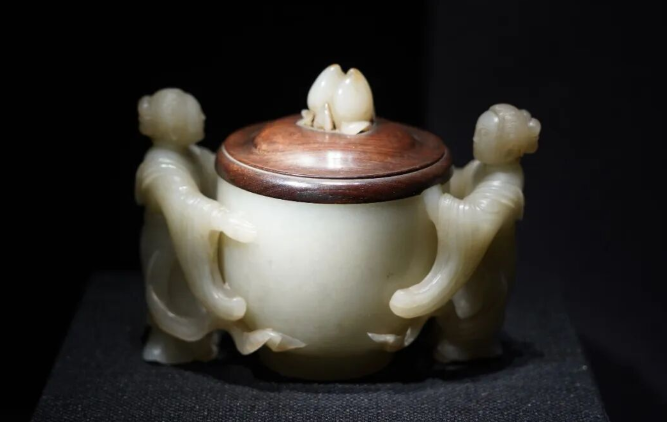
White Jade Censer with Twin Figure Handles, Ming Dynasty, Palace Museum Collection
This piece exemplifies the archaic and robust style characteristic of the Ming period. Upon close observation, one notes the jade has a slightly greyish hue, indicating it had not yet reached the pinnacle of quality. During the Ming Dynasty, the Hetian region was not under direct control of the Central Plains government, making the acquisition of premium jade material significantly more difficult compared to the mid-Qing period.
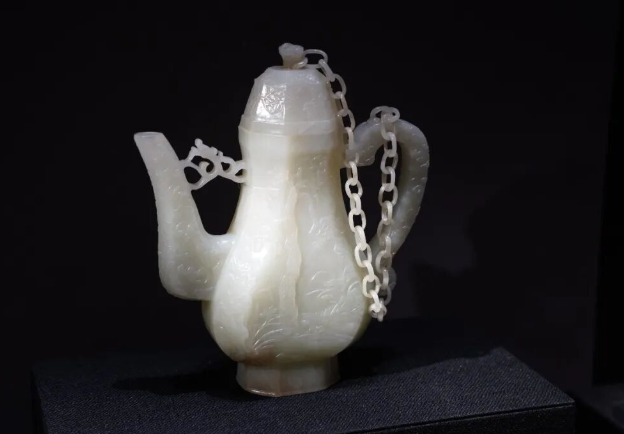
White Jade Ewer with Ganoderma and ‘Fu Shou’ (Blessing and Longevity) Motifs, Ming Dynasty, Palace Museum Collection
Carved from a single block of jade, this ewer showcases the bold and vigorous Ming aesthetic. Its decorative motifs carry auspicious meanings—a tradition that has persisted from that time to the present day.
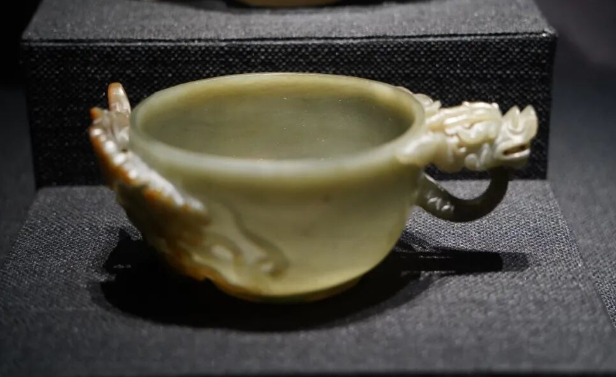
Grayish-Green Jade ‘Ear Cup’ with Flying Dragon Motif, Song to Yuan Dynasty, Palace Museum Collection
Made of a greyish-green jade, this cup features vigorous and powerful carving. The craftsman skillfully utilized the natural russet skin of the jade (the outer layer altered by oxidation) in a technique known as “qiaodiao” or clever carving.
White Jade ‘Jade Xiaoyao’ Ornament with Peony Design, Jin Dynasty, Palace Museum Collection
After the Tang Dynasty, symmetrical patterns frequently appeared in jade carving designs, such as paired cranes, birds, or floral motifs. These pieces typically used high-quality jade and often expressed themes of harmony and auspiciousness. A similar ornament was discovered sewn onto the headdress of a princess consort in the tomb of Jin Dynasty prince Wanyan Yan (excavated in Acheng, Heilongjiang, 1988). Scholar Sun Ji identified this type of artifact based on records in the History of Jin, which describes elderly noblewomen wearing headscarves adorned with jade pieces called “yu xiaoyao” (jade carefree). Therefore, this type of jade artifact should be called “yu xiaoyao,” serving as a jade ornament on the headdress of Jin Dynasty noblewomen.
White Jade ‘Spring Water’ Pendant, Jin Dynasty, Palace Museum Collection
The term “Spring Water” originates from the spring hunting excursions of Jin Dynasty nobility, activities described as “like spring water.” The hunt involved using gyrfalcons (Haidingqing) to capture swans or wild geese. The gyrfalcon is a small, agile, and fierce raptor, noted for being “small yet robust.” During the Liao, Jin, and Yuan periods, northern ethnic groups greatly enjoyed this form of falconry. Its depiction is common in Jin and Yuan jade carvings, collectively known as “Spring Water jade.”
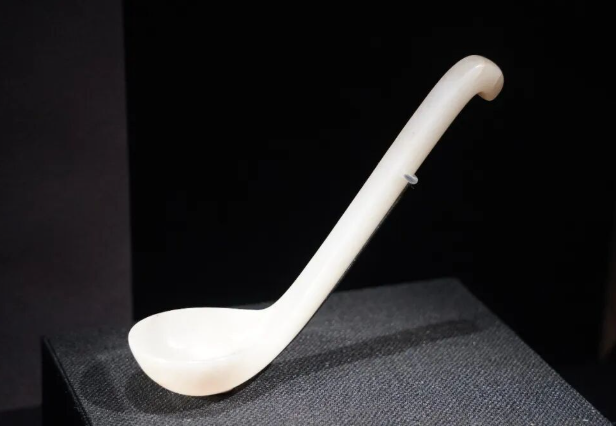
White Jade Spoon, Tang Dynasty, Palace Museum Collection
The Tang Dynasty style is characterized by its full, rounded, and substantial forms—a quality perfectly captured in this simple yet elegant spoon.
White Jade Square Belt Plaque with ‘Tribute Bearer’ Design, Tang Dynasty, Palace Museum Collection
Belt plaques are classic Tang Dynasty jade artifacts, representing a single piece from a complete jade-decorated belt. This plaque is carved with a design of a foreign tribute bearer presenting treasures—a snapshot of the prosperous trade along the Silk Road during the glorious Tang era. For similar high-quality jade artifacts, browse our Chinese antiques category.
Read more
FAQ
What is the difference between Hetian jade and jadeite?
Hetian jade is a nephrite jade that originates from the Xinjiang region of China, characterized by its fibrous interlocking structure and typically creamy white or greenish tones. Jadeite (fei cui) is a different mineral from Burma or Guatemala, known for its vivid green colors and higher translucency. Both are considered true jade in the gemological world.
How can I identify authentic Hetian jade?
Authentic Hetian jade has a smooth, oily sheen, a dense feel, and often exhibits a subtle internal texture when held to light. It is typically cold to the touch initially and warms quickly. For certainty, purchase from reputable dealers like VirtuCasa who provide certification and detailed provenance.
Why was Hetian jade so prized in the Qing imperial court?
After the Qing conquest of Xinjiang in 1759, regular tribute of high-quality Hetian jade reached the imperial workshops. Its fine texture, purity, and cultural significance made it the preferred material for ritual objects, ornaments, and decorative carvings, symbolizing virtue and status.
What is the historical significance of the ‘Spring Water’ jade pendants?
‘Spring Water’ pendants depict scenes of hunting with gyrfalcons, a tradition from Liao, Jin, and Yuan dynasties. They represent the integration of northern nomadic culture into Chinese jade carving, showcasing dynamic themes beyond traditional auspicious motifs.