
Why Ice-Type Jadeite Deserves a Buyer’s Attention
Ice-type jadeite sits at the heart of the modern jade market. Its defining trait is transparency: the stone reads as cool, clear, and almost crystalline, closer to frozen water than to the opaque green boulders many newcomers picture. That clarity is what allows two of the most collectible color stories in jadeite — floating green and violet — to look so different from one another even when both are cut from the same family of material.
For buyers, this matters because ice-type jadeite rewards careful looking. Color that appears vivid in one lighting condition can soften in another, and patterns that look subtle in a photo can become the most beautiful part of a piece in person. Understanding how transparency, color, and texture interact helps you judge whether a bracelet, necklace, or ring will still delight you years from now.
At VirtuCasa, our jadeite collection spans bead bracelets, necklaces, saddle rings, and gem-set pieces, so you can compare ice-type examples side by side. This guide walks through the quality factors that matter, the difference between floating green and violet, sizing, and how price tracks rarity — using only the specifications published on each product page.
Understanding Quality in Ice-Type Jadeite
Transparency and Texture
Transparency is the first thing to assess. In ice-type material, light passes through the stone rather than stopping at the surface, producing a cool, glassy sheen. Descriptions such as ‘transparent and delicate’ or ‘translucent, glossy appearance’ are the language sellers use to signal this quality. Texture matters just as much: a fine, compact internal structure is what makes the surface look smooth and reflective instead of grainy.
Gemological authorities treat color, clarity, and cut as the classic framework for evaluating jadeite, and they recommend judging color under both fluorescent and incandescent light. You can read more about these criteria in the GIA’s jadeite quality factor overview, which explains how lighting changes what you see. That single habit — viewing a piece in more than one light source — will improve your buying decisions more than any other.
Color: Saturation, Evenness, and Pattern
Color in jadeite is judged by hue, saturation, and evenness. A ‘full green’ piece with dense, even coloration is described very differently from one with ‘floating green patterns’ on a light base. Neither is inherently better; they are different aesthetics. What matters is that the color is natural-looking and that the pattern feels harmonious rather than patchy.
Violet jadeite, often called lavender, is prized for a soft, ethereal quality. Because violet can shift depending on lighting, buyers should pay close attention to descriptions like ‘soft and elegant lavender hue’ and ‘cool, ethereal charm.’ If a piece is described as vivid violet with excellent transparency, that combination is a strong indicator of premium material.
Treatment Status
The most important structural question is whether jadeite is Type A — untreated and natural — or has been bleached, polymer-impregnated, or dyed. Reputable educational guides emphasize that Type A status is the baseline for long-term value. The guidance on identifying natural Type A jade and avoiding common pitfalls is a useful primer before you compare listings. Every piece in the VirtuCasa jadeite category is presented as natural jadeite, and the product descriptions consistently emphasize natural germplasm and structure.
Types & Styles: Floating Green vs Violet
Floating green describes green color patches suspended in a lighter, more transparent base. The effect is botanical — like leaves drifting in clear water. A representative example is the Natural Ice-type Jadeite Bracelet with Floating Green Patterns, built from 13 round beads of 16mm diameter with a total weight of 101g. The description notes a transparent, delicate texture with a cool, lustrous glassy sheen and green patterns that blend subtly into the icy base. The uniform bead size gives it a harmonious, substantial presence on the wrist.
Violet jadeite occupies the opposite mood: quieter, softer, and often more romantic. The Natural Ice-type Violet Jade Bead Necklace is a striking example at scale — 68 beads ranging from 10mm to 12mm in diameter, weighing 158g, with a fine, delicate texture and a translucent, glossy lavender appearance. Its length supports multi-layered wearing or single-strand draping, so it adapts to different necklines.
Violet also appears in more formal settings. The Natural Ice-type Violet Jadeite Cabochon Ring Set with 18K White Gold, Sapphires, and Diamonds pairs an oval cabochon of vivid violet with excellent transparency against white gold and gem accents, at a 15 ring size and 4g. For buyers who want color variety rather than a single hue, the Natural Ice-type Tricolor Jade Necklace combines yellow, green, and white in 5.3mm beads at 25.8g, while the lighter tricolor strand uses 3.5mm beads at 10.4g for a more delicate look.
How to Choose the Right Size & Fit
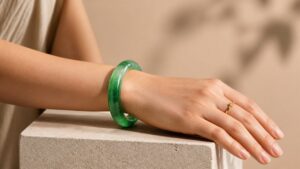
Fit is where jadeite buying becomes personal. For bead bracelets, the bead diameter and total circumference determine how the piece sits. The Natural Jadeite Bracelet, for instance, uses 19 round beads of approximately 10mm each, forming a flexible bracelet with a total circumference of about 18cm — the listing notes it suits wrists measuring 16-19cm. That kind of explicit guidance is far more useful than a generic ‘one size’ claim.
Larger beads create more visual weight. The floating green bracelet’s 16mm beads and 101g total make it a statement piece, while the Natural Three-Color Jadeite Bracelet uses 16 spherical beads of roughly 12mm at about 35g, with an elastic cord that adjusts to most wrist sizes. If you prefer a lighter feel, smaller beads and shorter strands are the better route.
For necklaces, bead diameter governs formality. A 3.5mm strand reads as subtle and layer-friendly, while a 10-12mm strand is a focal piece. For rings, ring size is the controlling measurement — the Natural Full-Green Jadeite Saddle Ring is a 24 ring size at 9.5g, and the Natural Jadeite Saddle Ring with Floating Green is a 26 ring size at 13.5g, both carved in the traditional saddle style with a curved top surface.

Price & Value: What Drives Cost
Ice-type jadeite pricing follows rarity. Greater transparency, finer texture, more even color, and larger bead sizes all push value upward. Comparing within the VirtuCasa range makes the pattern visible. The Natural Three-Color Jadeite Bracelet is $668, the Natural Jadeite Saddle Ring with Floating Green is $719, and the Natural Ice-type Tricolor Jade Necklace (3.5mm) is $740 — entry-level to mid-range pieces that still deliver natural material and careful craftsmanship.
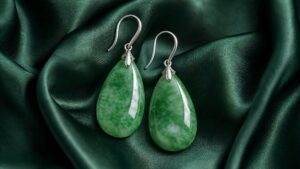
Mid-range examples include the Natural Ice-type Tricolor Jade Necklace (5.3mm) at $825, the Natural Jadeite Tassel Earrings at $852, the Natural Jadeite Bracelet at $1008, and the Natural Ice-type Jadeite Bracelet with Floating Green Patterns at $1517. Here you are paying for larger beads, stronger transparency, and more distinctive color patterning.
Premium pieces reflect scale and gem-setting. The Natural Ice-type Violet Jadeite Cabochon Ring Set with 18K White Gold, Sapphires, and Diamonds is $1926, the Natural Full-Green Jadeite Saddle Ring is $2437, and the Natural Ice-type Violet Jade Bead Necklace — 68 beads, 158g — is $6649. That top figure reflects a rare combination of size, weight, and uniform lavender material. For a broader overview of how these factors are weighed, the comparison guidance on color, clarity, imperfections, and price is worth reading before you commit.
Common Mistakes to Avoid
- Judging color from a single photo. Always ask how a piece looks in both warm and cool light.
- Confusing ‘icy look’ with genuine ice-type transparency. Texture and light passage matter more than surface shine.
- Ignoring bead size when comparing prices. A 16mm bead and a 3.5mm bead are not the same purchase.
- Overlooking total weight. A 158g necklace and a 10.4g necklace wear very differently.
- Assuming violet will always look violet. Lavender jadeite can shift tone under different lighting.
- Skipping treatment questions. Confirm natural, Type A status before buying.
- Choosing a ring size by habit rather than measurement, especially with saddle-style bands.
Top Picks
Natural Ice-type Jadeite Bracelet with Floating Green Patterns ($1517) — best for buyers who want a bold, transparent statement bracelet. The 16mm beads and 101g weight suit someone comfortable with substantial jewelry, and the floating green pattern is the classic expression of this material.
Natural Ice-type Violet Jade Bead Necklace ($6649) — the collector’s choice. Sixty-eight beads of 10-12mm and 158g of lavender ice-type jadeite make this a serious, heirloom-oriented acquisition for someone building a focused collection.
Natural Jadeite Bracelet ($1008) — ideal for a first fine jadeite purchase. The lavender-white hue, 10mm beads, and 18cm circumference with a stated 16-19cm wrist fit make it easy to wear daily.
Natural Ice-type Violet Jadeite Cabochon Ring Set with 18K White Gold, Sapphires, and Diamonds ($1926) — suited to someone who wants violet jadeite in a refined, gem-set form at a 15 ring size.
Natural Three-Color Jadeite Bracelet ($668) — a strong entry point for anyone curious about multi-hue jadeite, with 12mm beads and an adjustable elastic fit.
Final Tips
Buy ice-type jadeite for the qualities that never go out of style: transparency, fine texture, and natural color. Floating green and violet are simply two expressions of the same underlying standard, so let your own eye decide which you prefer rather than chasing trends. Compare bead sizes and weights carefully, confirm natural Type A status, and view pieces in more than one light before deciding. When you are ready, browse the full jadeite collection to compare every piece described here side by side.
FAQ
What does ice-type mean in jadeite?
Ice-type jadeite is material with high transparency and a cool, glassy sheen, so light passes through the stone rather than stopping at the surface. Product descriptions often call this texture ‘transparent and delicate’ or ‘translucent, glossy.’
Is floating green jadeite better than violet jadeite?
Neither is inherently better — they are different aesthetics. Floating green features green patches suspended in a lighter base, while violet (lavender) jadeite offers a softer, more ethereal tone. Value depends on transparency, texture, color evenness, and size rather than the color family alone.
How do I know a jadeite bracelet will fit?
Check the listed bead diameter and total circumference. The Natural Jadeite Bracelet, for example, has 19 beads of about 10mm, a circumference of about 18cm, and is stated to suit wrists measuring 16-19cm. Elastic-cord designs, like the Natural Three-Color Jadeite Bracelet, adjust to most wrist sizes.
Why do ice-type jadeite prices vary so much?
Price tracks rarity: greater transparency, finer texture, more even color, and larger bead sizes all raise value. Within the VirtuCasa range, pieces run from $668 to $6649, with the highest figures reflecting rare combinations of size, weight, and uniform color.