Why Clasp and Stringing Matter for Jadeite Bracelets
A jadeite bracelet is only as wearable as the structure that holds it together. Buyers naturally focus on color and translucency, but the clasp, cord, and stringing determine whether a strand of fine beads stays secure on the wrist or becomes a repair project. On beaded bracelets, the cord passes through every bead and bears the full weight of the piece, so the quality of the stringing is a genuine part of the product’s value.
This is especially true for natural jadeite. Individual beads can be dense and heavy—a substantial strand may weigh well over 100g—and that weight places steady tension on the cord and knots. A weak or poorly finished stringing job can fail long before the jade itself shows any wear. Inspecting the clasp and stringing is therefore one of the most practical checks a buyer can make.
According to GIA’s jadeite quality factors, color, transparency, and texture drive the market value of jadeite. Those qualities are what you pay for—but the clasp and stringing are what let you actually wear them. This guide explains what to inspect, how different styles are constructed, and which VirtuCasa pieces suit different needs.
Understanding Quality: What to Inspect
Cord Type and Elasticity
Many beaded jadeite bracelets are strung on elastic cord, which allows the bracelet to slip over the hand without a metal clasp. Elastic is comfortable and easy to wear, but it is also a wear item: it stretches, dries out, and eventually loses tension. When inspecting an elastic-strung bracelet, look for a cord that feels firm and returns to shape after stretching, and check that the knot is tucked neatly inside a bead hole rather than left exposed.
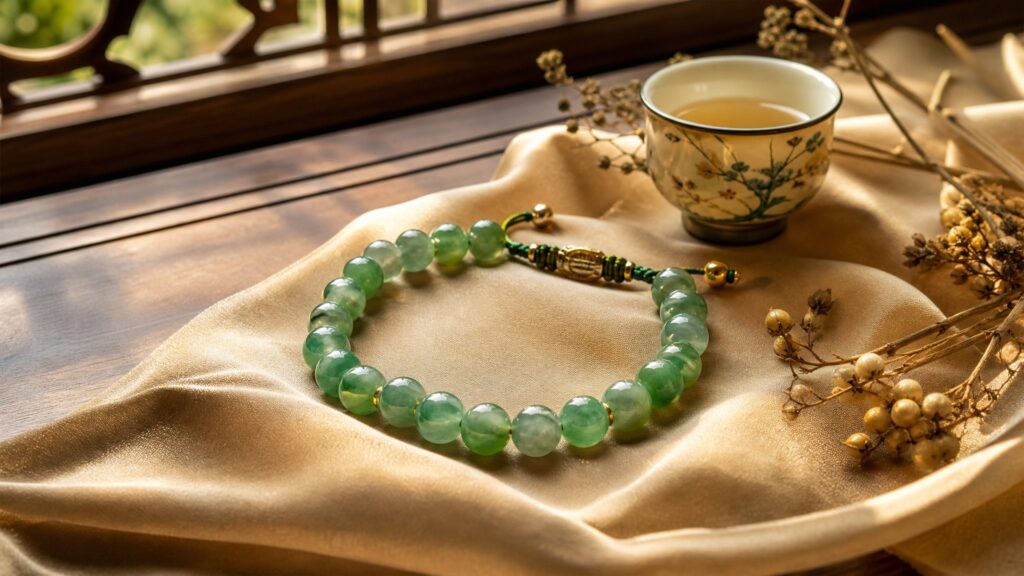
VirtuCasa’s Natural Jadeite Bracelet is simply strung together with the elastic cord, without any additional metal setting. That construction is typical of fine bead bracelets and puts the emphasis on the jade itself. Because there is no clasp to inspect, the cord and knot become the critical points to review.
Knots and Finishing
A well-finished bracelet hides its knot. The cord should be knotted tightly and pulled into a bead hole so it does not rub against the wrist or catch on clothing. On traditional cord-strung pieces, such as necklaces finished with rope-knotting, the knot should be compact and secure, with no loose tails. Loose or bulky knots are a sign of hurried assembly and a common cause of premature failure.
Bead Drilling and Spacing
Bead holes should be smooth and centered. Rough or off-center drilling can abrade the cord with every movement, shortening its life. Check that beads sit closely together without pinching the cord, and that the strand has a little give rather than being strung drum-tight. Even spacing and consistent bead size also affect how the bracelet drapes on the wrist.
Metal Clasps and Connections
Where metal is used, inspect the clasp mechanism and the connections between jade and metal. VirtuCasa’s Natural Jadeite Tassel Earrings show how jadeite beads are securely connected to 18K gold-plated chains, combining jade with gold for a classic look. For any metal component, look for secure connections and a finish that will not snag. As general buying guidance from the Gemological Society’s jade buying guide notes, construction and treatments are part of judging a piece, not afterthoughts.
Types & Styles: How Clasp and Stringing Vary
Beaded jadeite jewelry generally falls into two construction families: elastic-strung bracelets and cord- or metal-finished pieces. Elastic bracelets are the most convenient for daily wear because they need no clasp. The Natural Three-Color Jadeite Bracelet uses an elastic cord design with an adjustable circumference for a comfortable fit, and the Natural Ice-type Jadeite Bracelet with Floating Green Patterns offers a flexible fit across various wrist sizes. Both rely on the cord rather than a clasp to stay on the wrist.
Cord-strung necklaces use traditional knotting and no metal setting. The Natural Ice-type Tricolor Jade Necklace is strung with the traditional rope-knotting technique, while the Natural Ice-type Tricolor Jade Necklace in a smaller bead size is simply strung on durable brown cord with traditional knotting. These pieces ask the buyer to check knot security and cord condition rather than a mechanical clasp.
A third category uses metal settings and chains, as with the tassel earrings above. Here the inspection shifts to the connection points: how the jade is attached, whether the metal is secure, and whether the piece hangs evenly. Each construction type has its own wear points, and knowing which one you are buying makes inspection straightforward.
How to Choose the Right Size & Fit
Fit affects how much stress the stringing endures. A bracelet that is too tight will stretch the elastic every time it is put on, while one that is too loose will slide and knock against surfaces. The Natural Jadeite Bracelet is composed of 19 round beads of approximately 10mm diameter, forming a total circumference of about 18cm, suitable for wrists of 16-19cm. That stated range is a useful benchmark: measure your wrist and compare it with the bracelet’s circumference before ordering.
For larger beads, check the stated flexibility. The Natural Three-Color Jadeite Bracelet has 16 spherical beads of approximately 12mm and an adjustable circumference thanks to its elastic cord, while the Natural Ice-type Jadeite Bracelet with Floating Green Patterns comprises 13 round beads of 16mm and offers a flexible fit. Larger, heavier beads put more load on the cord, so a snug-but-not-tight fit is ideal.
Necklaces follow the same logic. The Natural Ice-type Tricolor Jade Necklace with 5.3mm beads weighs 25.8g, while the smaller-bead version weighs 10.4g—lighter strands place less tension on the cord and knot. For a more substantial option, the Natural Ice-type Violet Jade Bead Necklace comprises 68 beads of 10mm to 12mm and weighs 158g, so its stringing and knot deserve close attention. Browse the full jadeite collection to compare constructions side by side.
Price & Value: What Drives Cost
Price in jadeite reflects the stone first: color, transparency, and texture remain the dominant value factors, as GIA explains. Construction then adds practical value. A bracelet with carefully finished stringing and a well-hidden knot is less likely to need early repair, which matters over years of wear. Two bracelets with similar jade can differ in price because of bead size, bead count, and the labor involved in finishing.
Within VirtuCasa’s range, the Natural Three-Color Jadeite Bracelet is priced at $668, the Natural Jadeite Bracelet at $1008, and the Natural Ice-type Jadeite Bracelet with Floating Green Patterns at $1517. Necklaces range from $740 and $825 for the tricolor ice-type designs to $6649 for the Natural Ice-type Violet Jade Bead Necklace. These differences track bead size, transparency, and rarity rather than clasp type alone—but construction quality is part of what you are paying for at every level.
When comparing, weigh the cost of likely maintenance. An elastic-strung bracelet will eventually need restringing; a cord-strung necklace may need a knot refreshed. Neither is a flaw, but factoring that into value gives a truer picture than price alone. A mid-range piece with sound stringing can be a better long-term buy than a premium piece with neglected finishing.
Common Mistakes to Avoid
- Ignoring the knot: an exposed or bulky knot is a wear point and a sign of rushed assembly.
- Assuming elastic lasts forever: elastic cord stretches and dries out, so plan for restringing.
- Buying without measuring: a bracelet outside your wrist range will strain the cord or slide loose.
- Overlooking bead drilling: rough or off-center holes abrade the cord with every movement.
- Skipping connection checks on metal-set pieces: verify that jade-to-metal joins are secure.
- Judging only by color: construction quality affects how often the piece needs repair.
Top Picks
For everyday elastic convenience, the Natural Jadeite Bracelet ($1008) suits buyers who want a soft lavender-white strand with a gentle vitreous luster and a simple elastic construction—19 beads of about 10mm and roughly 30g.
For a bolder, multi-color look, the Natural Three-Color Jadeite Bracelet ($668) suits those who like larger 12mm beads and an adjustable elastic fit, at about 35g.
For a statement piece with high transparency, the Natural Ice-type Jadeite Bracelet with Floating Green Patterns ($1517) suits buyers prepared for a substantial 101g strand of 16mm beads who will check the cord and knot carefully.
For traditional cord-strung necklaces, the Natural Ice-type Tricolor Jade Necklace ($740) suits those who prefer a light 10.4g strand on durable brown cord with traditional knotting.
For metal-set construction, the Natural Jadeite Tassel Earrings ($852) suit buyers who want jadeite beads securely connected to 18K gold-plated chains in a light 8g pair.
Final Tips
Inspect the clasp and stringing the way you would inspect the stone: closely and with a specific question in mind. Ask how the piece is strung, where the knot sits, and what will wear first. For elastic bracelets, confirm the cord feels firm; for cord-strung necklaces, check knot security; for metal-set pieces, verify the connections. A practical buying guide such as GemSelect’s jade buying guide can help you compare treatments and authenticity alongside construction.
Finally, match the construction to how you will wear the piece. Daily wear favors simple, serviceable stringing; occasional wear allows more delicate finishing. With the right checks, a natural jadeite bracelet or necklace becomes a piece you can wear with confidence rather than a repair waiting to happen.
FAQ
How can I tell if a jadeite bracelet’s stringing is good quality?
Check that the cord feels firm and returns to shape, the knot is tucked inside a bead hole rather than exposed, and the bead holes are smooth and centered. These details reduce friction and the chance of premature failure.
Do all jadeite bracelets have a metal clasp?
No. Many beaded jadeite bracelets are simply strung on elastic cord with no metal setting, as with the Natural Jadeite Bracelet. Others use metal chains or settings, as with the Natural Jadeite Tassel Earrings, where jadeite beads are connected to 18K gold-plated chains.
How do I choose the right bracelet size?
Measure your wrist and compare it with the bracelet’s stated circumference. For example, the Natural Jadeite Bracelet has a total circumference of about 18cm and is suitable for wrists of 16-19cm. Elastic designs such as the Natural Three-Color Jadeite Bracelet offer an adjustable fit.
Will elastic stringing need to be replaced?
Elastic cord is a wear item—it stretches and dries out over time, so restringing is a normal part of ownership. Choosing a bracelet that fits well and inspecting the knot at purchase helps extend the time before replacement is needed.