Introduction: Why Jadeite Color Deserves Your Full Attention
Few gemstones reward observation the way jadeite does. A bracelet that looks like soft lavender in morning daylight can read almost grey in a dim hallway, then glow with unexpected warmth under a shop’s spotlights. This is not a defect and it is not a trick — it is the optical nature of jadeite, and understanding it is one of the most practical skills a buyer can develop.
Color is the single largest driver of value in jadeite, which is why gemologists evaluate it under multiple light sources rather than one. According to the Gemological Institute of America’s jadeite quality factors, buyers should judge jadeite color under both fluorescent and incandescent light, because the stone can appear noticeably different in each. That single habit — looking twice, under two kinds of light — separates confident buyers from disappointed ones.
At VirtuCasa, our jadeite collection spans lavender, deep green, three-color, and ice-type pieces, and each behaves differently as lighting changes. This guide explains why the shift happens, what quality factors matter, and how to choose a piece you will still love at home, in the office, and in evening light.
Understanding Quality: The Factors Behind the Shift
Color: Hue, Saturation, and Tone
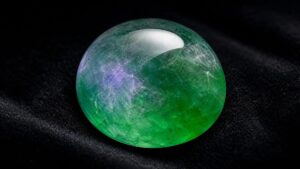
Jadeite color is usually described across three dimensions: hue (the actual color, such as green or violet), saturation (how intense or vivid it is), and tone (how light or dark it reads). A stone with high saturation and a medium tone tends to hold its character across lighting conditions, while very pale or very dark stones can appear to change more dramatically. This is why a pale lavender piece may look almost white in cool light but reveal a clear violet cast in warm light.
Transparency and Texture
Transparency interacts directly with color perception. In highly translucent jadeite, light travels deeper into the stone before reflecting back, which can make color appear richer and more evenly distributed. More opaque material tends to show color concentrated near the surface. Ice-type jadeite, prized for its transparent, delicate texture and cool, glassy sheen, often displays this depth effect most clearly.
Finish and Luster
A polished surface with a fine vitreous or glassy luster reflects light more cleanly, which can brighten apparent color. A dull or waxy finish scatters light and can mute even a well-colored stone. Luster is also one of the visible signals of natural material, which is why reputable guides to identifying natural A-jade when buying online emphasize examining surface finish and internal structure together.
Treatment Status
Whether jadeite is Type A (untreated), Type B, or Type C is fundamental to both value and color behavior. Untreated natural jadeite holds its color as a property of the stone itself. Buyers comparing pieces should confirm treatment status first, then evaluate color — a point stressed in most jadeite buying guides covering the Three Cs of color, clarity, and cut.
Types & Styles: How Different Jadeite Behaves in Light
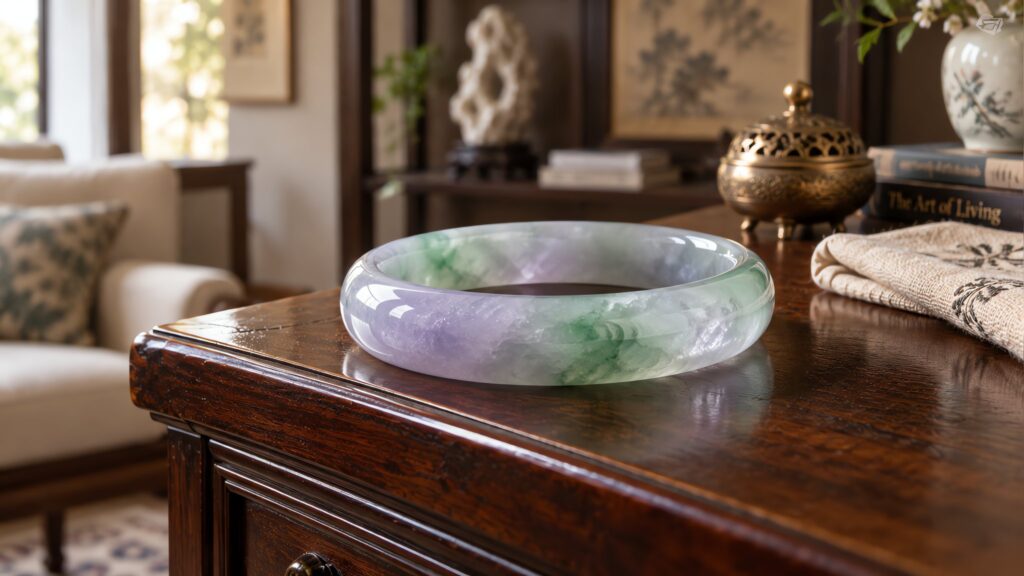
Lavender and violet jadeite are among the most light-sensitive varieties. The Natural Jadeite Bracelet, strung from natural jadeite beads with a soft lavender-white hue and gentle vitreous luster, is a good example: its uniform color distribution and translucent quality mean it can lean cooler indoors and warmer in daylight. A more saturated violet option, such as the Natural Ice-type Violet Jadeite Cabochon Ring Set with 18K White Gold, Sapphires, and Diamonds, shows how ice-type transparency can intensify a vivid violet hue into a soft, gem-like glow.
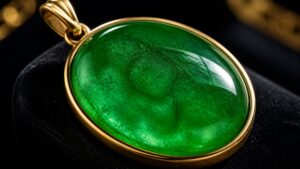
Green jadeite tends to be more stable but still shifts. Deep green material with a fine, compact texture and glassy luster, like the Natural Jadeite Tassel Earrings, reads rich and vibrant in most conditions because high saturation anchors the color. Full-green pieces behave similarly; the Natural Full-Green Jadeite Saddle Ring presents an even, dense yet translucent green with a warm vitreous sheen that holds up well across lighting.
Multi-color and ice-type jadeite are the most dynamic of all. The Natural Three-Color Jadeite Bracelet combines yellow, white, and light green, and those hues can trade prominence as light changes. Ice-type pieces with floating patterns, such as the Natural Ice-type Jadeite Bracelet with Floating Green Patterns, use transparency to make green patches appear to drift across the icy base. The same effect appears in the Natural Ice-type Tricolor Jade Necklace and the finer-beaded Natural Ice-type Tricolor Jade Necklace.
How to Choose the Right Size & Fit
Fit matters as much as color, because a piece that sits well is worn more often and seen in more lighting conditions. For bracelets, bead diameter and total circumference determine comfort. The Natural Jadeite Bracelet uses 19 round beads of approximately 10mm each, forming a flexible bracelet with a total circumference of about 18cm, suitable for wrists of 16–19cm. The Natural Three-Color Jadeite Bracelet uses 16 spherical beads of approximately 12mm each with an adjustable elastic cord, while the Natural Ice-type Jadeite Bracelet with Floating Green Patterns comprises 13 round beads of 16mm each for a more substantial presence.
Necklaces depend on bead size and strand length. The Natural Ice-type Tricolor Jade Necklace with 5.3mm beads offers a refined, harmonious look, whereas the finer 3.5mm version is suited to layering or subtle daily wear. The Natural Ice-type Violet Jade Bead Necklace, with 68 beads ranging from 10mm to 12mm, provides versatile length for multi-layered or single-strand draping.
Rings should be judged by ring size and profile. The Natural Full-Green Jadeite Saddle Ring is a 24 ring size, the Natural Jadeite Saddle Ring with Floating Green is a 26 ring size, and the Natural Ice-type Violet Jadeite Cabochon Ring Set is a 15 ring size. Saddle-style rings rest on a curved top surface, so comfort depends on both size and shape.
Price & Value: What Drives Cost
Price in jadeite reflects rarity, color intensity, transparency, and craftsmanship — not simply size. Entry-level pieces in our collection start at $668 for the Natural Three-Color Jadeite Bracelet and $719 for the Natural Jadeite Saddle Ring with Floating Green. Mid-range options include the Natural Ice-type Tricolor Jade Necklace at $740 and $825, the Natural Jadeite Tassel Earrings at $852, the Natural Jadeite Bracelet at $1008, the Natural Ice-type Jadeite Bracelet with Floating Green Patterns at $1517, and the Natural Ice-type Violet Jadeite Cabochon Ring Set at $1926.
At the premium end, the Natural Full-Green Jadeite Saddle Ring is $2437, and the Natural Ice-type Violet Jade Bead Necklace is $6649 — a piece whose 158g weight and 68 uniform beads reflect substantial, high-quality material. In general, vivid saturation, high transparency, even color distribution, and clean craftsmanship push value upward.
Common Mistakes to Avoid
- Judging color under a single light source — always check under both warm and cool light before deciding.
- Confusing surface shine with internal quality; luster is only one factor among color, transparency, and texture.
- Ignoring treatment status; confirm whether a piece is natural Type A jadeite rather than assuming.
- Buying for bead size alone without checking wrist or neck fit.
- Assuming a dramatic color shift means the stone is fake — natural jadeite genuinely changes with lighting.
- Overlooking how a piece will look in your everyday environment rather than in a showroom.
Top Picks
Natural Jadeite Bracelet ($1008) — a lavender-white bead bracelet with uniform color and translucent quality, ideal for buyers who want a soft, versatile everyday piece and a clear lesson in how pale jadeite shifts with light.
Natural Ice-type Jadeite Bracelet with Floating Green Patterns ($1517) — suited to collectors who value high transparency, a cool glassy sheen, and the visual drama of green patterns floating across an icy base.
Natural Three-Color Jadeite Bracelet ($668) — a warm, harmoniously blended yellow, white, and light green bracelet that makes an accessible entry point for anyone curious about multi-color jadeite.
Natural Ice-type Violet Jade Bead Necklace ($6649) — a substantial 158g strand of 68 translucent lavender beads, best for buyers seeking a statement piece with exceptional presence.
Natural Jadeite Tassel Earrings ($852) — deep green beads with a fine, compact texture and glassy luster, set on 18K gold-plated chains; a refined choice for those who want rich, stable color in a lightweight pair.
Final Tips & Conclusion
Before you commit, view any jadeite piece in at least two lighting environments — ideally daylight and warm indoor light — and ask how it will look in the settings where you will actually wear it. Remember that color shift is a natural characteristic, not a flaw, and that the most satisfying purchases balance color you love with transparency, texture, and fit that suits your daily life.
Explore the full range on our Jadeite collection to compare lavender, green, three-color, and ice-type pieces side by side, and choose a stone whose color you will enjoy in every light.
FAQ
Why does my jadeite bracelet look different colors in different rooms?
Jadeite color is affected by the light source itself. Cool fluorescent light can make lavender and violet tones appear greyer, while warm incandescent light can bring out warmer hues. This is why gemologists recommend evaluating jadeite under both fluorescent and incandescent light before judging its color.
Does a color shift mean my jadeite is fake or treated?
No. Natural jadeite genuinely changes appearance with lighting because of how light interacts with its internal structure and transparency. A color shift is normal. Treatment status is a separate question, so confirm whether a piece is natural Type A jadeite rather than assuming from color behavior alone.
Which jadeite colors are most stable across lighting?
Highly saturated greens tend to hold their character well, as seen in deep green pieces with a fine, compact texture and glassy luster. Pale lavender, violet, and multi-color jadeite are usually more light-sensitive and can shift more noticeably.
How do I choose the right jadeite bracelet size?
Look at bead diameter and total circumference. For example, the Natural Jadeite Bracelet uses 19 beads of approximately 10mm each with a total circumference of about 18cm, suitable for wrists of 16–19cm. Elastic-cord designs also offer adjustable fit.