Why Jadeite Bead Necklace Sizing Matters to Buyers
A jadeite bead necklace is one of the most versatile pieces in a jewelry collection. It can be worn as a single statement strand, doubled for a layered look, or knotted with a pendant. But because jadeite beads are sold in continuous strands with fixed bead diameters, the sizing of a necklace — not just its color — decides how it will actually sit on your neck and how it will pair with your wardrobe.
Unlike a metal chain that can be shortened at any jeweler, a jadeite bead strand is usually strung on traditional cord or elastic and knotted by hand. Changing the length means restringing, so it pays to understand bead count and diameter before you buy. A strand of large beads at a given length will weigh more and sit higher; a strand of small beads can drape longer and read as delicate rather than bold.
This guide explains how jadeite bead necklaces are sized, what the bead count tells you about a strand, and how to match a piece to your neckline and lifestyle. We also look at real examples from our jadeite collection so you can see how bead diameter and total weight translate into real-world wear.
Understanding Quality: What to Look For in Jadeite Beads
Type A, B, or C
The single most important quality question for any jadeite bead necklace is whether the jadeite is Type A, B, or C. Type A jadeite is untreated — only cut and polished — and it is the standard collectors and reputable sellers focus on. Type B has been bleached and polymer-impregnated, and Type C has been dyed. These treatments can change both appearance and long-term value, so treatment disclosure should always be part of the conversation.
Color, Clarity, and Cut
Gemologists evaluate fashioned jadeite on several factors, including color, clarity, and cut. Color is judged under both fluorescent and incandescent light, because jadeite can shift depending on the light source. For beads, uniformity matters: a strand looks more harmonious when the beads share a consistent hue and tone. Clarity relates to internal texture and transparency; icy, translucent material is generally prized over cloudy or opaque material. Cut, in the bead context, refers to how evenly each bead is shaped and polished — round beads should be round, with a smooth, even surface.
Luster and Texture
Luster is the surface glow of the jadeite. A fine, compact texture produces a glassy or vitreous sheen, while a coarser texture looks flatter. When you shop, look for beads that appear smooth and consistent across the whole strand rather than a few standout beads mixed with dull ones. For a deeper grounding in these criteria, see the GIA’s jadeite quality factors, which explains how professionals weigh color, clarity, and cut.
Types & Styles: How Jadeite Bead Necklaces Differ
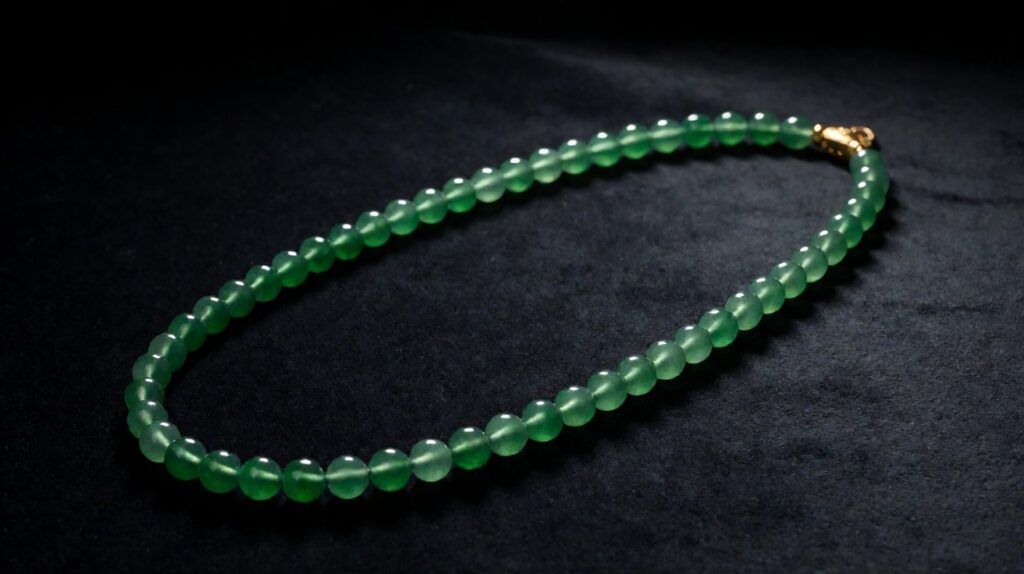
Jadeite bead necklaces range from delicate, near-invisible strands to bold, substantial pieces. Bead diameter is the clearest dividing line. Small beads, in the 3.5 mm range, create a refined, subtle look that layers easily. Our Natural Ice-type Tricolor Jade Necklace is a good example: each bead measures 3.5 mm, and the whole strand weighs just 10.4 g, making it ideal for everyday wear or stacking. A slightly larger option is the Natural Ice-type Tricolor Jade Necklace with 5.3 mm beads, which reads a little more present on the neck while staying lightweight at 25.8 g.
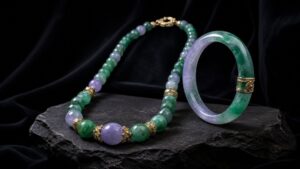
At the other end of the scale, the Natural Ice-type Violet Jade Bead Necklace comprises 68 beads with diameters ranging from 10 mm to 12 mm and weighs 158 g. That is a substantial, luxurious strand — the kind you wear as a focal point rather than a layer. Both ends of this spectrum are legitimate; the right choice depends on how you want the necklace to function in your wardrobe.
Color also defines style. Tricolor strands that combine yellow, green, and white (or green, yellow, and orange) offer a lively, patterned look, while a single-hue violet strand offers calm elegance. If you are new to buying jade online, it is often wise to start with smaller, more affordable pieces such as pendants or small-bead strands before committing to a large-bead necklace.
How to Choose the Right Size & Fit
Start with bead count and diameter, then work out the total length. A strand with a fixed number of beads and a known diameter has a predictable length, so the two figures together tell you how the necklace will drape. For instance, a strand of 68 beads at 10–12 mm will sit as a full, generous necklace, while a strand of tiny 3.5 mm beads will feel like a fine line on the neck.
Next, consider weight. Weight is a practical proxy for how substantial a strand feels. A 10.4 g necklace is barely noticeable; a 158 g necklace has real presence and will rest differently on the shoulders. Neither is better — but if you plan to wear a piece all day, a lighter strand is usually more comfortable.
Finally, match the necklace to your neckline. Fine, small-bead strands suit open collars and V-necks where the line of beads can be seen. Larger-bead strands work well over a simple top or dress as a standalone statement. If you want versatility, look for strands that can be doubled or layered, which is a common advantage of longer bead necklaces. For more general guidance on buying jade online, including treatment disclosure and craftsmanship checks, this guide to identifying natural A-grade jade online is a useful companion read.
Price & Value: What Drives the Cost of a Jadeite Bead Necklace
Price in jadeite reflects a combination of material quality, bead size, bead count, and workmanship. Larger beads of clean, translucent jadeite are rarer, so a strand of big beads generally costs more than a strand of small beads of similar quality. Uniformity also matters: a well-matched strand takes more material to assemble, because the beads must be sorted to look consistent.
Within our collection, you can see this range clearly. The Natural Ice-type Tricolor Jade Necklace is listed at $740, while the larger-bead Natural Ice-type Tricolor Jade Necklace is $825. The substantial Natural Ice-type Violet Jade Bead Necklace is $6649, reflecting its 68 beads at 10–12 mm and 158 g weight. These figures show that bead size and total material are major cost drivers, not marketing.
For context, other jadeite pieces in the collection span entry-level to premium: the Natural Jadeite Bracelet is $1008, the Natural Three-Color Jadeite Bracelet is $668, and the Natural Ice-type Jadeite Bracelet with Floating Green Patterns is $1517. When budgeting, decide whether you are buying for daily wear or as a collector piece, and let that guide how much bead size and weight you need.
Common Mistakes to Avoid
- Ignoring treatment disclosure — always confirm whether jadeite is Type A, B, or C before buying.
- Choosing by color alone and overlooking bead size, which determines how the necklace actually drapes.
- Forgetting to check weight, then finding a heavy strand uncomfortable for all-day wear.
- Assuming a strand can be easily resized — restringing bead necklaces is a specialist job.
- Buying a large-bead necklace as a first jade purchase instead of starting with a smaller, more affordable piece.
- Overlooking uniformity: a strand should look consistent from bead to bead, not patchy.
Top Picks: Jadeite Bead Necklaces and Who They Suit
Natural Ice-type Tricolor Jade Necklace — With 3.5 mm beads and a 10.4 g weight, this is the ideal first jadeite bead necklace or a layering piece. It suits buyers who want subtle, everyday elegance and versatile styling.
Natural Ice-type Tricolor Jade Necklace — At 5.3 mm per bead and 25.8 g, this strand offers a touch more presence while remaining light. It suits wearers who want a refined necklace that still reads clearly on the neck.
Natural Ice-type Violet Jade Bead Necklace — A 68-bead strand of 10–12 mm beads weighing 158 g, this is a collector-grade statement piece. It suits buyers seeking a luxurious focal necklace for special occasions or a serious jadeite collection.
Natural Jadeite Bracelet — If you prefer to start with beads on the wrist, this 19-bead bracelet with 10 mm beads and roughly 18 cm circumference is a comfortable, lightweight entry point at 30 g.
Natural Ice-type Jadeite Bracelet with Floating Green Patterns — For buyers drawn to icy transparency and floating green patterns, this 13-bead, 16 mm bracelet at 101 g delivers a bold, substantial feel.
Final Tips for Buying a Jadeite Bead Necklace
Decide on your target bead diameter first, then confirm the bead count and weight so you know the true length and feel of the strand. Ask about treatment, compare color under different light, and check that the beads are evenly matched. If you are building a collection, start with a smaller, lighter piece and add a larger strand later. Browse the full jadeite category to compare bead sizes, weights, and styles side by side, and choose the strand that fits both your neckline and your daily routine.
FAQ
What determines the length of a jadeite bead necklace?
Length is set by the bead count multiplied by the bead diameter, plus the knotting between beads. For example, a strand of 68 beads at 10–12 mm forms a long, substantial necklace, while a strand of 3.5 mm beads forms a fine, delicate line. Because jadeite bead strands are usually hand-knotted, resizing means restringing, so check bead count and diameter before buying.
Is a heavier jadeite bead necklace better?
Not necessarily. Weight reflects bead size and material volume, so a heavier strand is usually more substantial and luxurious — such as the Natural Ice-type Violet Jade Bead Necklace at 158 g. But lighter strands, like the 10.4 g Natural Ice-type Tricolor Jade Necklace, are more comfortable for all-day wear and layering. The right choice depends on how you plan to wear it.
How do I know if jadeite beads are natural Type A?
Look for clear treatment disclosure. Type A jadeite is untreated and only cut and polished, while Type B has been bleached and polymer-impregnated and Type C has been dyed. Reputable sellers state this openly, and authoritative references such as the GIA explain how color, clarity, and cut are evaluated in fashioned jadeite.
Should I start with a small or large bead necklace?
If you are new to jadeite, a smaller-bead strand is often the wiser first purchase. It is lighter, easier to style, and typically more affordable, letting you learn what bead size and color you prefer. You can then add a larger, collector-grade strand later once you know your ideal fit.