
The Mineral Composition of Jadeite: A Scientific Breakdown by Professor Michelle Au
Introduction
Jadeite, the most coveted gemstone in East Asian culture, derives its mesmerizing beauty and value from its complex mineral composition. Professor Michelle Au (歐陽秋眉), founder of the Hong Kong Gemmological Institute, revolutionized the understanding of jadeite by classifying its minerals into three genetic categories: metamorphic (crystalloblastic) minerals, primary minerals, and secondary minerals. This article distills her groundbreaking research, offering collectors and enthusiasts a clear guide to how mineralogy shapes jadeite’s color, texture, and market value.
1. Metamorphic Minerals: The Core of Jadeite
Over 50% of jadeite consists of pyroxene-group minerals, formed under high-pressure metamorphism:
- Major Minerals (Dominant Pyroxenes)
- Jadeite (NaAlSi₂O₆):
- The primary mineral in gem-quality jadeite.
- Color: Pure jadeite is colorless; traces of Cr³⁺ or Fe³⁺ substitute for Al³⁺, creating green hues.
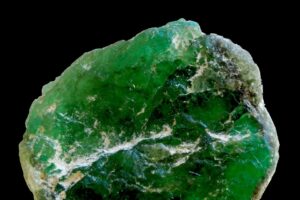
- Structure: Short/long columnar or fibrous crystals (see Fig. 1).
- Kosmochlor (NaCrSi₂O₆):
- Discovered terrestrially by Prof. Au in 1984.
- Color: Vibrant emerald-green (Fig. 3); key to ‘dry green’ jadeite varieties.
- Forms exsolution textures with jadeite under low-temperature conditions.
- Omphacite (Na-Ca-Mg-Fe pyroxene):
- Common in dark-green ‘black jadeite’ (mo cui 墨翠).
- Chemistry: Transitional between jadeite and diopside (Na/(Na+Ca) = 0.2–0.8).
- Minor Minerals (Less than 40%)
- Amphiboles (e.g., actinolite, magnesio-riebeckite):
- Form via retrograde metamorphism, often replacing pyroxenes.
- Cause ‘blue flowers’ (piao lan hua 飄藍花) or ‘black speckles’ in lower-grade jadeite.
- Feldspars (e.g., albite):
- Found in ‘water mozzi stone’ (shui mo zi 水沫子), a jadeite simulant.
- Accessory Minerals (Trace): Zircon, garnet, and apatite.
2. Primary & Secondary Minerals
- Chromite (FeCr₂O₄):
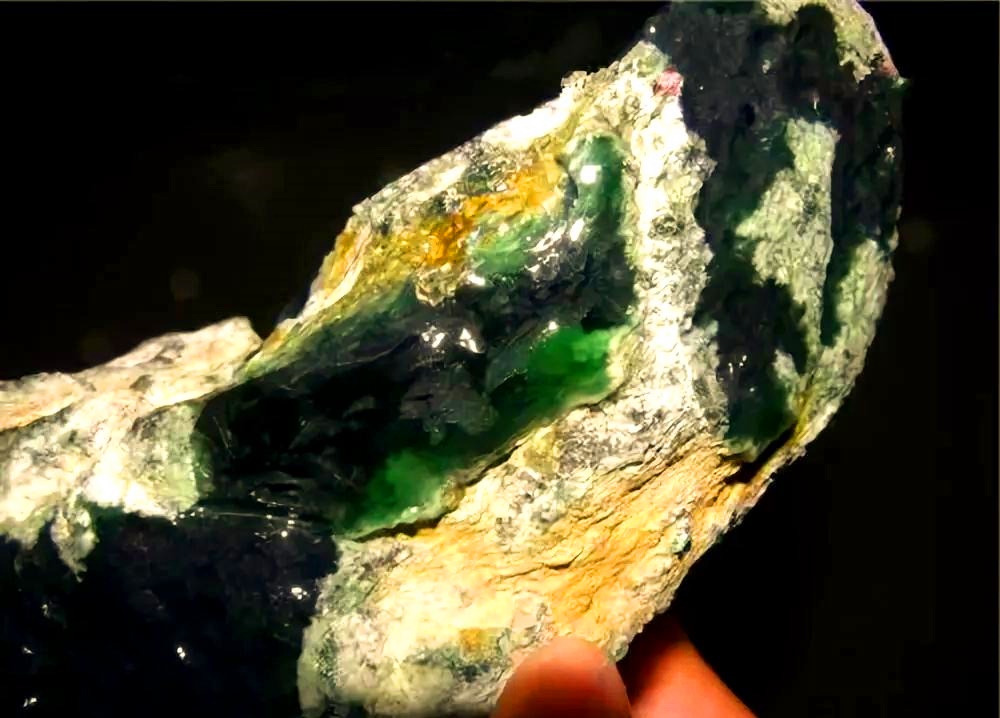
- A primary mineral providing Cr³⁺ for kosmochlor formation (Fig. 6).
- Hydrothermal Minerals:
- Molybdenite (MoS₂): Unique to Russian jadeite deposits.
- Weathering Products:
- Limonite/hematite: Cause yellow/red ‘skin’ in rough jadeite.
- Kaolinite: Forms from feldspar decomposition.
3. Key Implications for Collectors
- Quality Indicators:
- High-grade jadeite = jadeite + kosmochlor (vibrant green).
- Low-grade jadeite = amphiboles + albite (mottled textures).
- Authenticity: ‘Feit sui’ (fake jade) often lacks pyroxene diversity.
- Geographic Clues:
- Burmese jadeite: Rich in kosmochlor.
- Russian jadeite: Contains molybdenite.
Conclusion
Jadeite’s mineral complexity explains its aesthetic and economic diversity. As Prof. Au emphasizes, ‘Understanding these components is essential to appraising true value.’ For deeper study, refer to her seminal works: Jadeite ABC (1997) and The Definition of Jadeite (1984).
Source: Ouyang, Q. (1999). ‘Mineral Component of Jadeite Jade.’ Journal of Gems and Gemmology, 1(1), 18–26.
FAQ
What are the main minerals in jadeite?
Jadeite’s main minerals are pyroxenes: jadeite, kosmochlor, and omphacite. Together they make up over 50% of the rock. Minor minerals include amphiboles and feldspars.
How does kosmochlor affect jadeite color?
Kosmochlor (NaCrSi₂O₆) imparts a vivid emerald-green color. It is responsible for the intense green in ‘dry green’ jadeite varieties and is often found intimately intergrown with jadeite.
What is omphacite jade?
Omphacite is a sodium-calcium pyroxene that is the main component of dark-green ‘black jadeite’ (mo cui). Its composition is transitional between jadeite and diopside.
How can collectors identify high-grade jadeite?
High-grade jadeite contains abundant jadeite and kosmochlor with minimal amphiboles or albite. The texture is fine and even, with vibrant green coloration. Low-grade material often shows mottling from amphibole inclusions.
Read More
- Buying Guides (111)
- Collectors' Academy (192)
- Care Academy (8)
- Investment Academy (25)
- Jade Crafting Techniques (29)
- Michelle Au: The Gemstone Luminary (11)
- The Precious Metals & Jewels Compendium (54)