Why Jadeite Bead Sizes Matter to Buyers
When you shop for jadeite jewelry, bead diameter is one of the most practical details you can compare. A strand of small beads and a strand of large beads can both be beautiful, but they wear very differently: they sit differently on the wrist or neck, carry different visual weight, and often reflect different amounts of raw material. For buyers comparing pieces online, understanding jadeite bead sizes turns a vague impression into a measurable decision.
Bead size also interacts with the other qualities that define jadeite. Color, transparency, and texture are judged on each bead, and larger beads give those qualities more surface area to show. That is why the Gemological Institute of America’s jadeite quality factors emphasize evaluating color and clarity on the fashioned stone itself. A 3.5 mm bead and a 16 mm bead are both jadeite, but they present their color and luster at very different scales.
This guide explains how to read bead measurements, how bead count and diameter affect fit, and how to compare real pieces in the VirtuCasa jadeite collection. Every measurement below comes from the listed product details, so you can compare like with like.
Understanding Quality: What to Look For Beyond Size
Color and Hue Consistency
Jadeite color should be judged under both fluorescent and incandescent light, as GIA’s jadeite quality guidance notes, because the apparent hue can shift between lighting conditions. On a beaded piece, also check whether the beads are evenly matched. A uniform strand reads as harmonious, while deliberate multicolor strands rely on contrast. The Natural Three-Color Jadeite Bracelet, for example, is built around a yellow, white, and light green combination, so its appeal comes from variation rather than uniformity.
Texture, Transparency, and Luster
Texture describes how fine and smooth the jadeite feels and looks; transparency describes how much light passes through. Ice-type jadeite is valued for a transparent, delicate texture and a cool, glassy sheen, while other pieces present a softer vitreous luster. These qualities are easier to appreciate on larger beads, where light has more room to interact with the stone.
Bead Uniformity and Drilling
On any strand, look for consistent bead diameter, smooth polishing, and clean drilling. Evenly sized beads create a balanced line, and secure stringing matters for daily wear. A practical bracelet guide from Harmony of Jade’s bracelet buying guide makes the same point: matched bead sizes and tidy stringing are signs of careful workmanship.
Treatments and Authenticity
Ask whether the jadeite is natural and untreated. Buyers commonly distinguish Type A (untreated) from treated material, and a reputable seller should describe the piece clearly. General buying guides such as GemSelect’s jade buying guide cover treatments, authenticity, and the practical points that help buyers compare jade more confidently.
Types and Styles: How Bead Sizes Shape a Piece
Jadeite bead jewelry generally falls into three groups: fine-bead necklaces, statement-bead necklaces, and beaded bracelets. Fine-bead necklaces use small diameters for a delicate, layered look. The Natural Ice-type Tricolor Jade Necklace uses 3.5 mm beads in a continuous strand, while the Natural Ice-type Tricolor Jade Necklace with 5.3 mm beads offers a slightly more visible bead presence. Both are lightweight and suited to layering or subtle everyday wear.
Statement-bead necklaces use larger diameters for visual impact. The Natural Ice-type Violet Jade Bead Necklace comprises 68 beads with diameters ranging from 10 mm to 12 mm, giving it a substantial presence and versatility for multi-layered wearing or single-strand draping.
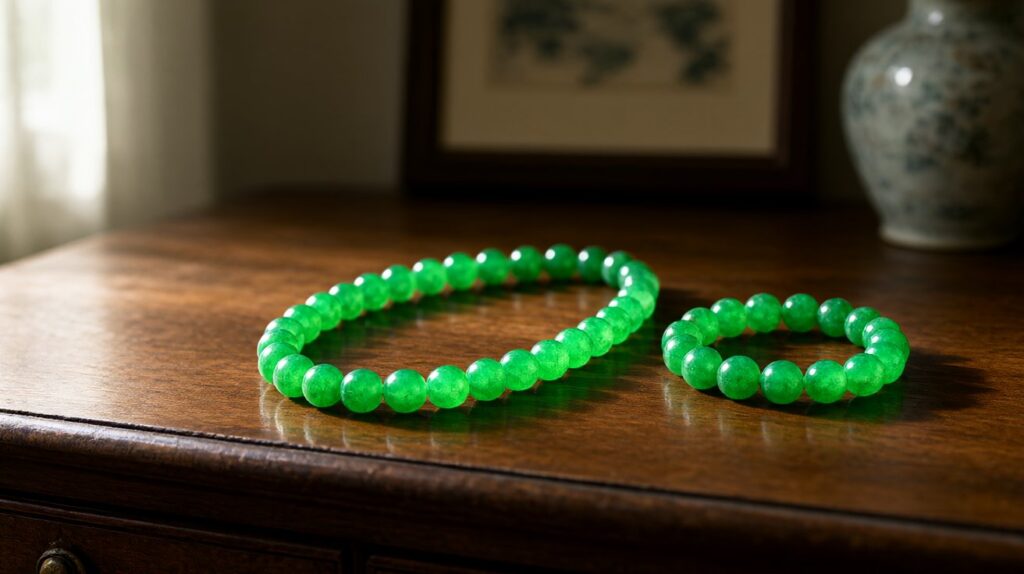
Bracelets show the widest range of bead sizes. The Natural Jadeite Bracelet uses 19 round beads of approximately 10 mm each, forming a flexible bracelet with a total circumference of about 18 cm, suitable for wrists with a circumference of 16–19 cm. The Natural Three-Color Jadeite Bracelet uses 16 spherical beads of approximately 12 mm each with an adjustable elastic cord. At the larger end, the Natural Ice-type Jadeite Bracelet with Floating Green Patterns uses 13 round beads of 16 mm each, a bold scale that makes the icy texture and floating green patterns the center of attention.
How to Choose the Right Size and Fit
Start with the wearer’s measurements. For a bracelet, measure the wrist circumference and compare it with the piece’s stated fit. The Natural Jadeite Bracelet, for instance, is described as suitable for wrists of 16–19 cm, which gives you a clear range to check against. For a necklace, consider how you plan to wear it: a small-bead strand sits close and layers easily, while a large-bead strand reads as a statement on its own.
Next, think about bead count and diameter together. Diameter tells you the visual weight of each bead; count tells you how many beads make up the strand. A 16 mm bracelet with 13 beads and a 10 mm bracelet with 19 beads may both fit, but they feel and look completely different. Larger beads generally mean fewer beads and a bolder look; smaller beads mean more beads and a finer, more delicate line.
Finally, consider weight and comfort. Heavier pieces feel substantial, while lighter pieces suit long daily wear. Compare the stated weights where available and match them to your preference. If you are unsure, a mid-size bead is often the most versatile choice, and an adjustable cord adds flexibility for gifting.
Price and Value: What Drives the Cost
Bead size is one factor among several. Larger beads require more raw material, and high-transparency ice-type jadeite with strong color commands more than opaque material. That is why a small-bead necklace and a large-bead bracelet can sit at very different price points even when both are natural jadeite.
In the current VirtuCasa selection, listed prices range from entry-level to premium. The Natural Ice-type Tricolor Jade Necklace is $740, the Natural Ice-type Tricolor Jade Necklace with 5.3 mm beads is $825, the Natural Three-Color Jadeite Bracelet is $668, and the Natural Jadeite Bracelet is $1008. The Natural Ice-type Jadeite Bracelet with Floating Green Patterns is $1517, and the Natural Ice-type Violet Jade Bead Necklace is $6649. Each price reflects the specific piece, its bead size, and its material qualities rather than bead size alone.
Value also depends on how often you will wear the piece. A lightweight necklace that layers with everything may offer more everyday value than a statement bracelet worn occasionally, even if the statement piece costs more. Compare pieces on the qualities that matter to you, not on size alone.
Common Mistakes to Avoid
- Assuming bigger beads are always better. Large beads suit bold looks, but small beads offer elegance and layering versatility.
- Ignoring wrist or neck measurements. Always check the stated fit range, such as the 16–19 cm wrist range given for the Natural Jadeite Bracelet.
- Comparing bead diameters without comparing bead counts. A strand is the sum of its beads, not a single measurement.
- Overlooking bead uniformity and stringing quality. Even sizing and secure stringing affect both appearance and durability.
- Judging color in only one lighting condition. Check jadeite under both fluorescent and incandescent light.
- Forgetting to ask about treatments and authenticity before buying.
Top Picks: Matching Bead Sizes to Wearers
The Natural Jadeite Bracelet is a strong choice for a first fine-bead bracelet. Its 19 beads of approximately 10 mm each and 18 cm circumference suit wrists of 16–19 cm, and its lavender-white hue with a gentle vitreous luster keeps it easy to wear daily.
The Natural Three-Color Jadeite Bracelet suits buyers who want a slightly larger bead and a multicolor look. Its 16 beads of approximately 12 mm each and adjustable elastic cord make it a flexible gift choice.
The Natural Ice-type Jadeite Bracelet with Floating Green Patterns is for someone who wants a statement piece. Its 13 beads of 16 mm each create a bold, harmonious line, and its ice-type transparency and floating green patterns reward closer inspection.
For necklaces, the Natural Ice-type Tricolor Jade Necklace with 5.3 mm beads suits layered, everyday wear, while the Natural Ice-type Violet Jade Bead Necklace with 68 beads of 10–12 mm suits buyers seeking a substantial, versatile statement strand.
Final Tips and Conclusion
Comparing jadeite bead sizes comes down to three numbers: bead diameter, bead count, and the stated fit range. Write them down for each piece you consider, then match them to the wearer’s measurements and style. Use the quality factors discussed above to judge the jadeite itself, and ask about treatments and authenticity before you buy.
With those basics in hand, you can browse the jadeite category at VirtuCasa and compare pieces on equal terms. The right bead size is the one that fits comfortably, suits how you dress, and lets the jadeite’s color and texture show at their best.
FAQ
How do I compare jadeite bead sizes between a necklace and a bracelet?
Compare bead diameter, bead count, and the stated fit range. For bracelets, check the circumference and wrist range, such as the 16–19 cm range given for the Natural Jadeite Bracelet. For necklaces, consider how the bead diameter affects visual weight and layering.
Are larger jadeite beads always more valuable?
Not necessarily. Larger beads use more material and can show color and transparency more prominently, but value also depends on texture, transparency, color, uniformity, and workmanship. A fine small-bead strand can be more valuable than a larger, lower-quality one.
What wrist size fits the Natural Jadeite Bracelet?
The product details state that it is suitable for wrists with a circumference of 16–19 cm, with a total bracelet circumference of about 18 cm.
Should I check jadeite color under different lighting?
Yes. GIA’s jadeite quality guidance recommends judging color under both fluorescent and incandescent light, because the apparent hue can shift between lighting conditions.