Why Understanding Jadeite Value Matters
Jadeite is one of the most rewarding stones a buyer can collect, but it is also one of the easiest to misjudge. Two bracelets can look similar at a glance yet differ enormously in quality and price, because jadeite value is built from a handful of interlocking factors: color, clarity (often called transparency or water), texture, and cut or form. Understanding how these factors combine lets you compare pieces honestly instead of relying on a single photograph or a single number.
For buyers shopping online, that knowledge is even more important. You cannot hold a stone to the light or feel its weight, so you need a framework for reading descriptions and product details. This guide walks through the classic quality factors, explains how they show up in real pieces from the VirtuCasa jadeite collection, and helps you decide which trade-offs are worth your budget.
Jadeite is also a material with deep cultural meaning, worn as everyday adornment and passed down as heirlooms. Whether you are buying a first pair of earrings or a statement necklace, the goal is the same: match the quality you can see and verify to the price you are paying.
Understanding Quality: The Factors That Set Value
Gemological references consistently rank color, transparency, and texture as the most important drivers of jadeite value, and reputable grading guidance from organizations such as the Gemological Institute of America’s jadeite quality factors explains how these interact. A practical buyer’s guide from GemSelect’s jade buying guide adds useful context on treatments, authenticity, and how to compare stones side by side. Below, each factor is broken down so you can apply it to real listings.
Color
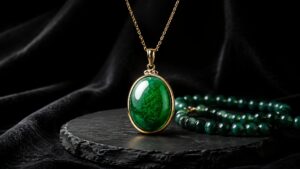
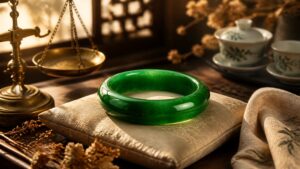
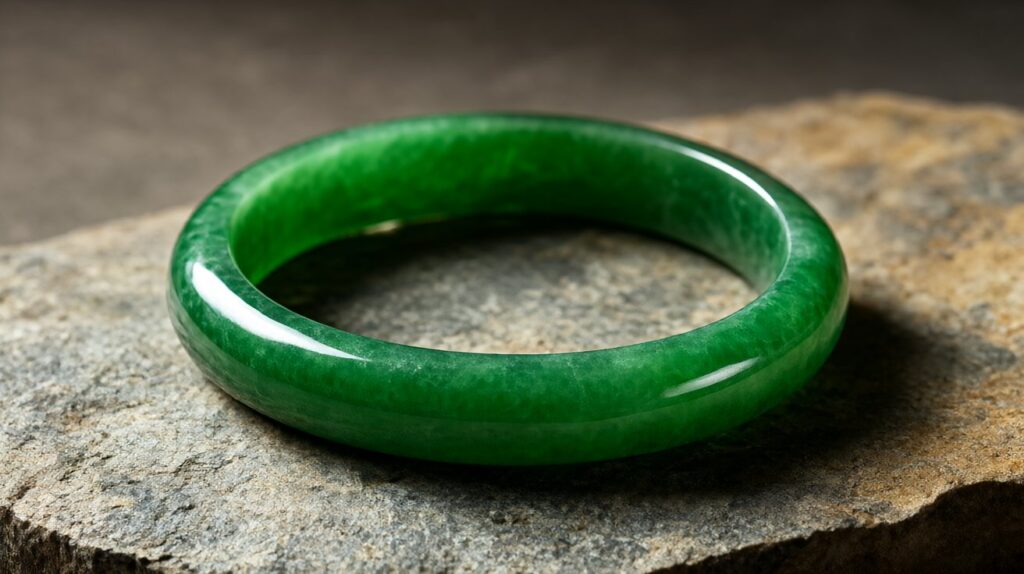
Color is usually the first thing people notice and often the largest single influence on value. Vivid, saturated green with even distribution is traditionally the most prized, but jadeite also occurs in lavender, yellow, white, and multi-color combinations. What matters is intensity, evenness, and liveliness: a rich, consistent hue generally reads as higher quality than a pale or patchy one. Multi-color pieces are valued differently, since the appeal lies in the natural pattern rather than uniformity.
Clarity and Transparency
Clarity in jadeite refers to internal texture and transparency rather than the absence of tiny inclusions the way it does in diamonds. Highly transparent material, often described as ice-type, shows a cool, glassy sheen and is generally more valuable than opaque stone. Fine, compact texture with few visible internal variations is a mark of quality, while a cloudy or coarse structure tends to lower value even when the color is attractive.
Cut and Form
Because jadeite is carved and polished rather than faceted, cut refers to the shape, proportion, and finish of the piece. Well-matched beads, smooth drilling, even polishing, and balanced proportions all signal careful workmanship. A bracelet whose beads are uniform in size and color reads as more harmonious than one with mismatched components. Traditional forms such as saddle rings and cabochons each have their own standards for symmetry and comfort.
Size and Weight
Larger pieces require larger, cleaner rough, so size and weight influence value alongside quality. A substantial strand or a large-bead bracelet represents more material and often more careful selection. That said, size should never be judged alone: a smaller, finer-quality piece can be worth more than a large, cloudy one.
Types & Styles: Comparing Real Pieces
VirtuCasa’s jadeite range shows how these factors play out across different forms. The Natural Ice-type Jadeite Bracelet with Floating Green Patterns is a clear example of transparency driving value: its ice-type texture is described as transparent and delicate with a glassy sheen, and it comprises 13 round beads of 16mm each, weighing 101g. That combination of high transparency and substantial bead size places it at the premium end of the collection.
Color-led pieces tell a different story. The Natural Full-Green Jadeite Saddle Ring is carved from a single piece of jadeite with an even full-green coloration and a warm vitreous sheen, at 9.5g and ring size 24. It is a classic example of color and traditional form working together. By contrast, the Natural Three-Color Jadeite Bracelet celebrates pattern: 16 spherical beads of about 12mm in yellow, white, and light green, weighing approximately 35g.
Style also shapes value perception. Beaded necklaces such as the Natural Ice-type Violet Jade Bead Necklace (68 beads from 10mm to 12mm, 158g) offer a rare lavender hue in a substantial strand, while smaller strands like the Natural Ice-type Tricolor Jade Necklace at 3.5mm beads and 10.4g suit buyers who prefer subtle, layerable jewelry. Rings and earrings, including the Natural Ice-type Violet Jadeite Cabochon Ring Set with 18K White Gold, Sapphires, and Diamonds, show how setting and craft add another layer to the comparison.
How to Choose the Right Size & Fit
Fit is where online jadeite buying most often goes wrong, so read measurements carefully. For bracelets, check bead diameter and total circumference against your wrist. The Natural Jadeite Bracelet, for instance, has 19 round beads of approximately 10mm each and a total circumference of about 18cm, described as suitable for wrists of 16-19cm. That kind of explicit guidance is far more useful than a generic size label.
Weight matters for comfort as well as value. A 101g bracelet feels substantial, while a 30g bracelet is light for daily wear. Necklaces range widely too: a 10.4g strand sits lightly, whereas a 158g strand makes a statement. For rings, ring size and the shape of the band matter; saddle rings rest on a curved top surface, so comfort depends on matching the listed ring size to your finger.
Finally, consider how you will wear the piece. Earrings such as the Natural Jadeite Tassel Earrings, with a total length of about 6cm and 8mm cylindrical beads, hang and swing, so weight and balance affect long-term comfort. A good buying guide from Harmony of Jade’s bracelet buying guide also recommends checking bead drilling, polishing, and stringing security, which are practical fit-and-finish checks you can apply to any listing.
Price & Value: What Drives Cost
Because jadeite value is cumulative, price differences between pieces usually reflect several factors at once. In the VirtuCasa collection, the Natural Three-Color Jadeite Bracelet is listed at $668, the Natural Jadeite Saddle Ring with Floating Green at $719, the Natural Ice-type Tricolor Jade Necklace at $740, the Natural Ice-type Tricolor Jade Necklace at $825, the Natural Jadeite Tassel Earrings at $852, and the Natural Jadeite Bracelet at $1008. These sit in the entry-to-mid range, where design, color interest, and everyday wearability are the main draws.
Higher up, the Natural Ice-type Jadeite Bracelet with Floating Green Patterns is $1517 and the Natural Ice-type Violet Jadeite Cabochon Ring Set with 18K White Gold, Sapphires, and Diamonds is $1926, reflecting premium transparency, rare color, and fine setting work. The Natural Full-Green Jadeite Saddle Ring is $2437, where even full-green color and traditional carving carry the value. At the top, the Natural Ice-type Violet Jade Bead Necklace is $6649, a combination of rare violet ice-type material and a large 158g strand.
The lesson is not that expensive is always better, but that you should be able to name what you are paying for. If a piece is priced for color, check the color; if it is priced for transparency, look for the glassy sheen and fine texture. When comparing, ask what each listing emphasizes, and weigh that against your own priorities.
Common Mistakes to Avoid
- Judging only by color and ignoring transparency and texture, which together drive much of jadeite value.
- Assuming a larger piece is automatically better; a smaller, finer stone can outperform a large, cloudy one.
- Skipping the measurements and buying a bracelet or ring that does not match your wrist or finger.
- Overlooking finish details such as bead matching, drilling, polishing, and stringing security.
- Treating multi-color or patterned pieces as inferior; their value lies in natural pattern and harmony.
- Comparing prices without comparing the specific qualities each piece is priced for.
Top Picks: Which Piece Suits Whom
For a first fine jadeite purchase, the Natural Jadeite Bracelet at $1008 is a balanced choice: a soft lavender-white hue, delicate smooth texture, 10mm beads, and a comfortable 18cm circumference make it easy to wear and easy to understand. Buyers who want a statement of transparency should look at the Natural Ice-type Jadeite Bracelet with Floating Green Patterns at $1517, whose ice-type texture and 16mm beads suit someone ready to invest in clarity.
Color traditionalists will appreciate the Natural Full-Green Jadeite Saddle Ring at $2437, a single-piece carving with even full-green color. Those drawn to rare hues and setting craft may prefer the Natural Ice-type Violet Jadeite Cabochon Ring Set with 18K White Gold, Sapphires, and Diamonds at $1926. And for a collector seeking a rare, substantial strand, the Natural Ice-type Violet Jade Bead Necklace at $6649 is the standout.
Final Tips and Conclusion
Buying jadeite well comes down to comparing like with like. Read the color, transparency, texture, and measurements in each listing, and match them to the price being asked. Use the quality framework above, cross-check with authoritative references, and let your own wearing habits guide size and form. A piece you understand is a piece you will enjoy for years.
Start with the VirtuCasa jadeite category to compare the full range, and choose the combination of color, clarity, cut, and size that fits both your taste and your budget.
FAQ
What matters most for jadeite value: color or clarity?
Both matter, but color and texture are usually the strongest drivers, with transparency close behind. A vivid, even color with fine, compact texture generally reads as higher value than a pale or cloudy stone, though the best pieces combine strong color with good transparency.
How do I choose the right bracelet size online?
Check the bead diameter and total circumference against your wrist. For example, the Natural Jadeite Bracelet has 19 beads of about 10mm and a total circumference of about 18cm, described as suitable for wrists of 16-19cm. Always read the listed measurements rather than relying on a general size label.
Are multi-color jadeite pieces lower quality?
Not necessarily. Multi-color pieces such as the Natural Three-Color Jadeite Bracelet or the Natural Ice-type Tricolor Jade Necklace are valued for their natural pattern and harmonious color blending rather than uniform single-color saturation, so they should be judged on their own terms.
Why do some jadeite pieces cost so much more?
Price differences usually reflect several factors at once: rare color, high transparency, fine texture, larger size and weight, and more elaborate setting or carving work. Comparing the specific qualities each listing emphasizes is the fairest way to judge whether the price makes sense for you.