Why Telling Type A Jadeite From Treated Jade Matters
Jadeite is one of the few gem materials where the difference between an untreated stone and a treated one can be dramatic — not only in appearance and durability, but in how the piece is valued and resold. For buyers treating jade as a long-term asset, the single most important question is whether a stone is Type A (natural jadeite, with no chemical bleaching or polymer impregnation beyond accepted surface finishing) or one of the treated categories, commonly called Type B (bleached and polymer-impregnated) and Type C (dyed), with B+C combining both.
This matters because treated jadeite is a legitimate product in its own right, but it is a different product. It is generally less durable, can change appearance over time, and is not valued the same way as untreated material. Investors who assume any green, glossy bangle is Type A are exposed to both financial and practical risk.
In this guide you will learn the fundamentals of jadeite grading, the observations buyers can make themselves, the limits of those observations, and the paperwork and due-diligence steps that actually reduce risk. The core message is simple: visual clues can raise or lower suspicion, but only a report from a qualified gem laboratory can establish treatment status with confidence.
Background and Key Concepts
What Type A, B, and C actually mean
The Type A/B/C classification is a trade convention describing how a piece of jadeite has been processed. Type A refers to natural jadeite that has not been bleached or impregnated with polymer; accepted surface finishing such as polishing and waxing is normally still considered within the Type A category. Type B has been bleached to remove impurities and then impregnated with a polymer resin to improve transparency and stability. Type C has been dyed to alter or intensify color. These treatments are not automatically ‘fakes’ — they are disclosed treatments — but they must be priced and represented accordingly.
Because the terminology is used loosely in some marketplaces, buyers should always ask what a seller means by ‘natural’ and whether a laboratory report accompanies the piece. A verbal assurance is not a grading standard.
Why treatment is hard to see
Jadeite is a polycrystalline aggregate, and treatments are designed to be subtle. Bleaching and polymer impregnation can improve transparency in ways that mimic fine material, and dye can be absorbed into surface-reaching fractures. Under normal lighting, and especially in photographs, treated and untreated stones can look very similar. This is why gemological laboratories use instruments — including spectroscopy and microscopy — rather than rely on the unaided eye.
What investors should understand about value
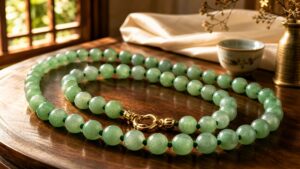
Untreated jadeite with strong color, good transparency, and fine texture is scarce, and scarcity is the basis of its investment case. Collector-focused guidance on evaluating vintage jade necklaces and spotting Type A jadeite emphasizes authentication and disclosure as the foundation of any purchase. Market commentary on whether jade is a good investment makes the same point: education and buying from reputable sources come before any consideration of price trends.
The Investor’s Checklist: How to Assess a Piece
Step 1 — Start with the paperwork
Ask for a report from a recognized gem laboratory before you evaluate the stone itself. A useful report should identify the material as jadeite (natural jadeite), state whether treatment was detected, and describe the testing performed. Read the wording carefully: a report that says ‘jadeite’ without addressing treatment is not the same as one that explicitly states ‘Type A’ or ‘no evidence of impregnation or dyeing.’
FTIR (Fourier-transform infrared) spectroscopy is especially useful for identifying polymer resin in a stone, so an FTIR-based finding of resin is a strong indicator of impregnation. However, the absence of a resin signature should not be read as proof that a stone is untreated in every case — treatment status is a conclusion drawn from the full set of tests a laboratory performs, not from a single instrument. Treat the report as a whole, and ask the lab or an independent appraiser if any wording is unclear.
Step 2 — Examine surface and interior with appropriate caution
Experienced dealers look at surface luster, the appearance of the grain, and how light behaves inside the stone. Some treated stones may show surface features that prompt closer inspection — for example, a slightly duller or resinous luster, or surface-reaching fractures that look filled. These are possible observations that warrant further testing, not reliable identifiers. Likewise, descriptions of crystal structure or ‘orange-peel’ surface effects are not dependable diagnostic tests for Type A versus treated material, and buyers should not treat them as such.
What you can do responsibly is look for inconsistency: a stone described as high-transparency but showing cloudy, patchy internal features; color concentrated along fractures; or a surface that looks different from the interior. Any of these should trigger a request for laboratory confirmation, not a confident verdict.
Step 3 — Judge color and lighting conditions honestly
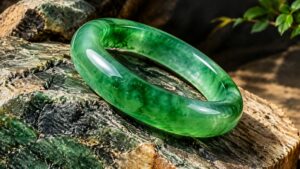
Color is where buyers are most often misled, and lighting is the usual culprit. Different light sources shift how green, lavender, or white jadeite appears, and photographs can flatter a stone considerably. Before comparing pieces, read up on how lighting changes jadeite bracelet color so you know what to expect in daylight versus indoor light. Ask for images or video in neutral daylight, and be skeptical of heavily saturated studio shots.
Step 4 — Inspect the setting and construction
Treatment questions are only part of due diligence. For bangles, check the stringing, clasp, and any metalwork; our guide to jadeite bracelet clasps and stringing explains what to inspect. For rings, band geometry and setting style affect both comfort and how the stone is protected — see our notes on jadeite saddle ring width and comfort. A well-made piece with a documented stone is a more defensible purchase than a bargain with unknowns.
Step 5 — Price the risk, not just the stone
If a piece is priced far below comparable documented Type A material, assume the difference reflects something — treatment, undisclosed repairs, or simply an asking price with no grading behind it. Reputable sellers of natural jadeite jewelry should be comfortable answering treatment questions and providing documentation. Where documentation is absent, negotiate on the basis that you are buying an unverified stone.
Practical Tips for Buyers
- Request a laboratory report that explicitly addresses treatment, and keep a copy with your purchase records.
- Ask which tests were performed; FTIR is particularly relevant to detecting polymer, but the overall conclusion is what counts.
- View stones in neutral daylight and ask for unedited video where possible.
- Compare like with like: color, transparency, texture, and size all affect value independently of treatment status.
- Buy from sellers with clear return policies and a track record of answering technical questions.
- For vintage or estate pieces, expect documentation to be incomplete and price accordingly; collector guidance on authenticating estate jade jewelry is useful background.
- Keep expectations realistic: no home test reliably proves Type A status.
Common Mistakes to Avoid
- Treating visual clues — luster, surface texture, internal structure — as proof of treatment status. They are not diagnostic.
- Accepting a report that names the material but says nothing about treatment.
- Assuming a high price guarantees Type A material, or that a low price means treated.
- Judging color from photographs taken under colored or directional lighting.
- Overlooking setting, stringing, and wear issues while focusing only on the stone.
- Buying without a written return window, which removes your ability to verify after purchase.
Conclusion: Verify, Document, Then Buy
The reliable path to buying Type A jadeite is not a secret visual trick — it is process. Understand the Type A/B/C framework, ask for a laboratory report that explicitly addresses treatment, examine the piece for inconsistencies that warrant further testing, and price any remaining uncertainty into the deal. Visual observations can guide your questions, but they cannot replace gemological testing.
Investors who follow that discipline are better protected than those who rely on appearance alone, and they are better positioned to enjoy jade for what it is: a beautiful, culturally rich material whose finest examples deserve documented provenance. Browse our jadeite rings and jadeite bracelets with these checks in hand, and ask questions before you commit.
FAQ
Can I tell Type A jadeite from treated jade by looking at it?
Not reliably. Visual clues such as luster or surface texture may prompt closer inspection, but they are not dependable identifiers. Only a qualified gem laboratory can establish treatment status with confidence.
What does an FTIR test tell me about jadeite?
FTIR spectroscopy is especially useful for detecting polymer resin, so it is relevant to identifying impregnation. However, treatment status is a conclusion based on the full set of laboratory tests, not a single instrument result.
Is treated jadeite always a fake?
No. Type B and Type C are disclosed treatments, not necessarily fakes, but they are different products from untreated Type A jadeite and should be represented and priced accordingly.
What should I ask a seller before buying jadeite?
Ask whether the piece is Type A, request a laboratory report that explicitly addresses treatment, ask which tests were performed, and confirm the return policy so you can verify the piece after purchase.