Introduction
When you are shopping for fine jadeite jewelry, a certification report is one of the most powerful tools you can hold. It transforms a beautiful stone from an unknown object into a documented gem with known origin, treatment status, and quality characteristics. Yet many buyers feel overwhelmed by the technical terms and small print. This guide explains every section of a typical jadeite certification report so you can make informed decisions with confidence.
Whether you are browsing jadeite pendants or evaluating investment-grade pieces, understanding the report protects you from misrepresentation and helps you compare items objectively. By the end of this article, you will know exactly what each entry means and which details matter most for value and authenticity.
Background / Key Concepts
Why Certification Exists
Jadeite is one of the most imitated and artificially treated gemstones in the world. Unscrupulous sellers may dye, polymer-impregnate, or bleach natural jadeite to improve its appearance. A reputable certification from an independent laboratory verifies that the material is natural (Type A) or discloses any enhancement. As complete jade certification guidance explains, the report also grades the stone’s color, transparency, and texture, giving you a standardized basis for value.
Type A, B, and C Jadeite
The most critical piece of information on a certification report is the treatment disclosure. Natural, untreated jadeite is labeled Type A. Type B jadeite has been bleached and impregnated with resin to fill cracks and improve clarity. Type C jadeite has been artificially dyed. Some stones combine both treatments (B+C). A trustworthy report will clearly state if any treatment is present. For a deeper dive into identification, see our guide to identifying Type A jadeite vs. treated B and C.
Instruments Used in Testing
Gemological laboratories use specialized equipment to authenticate jadeite. Fourier-transform infrared spectroscopy (FTIR) detects polymer residues in Type B jadeite. Raman spectroscopy identifies mineral composition, distinguishing jadeite from nephrite or simulants. UV-visible spectroscopy picks up dye-related absorption bands in Type C stones. Laboratories also use standard gemological tools like a refractometer, polariscope, and microscope to assess properties. As a guide to jade testing and certification details, these methods ensure objectivity and repeatability.
The Main Body
Decoding the Report Header
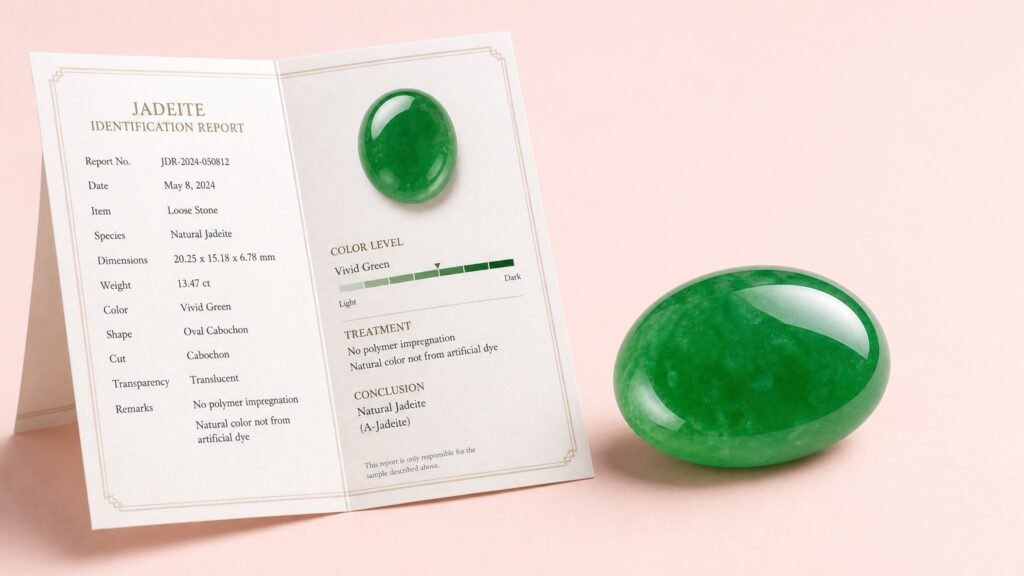
Every certification report begins with basic identifying information: the laboratory’s name and logo, a unique report number, and the date of issue. The report number is your key to verifying the document online — most reputable labs host searchable databases. Also check that the report describes the exact item you are buying, including a weight (in carats or grams), dimensions (length, width, depth), and often a photograph or diagram.
Treatment Status (Type A, B, or C)
This is the single most important line in the report. Look for a clear statement such as “Natural Jadeite (Type A)” or “No indication of artificial treatment.” If the report uses vague language like “may have been treated,” proceed with caution. Some labs also note additional treatments like waxing (a minimal enhancement often accepted for fine jadeite) or surface coating. Always confirm that the treatment disclosure matches what the seller has advertised.
Color Grading
Color is a primary driver of jadeite value. Certification reports describe color using hue, tone, and saturation. The most prized hues are intense, vibrant greens often called Imperial green. However, jadeite also appears in lavender, white, yellow, brown, red, black, and even multicolored combinations. The report may use terms like “vivid green” or “medium lavender.” Some labs provide a color grade letter (A, B, C, etc.) or a numerical reference. For a detailed understanding of color quality, refer to our Imperial jadeite buying guide, which covers rarity and quality factors.
Transparency and Texture
Transparency ranges from opaque to translucent to semi-transparent. The finest jadeite is semi-transparent, allowing light to pass through and create a glowing effect known as “jadeite’s inner fire.” Texture describes the granularity or “feel” of the stone. The best material is very fine-grained and appears smooth, even under magnification. Coarse textures reduce value. Reports may note “very fine grain” or simply grade the jadeite’s overall clarity.
Cut, Shape, and Carving
Even though jadeite is often carved into classic bangles, pendants, or beads, the certification report will describe the item’s shape and cut quality. For example, a round bangle may be specified as “round bangle, smooth finish.” The cut grade assesses symmetry, proportions, and surface finish. A well-balanced, flawless polish enhances a stone’s brilliance and value. If you are considering bangles, our guide on jadeite bangle shapes can help you understand how shape affects both fit and appearance.
Origin and Geographic Indication
Some certification reports state the geographic origin of the rough material — most famously from Myanmar (Burma), but jadeite also comes from Guatemala, Russia, and Japan. While origin can influence market perception, many experts argue that quality is more important than provenance. Be aware that origin determinations are based on a combination of visual features and trace-element analysis, and not all labs offer this service.
Practical Tips
- Always verify the report online. Use the unique report number on the lab’s official website to ensure the document has not been altered or fabricated.
- Compare the photo to the item. Many reports include an image of the specific piece. Double-check that the weight and dimensions match your actual purchase.
- Look for a “Dissemination” or “Security” section. Some labs add holograms, QR codes, or microprint to prevent counterfeiting.
- Understand the lab’s reputation. Prefer reports from internationally recognized gemological laboratories such as GIA, SSEF, Gubelin, or AIGS. For online purchases, ask the seller which lab they use.
- Ask for both the report and a copy of the stone’s receipt. A certification alone does not prove that the stone you receive is the one in the report — the seller should also provide a detailed invoice or certificate of authenticity.
Common Mistakes to Avoid
- Ignoring the treatment disclosure. Do not assume “natural” means untreated; some jadeite is natural but still receives minor waxing. The disclosure clarifies exactly what has been done.
- Assuming all labs are equal. Some lesser-known labs issue overly generous grades to please sellers. Stick to labs with a strong global reputation.
- Focusing only on color. A beautiful color is worthless if the stone is Type B or C, or if it has poor texture. Always check all sections of the report.
- Misinterpreting “enhanced.” Some reports use “improved” or “enhanced” instead of “treated.” These terms are often euphemisms for artificial treatment. Look for the precise treatment status.
- Overlooking the report’s date. Jadeite reports are not timeless; a decade-old report may not reflect current knowledge about the stone or any later treatments. Ideally, the report should be recent.
Conclusion / Key Takeaways
A jadeite certification report is your best defense against counterfeit and misrepresented gemstones. By learning to read the treatment status, color grade, transparency, and origin details, you equip yourself with the knowledge to buy with confidence. Remember that the report is only as reliable as the laboratory that issued it, so always verify the report online and cross-reference the information with the actual piece.
When you are ready to explore certified jadeite, browse our selection of jadeite bracelets and other fine pieces. Each item is accompanied by thorough documentation to help you make an educated purchase.
FAQ
What is the most important thing to look for on a jadeite certification report?
The most critical section is the treatment disclosure. Look for a clear statement that the jadeite is Type A (natural, untreated). If the report mentions Type B, C, or any enhancement, the value and durability may be significantly affected.
Can I trust a certification report from an unknown lab?
It is safer to rely on reports from internationally recognized gemological laboratories such as GIA, SSEF, Gubelin, AIGS, or reputable national labs. Lesser-known labs may have less rigorous testing standards or could be sympathetic to sellers. Always verify the report number on the lab’s official website.
What does ‘Type A jadeite’ mean on a report?
Type A jadeite refers to natural, untreated jadeite that has not been chemically bleached, polymer-impregnated, or dyed. It may still have minor surface waxing, which is considered an acceptable finish. Type A is the most desirable and valuable category.
Why does my jadeite certification report not mention origin?
Not all laboratories offer origin determination because it requires advanced testing and may not be conclusive. Origin is less important than quality and authenticity. However, if origin is stated, it can add context to the stone’s market perception.