Why Clasp and Stringing Matter When Buying a Jadeite Bead Necklace
A jadeite bead necklace is only as wearable as the cord and clasp that hold it together. The beads themselves may be natural, beautifully matched and finely polished, but if the stringing is loose, the knots are insecure or the clasp is misaligned, a single snag can send a strand sliding off the table. That is why experienced buyers inspect the construction first and the beads second — the construction tells you how much care went into the piece and how much maintenance it will need.
Jadeite is a dense, tough stone, but a bead strand is only as strong as its weakest connection point. Over time, cord stretches, knots loosen and metal fittings wear. Understanding how a necklace is assembled lets you judge whether it is ready to wear, whether it needs restringing, and what that will cost in time and attention. For a broader view of what separates fine jadeite from treated material, the GIA’s jadeite quality factors are an authoritative starting point on color, transparency and texture.
This guide walks through the checks that matter most: how the strand is strung, how the clasp aligns, how to spot cord wear, and when professional restringing is the right call. It also points to specific pieces in the VirtuCasa jadeite collection so you can see how these principles apply to real necklaces.
Understanding Quality: What to Inspect on a Bead Necklace
Stringing Method and Knot Security
Traditional jadeite strands are often knotted between beads, which protects the stones from rubbing and prevents a single break from losing the whole strand. Others are strung on elastic cord or continuous rope. Each method has trade-offs. Knotted silk or nylon gives security and a classic drape; elastic gives flexibility but degrades over time. When you examine a necklace, check that each knot sits consistently between beads, that the cord exits the drill holes cleanly, and that no knot is frayed or slipping. The jade bracelet buying guide from Harmony of Jade offers useful checks on bead drilling, polishing and stringing security that apply equally to necklaces.
Cord Wear and Drill Holes
Cord wear is the most common failure point. Look closely at the beads nearest the clasp and at any point where the strand bends sharply — these take the most strain. Frayed fibers, discoloration or a cord that looks thinner in one section are signs that restringing is due. Also inspect the drill holes: rough or chipped edges can abrade the cord over time. A well-finished strand has smooth, centered holes with no sharp rims.
Clasp Alignment and Metal Condition
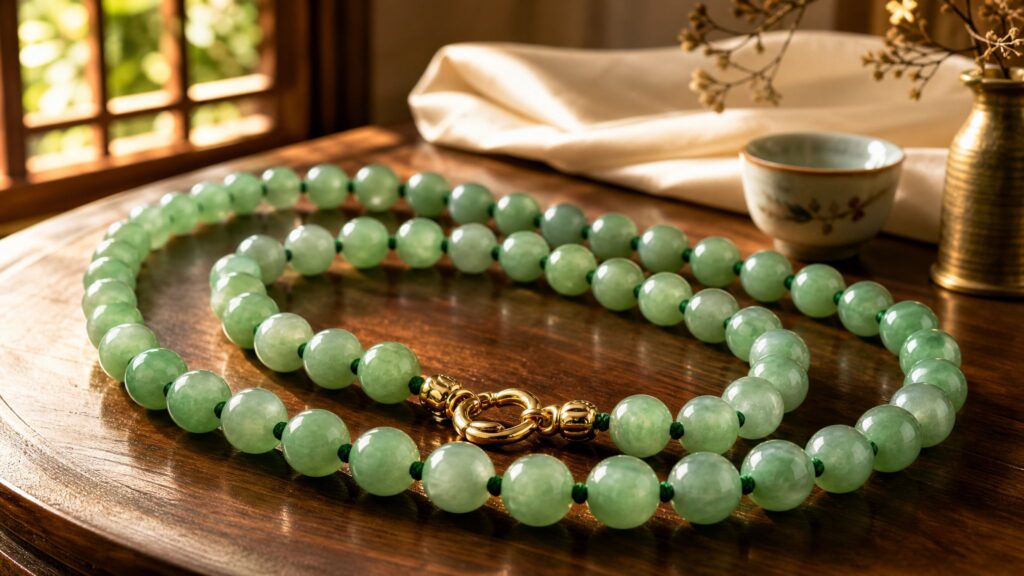
A clasp should close firmly, sit flat against the skin and align with the strand so the necklace hangs evenly. Check for loose hinges, bent hooks, worn plating or a clasp that opens with only slight pressure. On a beaded necklace, an oversized or poorly matched clasp can also throw off the balance of the strand, causing it to rotate while worn. If the clasp is gold-plated, inspect the high-wear contact points for thinning.
Bead Matching and Polish
Beyond construction, the quality of the beads themselves matters. According to the GIA’s jadeite quality factors, color, transparency and texture are the qualities that most affect jadeite’s market value, with color and texture often carrying particular weight. On a strand, also look for consistent bead size, even color distribution and uniform polish — mismatched beads are a sign of a less carefully assembled piece.
Types & Styles: Necklaces and Related Pieces
The VirtuCasa range includes necklaces built on different stringing traditions. The Natural Ice-type Tricolor Jade Necklace uses 5.3 mm beads in yellow, green and white, strung with traditional rope-knotting and weighing 25.8 g. A finer alternative is the Natural Ice-type Tricolor Jade Necklace with 3.5 mm beads on durable brown cord with traditional knotting, at 10.4 g — a delicate, lightweight strand.
At the premium end, the Natural Ice-type Violet Jade Bead Necklace comprises 68 beads of 10 mm to 12 mm and weighs 158 g, a substantial strand that rewards careful handling and secure stringing. Buyers comparing bead jewelry more broadly may also consider bracelets such as the Natural Jadeite Bracelet, which is simply strung on elastic cord without additional metal fittings — a useful reminder that elastic strands need periodic replacement.
How to Choose the Right Size & Fit
Fit for a bead necklace depends on strand length, bead diameter and weight. Larger beads create a bolder look but add weight; smaller beads drape more delicately. The product data for each piece is the best guide: the tricolor necklaces list bead diameters of 5.3 mm and 3.5 mm respectively, while the violet necklace lists 10 mm to 12 mm beads. Note that the product data does not specify strand length for the tricolor necklaces, so treat any layering recommendation as a styling suggestion rather than a verified fit claim.
Consider how the necklace will sit against your neckline and whether the clasp will rest at the back of the neck or be visible. A well-fitted strand should not pull or twist. If you are between sizes, a knotted strand can often be adjusted during professional restringing, while an elastic strand relies on its original circumference.
Price & Value: What Drives Cost
Price in jadeite reflects bead quality, size, uniformity and construction. In the VirtuCasa range, the tricolor necklaces sit at $825 and $740, reflecting their finer bead sizes and lighter weights. The violet necklace, with larger 10 mm to 12 mm beads and a 158 g weight, is priced at $6649 — a premium piece where bead size and color rarity drive value.
Construction affects long-term value too. A securely knotted strand with a sound clasp needs less maintenance, while an elastic or worn strand may require restringing soon after purchase. Budget for that possibility, and compare pieces on the quality of both the beads and the stringing.
Common Mistakes to Avoid
- Buying on bead color alone without checking knots, cord and clasp.
- Ignoring cord wear near the clasp until the strand fails.
- Assuming elastic cord is permanent — it stretches and should be replaced periodically.
- Forcing a stiff or misaligned clasp instead of having it serviced.
- Restringing with unsuitable cord or knots that abrade the drill holes.
- Treating layering recommendations as verified fit when strand length is not specified.
Top Picks
The Natural Ice-type Tricolor Jade Necklace at $825 suits buyers who want a traditional knotted strand with mid-size 5.3 mm beads and a comfortable 25.8 g weight.
The finer Natural Ice-type Tricolor Jade Necklace at $740 is ideal for those who prefer a delicate, lightweight strand on brown cord.
The Natural Ice-type Violet Jade Bead Necklace at $6649 suits collectors seeking larger 10 mm to 12 mm beads and a substantial 158 g strand.
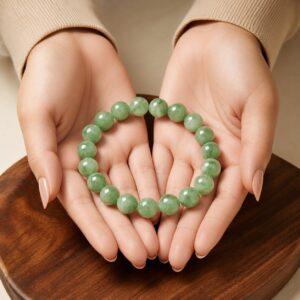
For a complementary elastic-strung piece, the Natural Jadeite Bracelet at $1008 offers 10 mm beads in a soft lavender-white hue.
Final Tips
Inspect the clasp, knots and cord before you buy, and ask about restringing options if the strand shows wear. Store bead necklaces flat or hanging to avoid strain, and have them checked periodically. For further guidance, see the Jade Artisan guide to buying jade online. Browse the full jadeite collection to compare pieces.
FAQ
How often should a jadeite bead necklace be restrung?
There is no fixed interval. Inspect the cord near the clasp and at bend points regularly; fraying, discoloration or thinning means it is time for professional restringing. Elastic strands generally need replacement sooner than knotted silk or nylon.
What should I check on the clasp of a jadeite bead necklace?
Check that it closes firmly, sits flat, aligns with the strand and shows no loose hinges, bent hooks or worn plating. An oversized or mismatched clasp can make the necklace hang unevenly.
Does the product data specify strand length for the tricolor necklaces?
No. The product data lists bead diameters and weights but not strand length, so layering recommendations should be treated as styling suggestions rather than verified fit claims.
Can a knotted jadeite necklace be adjusted in size?
Often yes. A professional restringer can adjust a knotted strand during restringing, whereas an elastic strand relies on its original circumference.