Why a Fake Jade Certificate Matters More Than You Think
When you buy a piece of jadeite jewelry, the certificate is often the single document that turns an attractive green stone into a purchase you can trust. A genuine lab report tells you what the material is, whether it has been treated, and who stands behind that opinion. A fake jade certificate, by contrast, gives you false confidence — and because jade value depends heavily on whether a stone is natural Type A or has been bleached and polymer-impregnated, that false confidence can be expensive.
The problem is that certificates are easy to imitate. They are printed documents with logos, seals, and reference numbers, and a convincing-looking report can be produced by anyone with a design program. The good news is that fake or misleading reports tend to share a set of recognizable weaknesses. Once you know what to look for, you can screen a certificate in a few minutes and know whether it is worth relying on.
This guide explains how jade certification works, then walks through seven practical red flags — from labs you cannot verify to reports that never mention treatment. It also covers what to do when a certificate looks suspicious, and how to combine a report with your own inspection so that the document supports your judgment rather than replacing it.
Background: What a Jade Certificate Actually Is
What a legitimate report should tell you
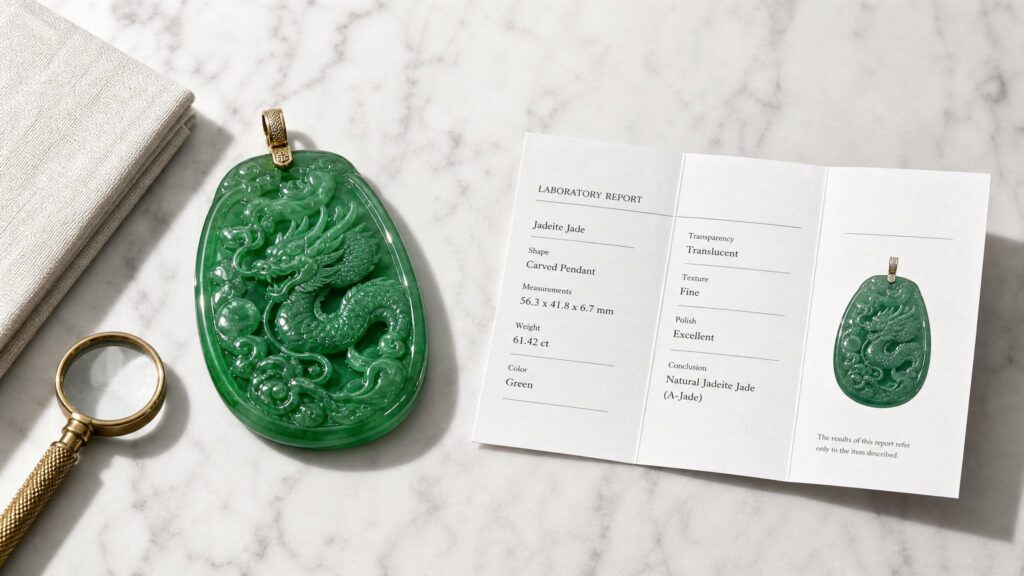
A credible jadeite report is an opinion issued by a gemological laboratory after physical testing. It typically identifies the material, states whether the piece is natural or treated, describes color and other observable features, and includes a photograph, a report number, the testing date, and the lab’s identity. For jadeite specifically, the most important disclosure is whether the stone is Type A (natural color, no polymer impregnation) or has been treated. A report that is vague on this point is not doing its job.
Because the terminology varies between labs and countries, it helps to understand how reports are structured before you judge one. Our guide on how to read a jadeite lab report field by field explains the common sections and what each one means, which makes the red flags below much easier to apply.
Why counterfeit and misleading reports exist
Jade is sold across borders, often through informal channels, and buyers frequently cannot visit a lab themselves. That gap creates an incentive for sellers to supply paperwork that looks official. Sometimes the document is entirely fabricated; sometimes it is a real report for a different stone, or a real report that omits a treatment disclosure. Educational resources on certification note that verifying the lab and the report number is the most reliable defense, and that reputable labs publish sample reports and charge a certification fee — a detail worth remembering when a seller offers a certificate at no cost.
It is also worth understanding what treatments look like, because many misleading certificates exist to disguise them. Our article on Jadeite Type A vs treated resin-coated fakes covers the visual and structural differences that a proper report should confirm.
The Seven Red Flags to Check
1. The laboratory cannot be independently verified
Start with the lab, not the stone. A legitimate gemological laboratory has a verifiable presence: a website, a physical address, contact details, and typically a way to look up a report number online. If the only information on the certificate is a logo and a phone number, or if a search for the lab name returns nothing but the seller’s own listings, treat the report as unverified. Reputable labs are easy to find and easy to contact, and they will confirm whether a report number belongs to them.
2. The report number does not match any database record
Even a real-looking certificate is only useful if the number on it can be checked. Look up the report number on the lab’s own website — not through a link the seller provides, which could point to a lookalike page. The record should match the item: same photograph, same description, same date. A number that returns no result, or a result for a different piece, is one of the clearest signs of a fake jade certificate.
3. Photos and descriptions do not match the actual piece
Compare the certificate photograph with the item in front of you. Look at shape, proportions, color pattern, and any distinctive inclusions. Natural jade is never perfectly uniform, so the pattern of color and any internal features should correspond closely. If the photo shows a different cut, a different hue, or a noticeably different size, the report may belong to another stone entirely. This is a common tactic: a genuine certificate is reused for a similar but inferior piece.
4. Treatment disclosure is missing or deliberately vague
The core question for jadeite is whether the material is natural or treated. A report that describes the stone only as ‘jade’ or ‘jadeite’ without addressing treatment is incomplete. Watch for evasive wording such as ‘enhanced,’ ‘stabilized,’ or a description that simply omits the topic. Guidance on certified jade emphasizes that interpreting common report fields — especially treatment status — is essential, because a certificate that does not clearly state natural, untreated jadeite leaves the most important question unanswered.
5. The lab is unknown, unaccredited, or suspiciously generic
Certificates from established gemological organizations carry more weight than those from an unfamiliar office with a generic name. Accreditation, published testing standards, and a track record are what make a lab’s opinion meaningful. A practical checklist for evaluating appraisal labs includes checking whether the lab publishes sample reports, whether its credentials can be confirmed, and whether it operates transparently. If none of these can be established, the certificate should not be treated as evidence of anything.
6. Printing, seals, and layout show inconsistencies
Physical quality matters. Look for blurry text, mismatched fonts, crooked seals, low-resolution photographs, or a laminate that looks hastily applied. Check that the report number, date, and item description are internally consistent — for example, a testing date that precedes the lab’s founding, or a number format that differs from the lab’s published examples. These details are hard to fake consistently across a whole document, so inconsistencies tend to cluster.
7. The seller resists independent verification
The final red flag is behavioral. A seller with a genuine certificate should welcome verification: they will share the lab’s name, the report number, and clear photographs, and they will not object if you contact the lab directly or arrange your own appraisal. Resistance — pressure to decide quickly, refusal to provide the report number, or a claim that the certificate ‘cannot be checked online’ — is a warning sign regardless of how convincing the paperwork looks. Reputable appraisal guidance notes that a certified report gives buyers confidence precisely because it can be independently confirmed.
Practical Tips for Verifying a Jade Certificate
- Verify the lab first: search its name independently, confirm a physical address, and check whether it publishes sample reports.
- Look up the report number on the lab’s own website by typing the address yourself rather than following a seller’s link.
- Compare the certificate photo with the actual piece side by side, paying attention to color pattern and proportions.
- Confirm that treatment status is stated explicitly, and ask what the report says about natural versus treated material.
- Ask for high-resolution images of the certificate and the item before committing, and keep copies of both.
- For higher-value pieces, commission your own appraisal from an independent lab rather than relying solely on the seller’s document.
- Cross-check the piece against what you know about natural jadeite; our jadeite bracelet buying guide covering Type A, color, and clarity explains the qualities a report should be consistent with.
Common Mistakes to Avoid
- Trusting a certificate because it looks official — logos, seals, and glossy paper are easy to reproduce.
- Assuming any printed report means the stone is natural; the report must specifically address treatment.
- Checking the report number through a link supplied by the seller instead of the lab’s own site.
- Ignoring photo mismatches, which often reveal that a genuine certificate is being reused for another stone.
- Accepting vague language such as ‘enhanced’ or ‘stabilized’ without a clear statement of what was done.
- Letting time pressure override verification; a legitimate seller will not object to a few days of checking.
- Treating the certificate as a substitute for inspection — the document should support your own assessment, not replace it.
Conclusion: Verify the Lab, the Number, and the Stone
A fake jade certificate is not usually exposed by one dramatic detail. It is exposed by a pattern: a lab you cannot find, a number that does not check out, a photo that does not match, or a treatment question that is quietly avoided. Working through these seven red flags in order — lab, number, photo, treatment, accreditation, print quality, and seller behavior — gives you a repeatable method that takes only a few minutes and applies to any jadeite purchase.
The most important habit is independent verification. A certificate is valuable because it can be checked, so check it: confirm the lab exists, look up the number yourself, and compare the document to the piece. When you are ready to explore natural jadeite and Chinese antiques with that mindset, browse our jadeite collection and our Chinese antiques, and keep these checks in hand as you evaluate each piece.
FAQ
Can a fake jade certificate look completely authentic?
Yes. Certificates are printed documents, so a convincing fake can reproduce logos, seals, and layout. That is why verification matters more than appearance: confirm the laboratory exists independently, look up the report number on the lab’s own website, and compare the certificate photograph with the actual piece.
How do I check whether a jade certificate is real?
Start with the lab: search its name independently, confirm a physical address and contact details, and see whether it publishes sample reports. Then type the lab’s website address yourself and look up the report number. The record should match the item’s photograph, description, and date. If the number cannot be found, treat the certificate as unverified.
Why is treatment disclosure so important on a jade report?
For jadeite, the key distinction is between natural, untreated Type A material and stone that has been bleached and polymer-impregnated. A report that describes the piece only as ‘jade’ or ‘jadeite’ without addressing treatment leaves the most important question unanswered, so look for an explicit statement of natural versus treated status.
What should I do if I suspect a certificate is fake?
Do not rely on it. Ask the seller for the lab’s name and report number, verify them independently, and request high-resolution images of both the certificate and the item. For higher-value pieces, commission an appraisal from an independent lab. If the seller resists verification or pressures you to decide quickly, treat that as a warning sign.