Why Jadeite Bracelet Styles Matter to Buyers
Choosing a jadeite bracelet is not simply a matter of picking a color you like. The form of the piece — a carved solid bangle versus a strand of round beads — changes how it sits on the wrist, how it wears over time, and how much of the jade’s natural character you can actually see. Jadeite is valued for its translucency, its luster, and the way light moves through the stone, and each bracelet style presents those qualities differently. A beaded strand lets you read color and grain bead by bead, while a carved bangle shows the stone as a single continuous surface.
For buyers shopping online, understanding these distinctions is the difference between a piece that feels comfortable every day and one that stays in the drawer. Jadeite is also a material with real cultural weight, and reputable guides to jadeite versus nephrite and the meaning of different jade types can help you frame what you are looking at. This guide compares the two dominant bracelet formats using real product information from our collection, so you can match a style to your wrist, your wardrobe, and your budget.
The core question is practical: do you want the flexible, elastic fit of a beaded bracelet, or the solid, traditional presence of a bangle? Both are legitimate choices, and neither is inherently superior. What matters is that the piece’s dimensions, weight, and material quality suit the way you actually wear jewelry.
Understanding Quality in Jadeite Bracelets
Before comparing shapes, it helps to know what separates a fine jadeite bracelet from an ordinary one. The factors below apply equally to beaded and bangle formats, though they show up in different ways.
Texture and Translucency
Jadeite quality begins with the internal structure. A fine, compact texture reads as smooth and dense, while a coarse one looks grainy under light. Translucency — often described in trade terms related to “water” — determines how much light passes through the stone. Ice-type jadeite, for example, is prized for a transparent, delicate texture with a cool, glassy sheen. In a beaded bracelet, translucency is judged bead by bead; in a bangle, it is judged across the whole carved surface, where any inconsistency is more visible.
Color and Distribution
Color is the most talked-about value factor in jadeite, and distribution matters as much as hue. Uniform color is admired, but natural variation — floating green patterns, three-color combinations, or a soft lavender-white tone — is part of what makes jadeite distinctive. Buyers should look for color that appears natural and harmonious rather than patchy or forced. Educational resources on how jade color and significance are evaluated in jewelry buying guides can help you calibrate your eye.
Luster and Surface Finish
Luster describes how the polished surface reflects light. A vitreous, glassy luster signals a well-finished, high-quality stone; a dull or waxy surface may indicate lower-grade material or poor polishing. On a beaded bracelet, every bead should share a consistent luster. On a bangle, the polish should be even across the curved top and the inner band, with no flat or chalky patches.
Workmanship and Stringing
For beaded pieces, the setting matters. Simple elastic cord keeps a bracelet flexible and easy to wear, while traditional knotting adds security and a handcrafted look. For bangles, workmanship means the carving itself — a smooth interior, an even profile, and a comfortable curve. Neither approach is better, but the finishing should match the price tier of the piece.
Types and Styles: Bangles, Beaded Strands, and More
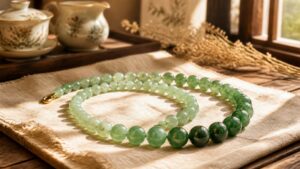
Jadeite bracelets in our collection fall into a few clear formats, and each has a distinct personality. The Natural Jadeite Bracelet is a classic beaded strand: 19 round beads of approximately 10mm each, strung on elastic cord, with a total circumference of about 18cm and a weight of roughly 30g. Its soft lavender-white hue and gentle vitreous luster make it an easy everyday piece.
At the more dramatic end of beaded design is the Natural Ice-type Jadeite Bracelet with Floating Green Patterns. It comprises 13 round beads of 16mm diameter, weighs 101g, and shows floating green patterns against an icy, transparent base. This is a substantial bracelet with a bold visual presence. The Natural Three-Color Jadeite Bracelet takes a different route, combining yellow, white, and light green across 16 spherical beads of approximately 12mm, at about 35g, with an elastic cord for an adjustable fit.
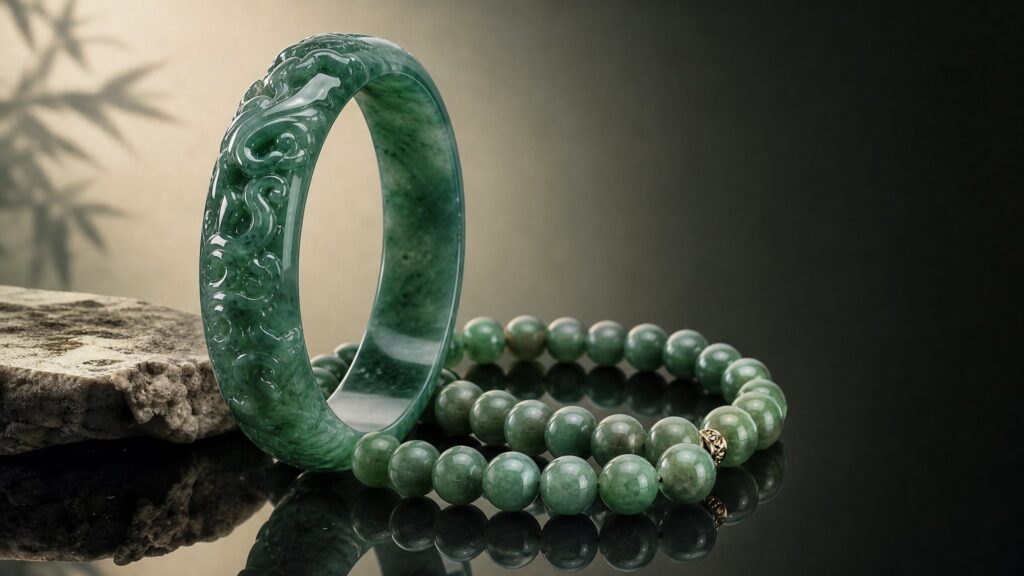
Bangles, by contrast, are carved from a single piece of jadeite rather than assembled from beads. Their solid form showcases the stone as a continuous surface, and they are traditionally worn as a statement piece. The same single-stone logic appears in our Natural Full-Green Jadeite Saddle Ring, carved entirely from one piece of jadeite — a useful reference point for understanding how carved jadeite reads on the hand. Buyers comparing formats should also browse the full jadeite collection to see how beaded strands, carved pieces, and mixed designs sit alongside one another.
How to Choose the Right Size and Fit
Fit is where beaded and bangle bracelets diverge most sharply. Beaded bracelets strung on elastic cord are inherently forgiving. The Natural Jadeite Bracelet, for instance, has a circumference of about 18cm and is described as suitable for wrists with a circumference of 16–19cm. That range covers most wearers and allows the bracelet to slide on without a clasp. The Natural Three-Color Jadeite Bracelet similarly uses an elastic cord for an adjustable fit across most wrist sizes.
Bead diameter changes the feel as much as the circumference. A 10mm bead strand like the Natural Jadeite Bracelet sits close to the wrist and works well under sleeves. A 16mm bead strand like the Natural Ice-type Jadeite Bracelet with Floating Green Patterns is a much larger, heavier piece at 101g — it makes a statement and is best suited to wearers who like a bold, substantial feel. The 12mm beads of the Natural Three-Color Jadeite Bracelet fall in between, at roughly 35g.
Bangles require a more precise fit because they must pass over the hand. A carved bangle should slide on with slight resistance and sit securely without pinching. If you are new to bangles, it is worth measuring your hand at its widest point rather than only your wrist, and comparing that to the inner diameter of the piece. When in doubt, a beaded elastic bracelet is the lower-risk first purchase; a bangle is a more committed choice that rewards accurate measurement.
Price and Value: What Drives Cost
Jadeite pricing reflects a combination of material quality, size, and workmanship. In our collection, beaded bracelets span a wide range. The Natural Three-Color Jadeite Bracelet is listed at $668, while the Natural Jadeite Bracelet is $1008. The Natural Ice-type Jadeite Bracelet with Floating Green Patterns, with its larger 16mm beads, ice-type transparency, and 101g weight, is listed at $1517. These differences track directly with bead size, translucency, and the visual drama of the stone.
Carved and set pieces sit in a different pricing context because they involve more material and often more labor. The Natural Full-Green Jadeite Saddle Ring is $2437, and the Natural Ice-type Violet Jadeite Cabochon Ring Set with 18K White Gold, Sapphires, and Diamonds is $1926 — a reminder that metalwork and accent stones add value independent of the jade itself. For buyers who want to understand how gemological grading and reputable gemology publications assess jadeite value, buying guides that explain multi-color jade grading are a useful reference.
The practical takeaway is that you do not need to spend the most to get a beautiful bracelet. An entry-level beaded piece can offer excellent color and luster, while premium pieces justify their cost through rarity, size, and translucency. Decide which of those factors you value most before you compare prices.
Common Mistakes to Avoid
- Buying for color alone without checking texture, luster, and translucency together.
- Assuming a bangle will fit because it matches your wrist measurement — bangles must clear the hand.
- Overlooking bead diameter and weight, which change comfort far more than photos suggest.
- Treating all “jade” as jadeite; jadeite and nephrite are different materials with different value.
- Ignoring the stringing or setting, which affects durability and daily wearability.
- Comparing prices across formats without accounting for bead size, stone weight, and metalwork.
Top Picks: Which Jadeite Bracelet Suits You
If you want a versatile everyday bracelet, the Natural Jadeite Bracelet at $1008 is the safest all-rounder. Its 10mm beads, 18cm circumference, and roughly 30g weight suit wrists of 16–19cm, and the lavender-white tone pairs easily with daily outfits.
For a bolder, more dramatic look, the Natural Ice-type Jadeite Bracelet with Floating Green Patterns at $1517 suits wearers who love large-scale jewelry and appreciate ice-type transparency. Its 16mm beads and 101g weight give it real presence.
If color variation is what draws you to jadeite, the Natural Three-Color Jadeite Bracelet at $668 offers a harmonious yellow, white, and light green palette across 12mm beads — an approachable entry point with plenty of character.
For a coordinated look, consider the Natural Ice-type Tricolor Jade Necklace at $740, whose green, yellow, and orange beads echo the multi-color theme in a lightweight 10.4g strand. And for those ready to move from beaded to carved jadeite, the Natural Full-Green Jadeite Saddle Ring at $2437 demonstrates the single-stone craftsmanship that defines the bangle tradition.
Final Tips
Start with fit, then move to style, then to price. A bracelet that fits well and suits your daily wardrobe will be worn far more than one chosen purely on color or trend. Beaded elastic bracelets are forgiving and easy to size; bangles reward careful measurement and offer a more traditional, sculptural look. Whichever you choose, judge the jadeite by texture, translucency, luster, and color distribution together rather than any single factor.
Finally, buy from a seller who describes each piece in specific, verifiable terms — bead counts, diameters, weights, and stringing methods. That transparency is the clearest signal of quality you can get before a piece reaches your wrist.
FAQ
Is a beaded or bangle jadeite bracelet better for everyday wear?
Beaded bracelets on elastic cord are generally more forgiving for daily wear because they flex and accommodate a range of wrist sizes. Bangles are solid and require a more precise fit, so they suit wearers who have measured carefully and prefer a traditional look.
What wrist size does the Natural Jadeite Bracelet fit?
The Natural Jadeite Bracelet has a total circumference of about 18cm and is described as suitable for wrists with a circumference of 16–19cm.
Why do jadeite bracelet prices vary so much?
Price reflects bead size, stone weight, translucency, color, and workmanship. Larger beads, ice-type transparency, and heavier pieces generally cost more, while metalwork and accent stones add value to set pieces.
Can I wear a jadeite bangle if my wrist is between sizes?
Bangles must pass over the hand, so measure the widest part of your hand rather than only your wrist. If you are between sizes, a beaded elastic bracelet is the lower-risk option.