Introduction: Why the Right Size Matters for a Jadeite Saddle Ring
Unlike a diamond solitaire that can be resized with relative ease, a jadeite saddle ring is carved from a single piece of natural jadeite. This traditional style, with its smooth curved top and open shank, cannot be stretched or compressed without risking damage to the stone. That is why understanding your jadeite saddle ring size before you buy is not just a matter of comfort—it is essential to preserving the integrity and value of your investment.
At VirtuCasa, we specialize in natural jadeite jewelry and Chinese antiques. Our collection includes several exquisite saddle rings, each with its own character and size. Whether you are drawn to the deep, even green of a full-green jadeite saddle ring or the delicate floating patterns of a jadeite saddle ring with floating green, getting the size right ensures that the ring sits comfortably and securely on your finger, allowing you to enjoy its beauty for years to come.
This guide will walk you through the key factors that define jadeite quality, the different styles available, and most importantly, how to measure your finger accurately to find your perfect fit. We will also explore what drives the price of these remarkable pieces and highlight some of our top recommendations to help you make a confident, informed purchase.
Understanding Jadeite Quality
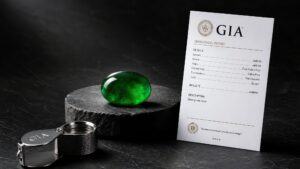
Before you can truly appreciate a saddle ring, it helps to understand what makes jadeite so special. Jadeite is one of two minerals commonly known as jade, the other being nephrite. Fine jadeite is prized for its intensity of color and its glassy, translucent appearance. When experts evaluate jadeite, they look at several factors, which are often summarized as the “Three Cs”: Color, Clarity, and Cut. However, as the Gemological Institute of America (GIA) explains in its jadeite quality factors, the evaluation goes deeper, considering texture, transparency, and the presence of natural flaws.
Color: The Heart of Jadeite
Color is arguably the most important quality factor in jadeite. The most prized color is a vivid, even green known as “imperial” green, but jadeite also occurs in lavender, white, yellow, and even combinations of these hues. In a saddle ring, the color should be evenly distributed across the top surface, with no dull or washed-out areas. For example, the Natural Full-Green Jadeite Saddle Ring boasts an even “full green” coloration that is dense yet translucent, exemplifying the ideal of a rich, uniform hue.
Texture and Transparency
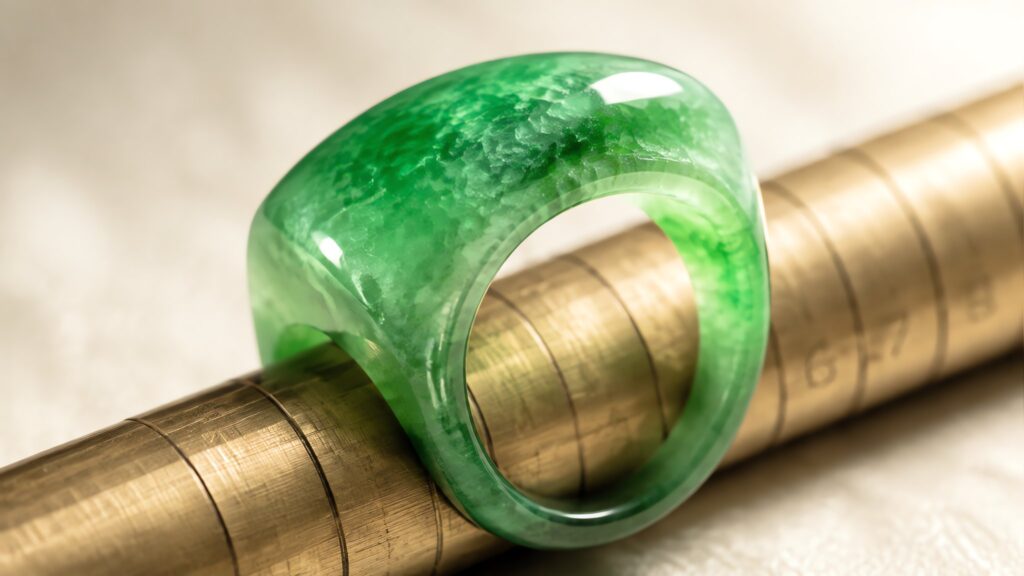
Fine jadeite has a smooth, fine-grained texture that allows light to pass through, creating a soft, vitreous luster. The highest grades, such as “ice-type” jadeite, are nearly transparent, resembling frozen water. In contrast, lower grades may appear more opaque or chalky. When examining a saddle ring, look for a surface that feels silky to the touch and has a gentle, internal glow. The Natural Jadeite Saddle Ring with Floating Green is a beautiful example of moderate transparency, where elegant green patches float on a lighter base, showcasing the natural patterns of the stone.
Cut and Carving
Because saddle rings are carved from a single piece of jadeite, the cut is crucial. A well-executed saddle ring will have a smooth, curved top that sits comfortably against the finger, with no sharp edges or asymmetrical lines. The underside should be carefully hollowed to reduce weight and ensure a secure fit. The craftsmanship directly affects both the aesthetic appeal and the structural integrity of the ring, so always inspect the finish closely.
Types & Styles of Jadeite Saddle Rings
While the classic saddle ring is the most traditional style, jadeite rings come in a variety of designs to suit different tastes. Understanding these styles will help you narrow down your choice before you even start measuring.
The most common type is the full saddle ring, which features a rectangular or slightly curved top that spans the width of the finger. This design is often left plain to showcase the jadeite’s color and texture, as seen in the jadeite collection at VirtuCasa. Another popular variation is the floating green saddle ring, where patches of green are distributed across a lighter background, creating a unique, painterly effect. For those who prefer a more contemporary look, jadeite is also set into precious metal mounts, such as the Natural Ice-type Violet Jadeite Cabochon Ring Set with 18K White Gold, Sapphires, and Diamonds, which combines the ethereal beauty of violet jadeite with the brilliance of diamonds and sapphires.
Each style has its own sizing considerations. Full saddle rings are typically sized by their inner diameter, just like any other ring, but because they are open-backed, they may feel slightly different on the finger. Cabochon rings set in metal are more traditional in sizing and can often be adjusted by a jeweler, though resizing may be limited by the stone setting.
How to Choose the Right Size & Fit for a Jadeite Saddle Ring
Finding your correct jadeite saddle ring size is the most critical step in your purchase. A ring that is too tight will be uncomfortable and may restrict circulation, while one that is too loose could slip off and become lost or damaged. Here is a step-by-step guide to measuring your finger accurately at home.
First, you will need a piece of string or a flexible measuring tape, a ruler, and a pen. Wrap the string around the base of the finger where you plan to wear the ring. Make sure it is snug but not tight—there should be just enough room to slide a toothpick underneath. Mark the point where the string overlaps, then lay it flat against a ruler to measure the circumference in millimeters. This measurement corresponds to a standard ring size. For example, a circumference of approximately 51.9mm corresponds to a US size 6, while 54.4mm is a size 7.
Keep in mind that your finger size can vary throughout the day due to temperature, humidity, and activity. It is best to measure in the evening when your fingers are at their largest. Also, consider the width of the saddle ring itself. Wider rings tend to fit more snugly than narrow bands, so you may need to go up half a size for a comfortable fit. The saddle rings at VirtuCasa are available in specific sizes—for instance, the Natural Full-Green Jadeite Saddle Ring is a 24-ring size, while the Natural Jadeite Saddle Ring with Floating Green is a 26-ring size. These correspond to standard US sizes, but if you are between sizes, it is wise to consult with our customer service team for personalized advice.
Finally, remember that jadeite saddle rings are not easily resized. Unlike metal rings, which can be stretched or cut, a jadeite ring must be re-carved, a risky and costly process that may compromise the stone. Therefore, taking the time to measure correctly is the best way to ensure a ring you will treasure for life.
Price & Value: What Drives the Cost of a Jadeite Saddle Ring
The value of a jadeite saddle ring is determined by a combination of factors, including the quality of the jadeite, the intensity and evenness of its color, its transparency, and the craftsmanship of the carving. As with all gemstones, rarity plays a significant role. High-grade jadeite, especially in vivid green or fine lavender, is scarce and commands premium prices.
In the VirtuCasa collection, you will find saddle rings at various price points, reflecting these differences. For example, the Natural Full-Green Jadeite Saddle Ring is priced at $2437, a reflection of its even, dense green color and substantial weight of 9.5g. In contrast, the Natural Jadeite Saddle Ring with Floating Green is offered at $719, making it an accessible entry point into the world of natural jadeite. The floating green pattern, while beautiful, is considered less rare than a full, uniform green, which is why this piece is more affordable.
When comparing prices, it is essential to consider not just the price tag but the overall quality and craftsmanship. A higher-priced ring may offer better color saturation or a more refined finish, while a lower-priced piece can still be a wonderful choice for those new to jadeite. As with any fine jewelry, the value lies in the eye of the beholder, but understanding these factors will help you make a wise investment.
Common Mistakes to Avoid When Buying a Jadeite Saddle Ring
- Ignoring the size: The most common mistake is purchasing a ring without knowing your exact finger size. Because jadeite saddle rings are carved from a single piece of stone, they cannot be easily resized. Always measure carefully before buying.
- Confusing jadeite with nephrite: Jadeite is rarer and generally more valuable than nephrite. Ensure that the ring you are considering is specifically labeled as natural jadeite, and ask for certification if possible.
- Overlooking the color under different lights: Jadeite color can appear different under fluorescent versus incandescent light. As gemological experts note, it is important to examine jadeite under both light sources to get a true sense of its color.
- Assuming all saddle rings are the same: Saddle rings vary in width, thickness, and curvature. A ring that fits well in one style may feel different in another. Pay attention to the specific dimensions and weight of each piece.
- Neglecting the setting: For saddle rings with metal settings, such as the cabochon ring set, ensure that the prongs are secure and the stone is well-fitted. A loose stone can become damaged with everyday wear.
Top Picks: Three Jadeite Saddle Rings to Consider
To help you start your search, we have selected three exceptional jadeite saddle rings from our collection, each suited to different preferences and budgets.
For the collector who appreciates the pinnacle of jadeite quality, the Natural Full-Green Jadeite Saddle Ring is an outstanding choice. Priced at $2437, this ring features an even, full green color that is both dense and translucent, a hallmark of top-tier jadeite. With a 24-ring size and a weight of 9.5g, it offers a comfortable, classic fit. This is the ring for someone who wants a piece that makes a bold statement of elegance and rarity.
If you prefer a more unique and affordable option, the Natural Jadeite Saddle Ring with Floating Green is a beautiful alternative. At $719, it is an entry-level piece that does not compromise on beauty. The floating green patches on a light base create a distinctive, artistic look, and the 26-ring size offers a comfortable fit for those with larger fingers. Weighing 13.5g, it has a balanced, substantial feel that speaks to the density of natural jadeite. This ring is ideal for the jadeite enthusiast who values character and natural patterns over uniform color.
For those who desire the beauty of jadeite in a more contemporary setting, the Natural Ice-type Violet Jadeite Cabochon Ring Set with 18K White Gold, Sapphires, and Diamonds is a stunning choice. Priced at $1926, this ring features a vivid violet cabochon with excellent transparency, set in 18K white gold and accented with sapphires and diamonds. The 15-ring size is designed for a moderate finger circumference, and at only 4g, it is lightweight and perfect for daily wear. This is the ring for someone who wants a modern, luxurious piece that combines the mystique of jadeite with the brilliance of fine gemstones.
No matter which ring you choose, remember that the right size is essential. Take the time to measure your finger accurately, and do not hesitate to reach out to VirtuCasa for guidance. Our goal is to help you find a jadeite saddle ring that not only fits perfectly but also brings you joy for a lifetime.
Final Tips & Conclusion
Purchasing a jadeite saddle ring is a meaningful investment, both financially and emotionally. By understanding the quality factors—color, texture, transparency, and cut—you can select a piece that truly resonates with you. And by measuring your finger correctly, you ensure that your ring will be a pleasure to wear every day.
When you are ready to explore, we invite you to browse our jadeite collection to see the full range of saddle rings and other jadeite jewelry. Each piece is carefully selected for its natural beauty and craftsmanship. Whether you are drawn to the classic full green or the charming floating green, you will find a ring that speaks to your personal style.
Remember, a jadeite saddle ring is not just an accessory; it is a piece of natural art that carries centuries of cultural significance. Treat it with the care it deserves, and it will remain a treasured heirloom for generations. Happy ring hunting!
FAQ
How do I measure my finger for a jadeite saddle ring?
Wrap a piece of string or a flexible measuring tape around the base of your finger. Mark where it overlaps, then measure the length in millimeters with a ruler. This circumference corresponds to a ring size. For best accuracy, measure in the evening when fingers are largest, and consider that wider saddle rings may fit more snugly.
Can a jadeite saddle ring be resized?
Resizing a jadeite saddle ring is very difficult and risky because it is carved from a single piece of natural jadeite. Unlike metal rings, it cannot be stretched or cut easily. Attempting to resize it may damage the stone, so it is crucial to choose the correct size from the start.
What is the difference between a full green and a floating green jadeite saddle ring?
A full green saddle ring has an even, uniform green color across the entire top surface, which is rarer and typically more expensive. A floating green saddle ring features patches or streaks of green on a lighter background, creating a unique, artistic pattern. Both are natural jadeite, but the color distribution affects their value and appearance.
Are jadeite saddle rings suitable for everyday wear?
Yes, jadeite is a durable gemstone, but it should be worn with care to avoid impacts or harsh chemicals. Saddle rings are designed to sit comfortably on the finger, but daily activities like heavy lifting or contact sports can risk chipping. It is best to remove the ring during such activities to preserve its beauty.