Introduction: Why the Saddle vs Cabochon Decision Matters
Choosing your first piece of jadeite jewelry is exciting, but the range of forms can make the decision feel overwhelming. Two of the most distinctive ring styles you will encounter are the saddle ring and the cabochon ring. They differ not only in silhouette but in how the stone is cut, how it sits on the hand, and what it communicates about the wearer’s taste. Understanding these differences before you buy helps you avoid a purchase you later regret, and it makes it easier to compare pieces fairly across a marketplace.
At VirtuCasa, our jadeite collection includes both traditional saddle rings and gem-set cabochon rings, each made from natural jadeite. This guide walks through the quality factors that matter, the main style variations, sizing considerations, and how price reflects rarity and craftsmanship. By the end, you should have a clear sense of which style suits your lifestyle and which specific pieces are worth a closer look.
Jadeite has been prized for centuries in East Asian cultures, and modern buyers increasingly rely on established buying frameworks. Reputable guides emphasize evaluating appearance, craftsmanship, disclosure, and suitability for the jewelry you want, rather than chasing a single metric. That approach is especially useful when comparing a carved saddle ring with a polished cabochon set in precious metal.
Understanding Quality: What Separates a Good Jadeite Ring from a Great One
Color and Saturation
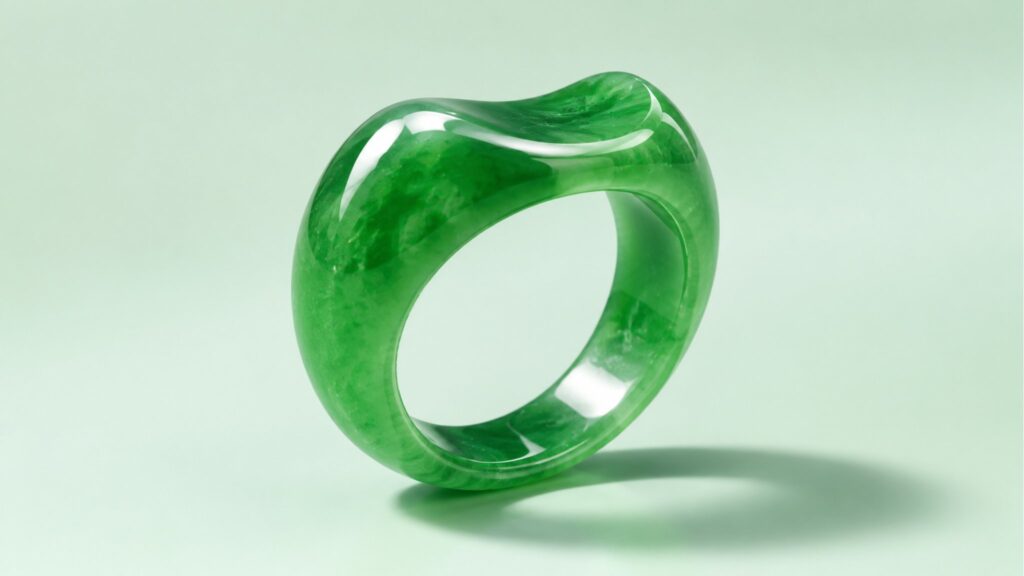
Color is often the first thing buyers notice. In jadeite, evenness and saturation matter greatly. A Natural Full-Green Jadeite Saddle Ring demonstrates an even “full green” coloration, with a dense yet translucent hue that shows the stone’s internal structure. By contrast, a piece like the Natural Jadeite Saddle Ring with Floating Green features green patches floating on a light base, a different aesthetic that highlights natural patterns rather than uniform color.
Neither approach is inherently better; they appeal to different tastes. What matters is that the color looks natural and consistent with the stone’s transparency. Buyers comparing multiple pieces should pay attention to differences in color, clarity, imperfections, and price, as noted in guidance on how to buy jade online and identify natural A jade.
Transparency and Texture
Transparency, often described as “water” or “ice” quality, strongly influences value. Ice-type jadeite is prized for a cool, glassy sheen and fine internal texture. The Natural Ice-type Violet Jadeite Cabochon Ring Set with 18K White Gold, Sapphires, and Diamonds illustrates this: its oval cabochon has a vivid violet hue with excellent transparency and a smooth, lustrous surface that emanates a soft, gem-like glow. Saddle rings can also show fine texture, as with the full-green saddle ring’s warm, lustrous vitreous sheen.
Texture and transparency are linked to how light interacts with the stone. Premium Burmese jade is often associated with translucency, where light gently enters the stone before reflecting back, producing a soft glow. This is a useful qualitative benchmark when you cannot handle a piece in person.
Craftsmanship and Setting
Craftsmanship shows in symmetry, polish, and the quality of the setting. A saddle ring is typically carved entirely from a single piece of jadeite, so the shape and comfort depend on the carver’s skill. The full-green saddle ring, for example, is described as a traditional saddle ring style carved from a single piece of jadeite, with a curved top surface that rests comfortably on the finger. Cabochon rings involve a different skill set: cutting a smooth dome and setting it securely. The violet cabochon ring set is elegantly set with 18K white gold, sapphires, and diamonds, combining jade with precious materials.
Disclosure and Certification
Always look for clear disclosure about treatment. Natural, untreated jadeite (often called A jade) is the standard for fine jewelry. Ask whether the piece has been dyed, bleached, or polymer-impregnated, and request documentation where available. A trustworthy seller will describe the stone honestly and provide enough detail for you to evaluate it. VirtuCasa’s product pages describe each piece’s germplasm, size, weight, and setting, giving you a starting point for comparison.
Types & Styles: Saddle Rings and Cabochon Rings Compared
Saddle rings are characterized by a curved, saddle-shaped top that arches over the finger. This traditional form is often carved from a single piece of jadeite and tends to have a substantial, sculptural presence. The Natural Full-Green Jadeite Saddle Ring is a 24-ring size, weighs 9.5g, and offers a classic, elegant fit. The Natural Jadeite Saddle Ring with Floating Green is a 26-ring size and weighs 13.5g, with a balanced, substantial feel. Both are entirely jadeite, with no additional metal setting, which appeals to buyers who want the stone to speak for itself.
Cabochon rings feature a polished, domed stone, usually oval or round, set into metal. The Natural Ice-type Violet Jadeite Cabochon Ring Set with 18K White Gold, Sapphires, and Diamonds is a 15-ring size and weighs 4g. Its 18K white gold setting with sapphires and diamonds gives it a more contemporary, gem-set look. This style tends to suit buyers who want a ring that reads as fine jewelry and can transition between formal and everyday wear.
Beyond rings, VirtuCasa’s jadeite category includes bracelets and necklaces that can help you build a coordinated look. The Natural Jadeite Bracelet, for instance, is made of 19 round beads each approximately 10mm in diameter, with a total circumference of about 18cm, suitable for wrists of 16-19cm. The Natural Ice-type Jadeite Bracelet with Floating Green Patterns comprises 13 round beads each 16mm in diameter and weighs 101g, a substantial piece for those who prefer bold jadeite. If you are considering a first purchase, a ring is often the most wearable entry point, but these pieces show the breadth of the collection.
How to Choose the Right Size & Fit
Ring sizing is critical, especially for saddle rings, which have a rigid, carved form and cannot be resized easily. The full-green saddle ring is listed as a 24-ring size, while the floating-green saddle ring is a 26-ring size. These correspond to specific finger circumferences, so measure your finger carefully or have a jeweler do it. A saddle ring should sit securely without pinching; because the top is curved, it may feel different from a flat band, so allow time to adjust.
Cabochon rings can sometimes be resized by a jeweler depending on the setting, but the violet cabochon ring set is listed as a 15-ring size. Its 4g weight makes it lightweight and comfortable for all-day wear. If you are between sizes, consider the width of the band and whether you plan to stack the ring with others. For saddle rings, the internal profile matters as much as the stated size; a curved top surface that rests comfortably on the finger is a hallmark of good design.
When shopping online, compare the stated size with a ring you already own and love. If you are unsure, ask the seller for guidance. VirtuCasa lists ring sizes and weights for each piece, which helps you compare like with like. Remember that jadeite is a natural material, so slight variations in shape and fit are normal.
Price & Value: What Drives Cost
Price in jadeite reflects color, transparency, texture, size, and craftsmanship. Among the rings in this collection, the Natural Full-Green Jadeite Saddle Ring is priced at $2437, reflecting its even full-green coloration and fine texture. The Natural Jadeite Saddle Ring with Floating Green is $719, a more accessible entry into the saddle-ring form. The Natural Ice-type Violet Jadeite Cabochon Ring Set with 18K White Gold, Sapphires, and Diamonds is $1926, where the ice-type violet jadeite and the 18K white gold, sapphire, and diamond setting both contribute to the cost.
Other pieces in the category illustrate how price scales with material and complexity. The Natural Ice-type Violet Jade Bead Necklace is $6649, a premium piece with 68 beads ranging from 10mm to 12mm and a weight of 158g. The Natural Ice-type Jadeite Bracelet with Floating Green Patterns is $1517, while the Natural Jadeite Bracelet is $1008. For a lower-entry option, the Natural Three-Color Jadeite Bracelet is $668, and the Natural Ice-type Tricolor Jade Necklace is $740. Earrings such as the Natural Jadeite Tassel Earrings are $852.
Value is not only about price. Consider how often you will wear the piece, whether it suits your wardrobe, and whether the craftsmanship justifies the cost. A $719 saddle ring may be a better first purchase than a $2437 piece if you are exploring the style. Conversely, if you want a statement piece with even color and fine texture, the higher-priced saddle ring may be worth the investment.
Common Mistakes to Avoid
- Buying without confirming the ring size, especially for rigid saddle rings that cannot be resized.
- Assuming all green jadeite is the same; evenness, saturation, and transparency vary widely.
- Ignoring treatment disclosure; natural, untreated jadeite is the standard for fine jewelry.
- Overlooking the setting quality on cabochon rings, where metalwork and stone security matter.
- Comparing prices without comparing specs such as weight, size, and craftsmanship.
- Choosing a style that does not fit your lifestyle, such as a delicate cabochon ring for heavy daily wear.
Top Picks: Which Jadeite Ring Suits You?
If you want a traditional, all-jadeite ring with even color and a substantial feel, the Natural Full-Green Jadeite Saddle Ring at $2437 is a strong choice. Its 24-ring size and 9.5g weight make it comfortable for daily wear, and the full-green coloration is classic. It suits buyers who appreciate carved jadeite and want a piece that stands on its own.
For a more accessible introduction to the saddle form, the Natural Jadeite Saddle Ring with Floating Green at $719 offers a 26-ring size and 13.5g weight. Its floating green patches on a light base appeal to buyers who prefer natural patterns over uniform color. It is a good first saddle ring for someone testing the style.
If you want a gem-set ring that reads as fine jewelry, the Natural Ice-type Violet Jadeite Cabochon Ring Set with 18K White Gold, Sapphires, and Diamonds at $1926 is the standout. Its 15-ring size and 4g weight make it lightweight, while the ice-type violet jadeite and precious-metal setting give it a contemporary look. It suits buyers who want versatility and a touch of luxury.
To coordinate with a ring, consider the Natural Ice-type Tricolor Jade Necklace at $825, with 5.3mm beads and a 25.8g weight, or the Natural Ice-type Tricolor Jade Necklace at $740, with 3.5mm beads and a 10.4g weight. Both offer the three-color combination that pairs well with jadeite rings.
Final Tips and Conclusion
Choosing between a jadeite saddle ring and a cabochon ring comes down to your personal style, how you plan to wear the piece, and your budget. Saddle rings offer a traditional, sculptural look with the stone as the centerpiece. Cabochon rings offer a more contemporary, gem-set aesthetic with the option of precious metals and accent stones. Neither is better; they serve different purposes.
Before you buy, measure your ring size, review the product specs, and consider how the piece fits your wardrobe. Use the jadeite category to compare pieces side by side. If you are new to jadeite, start with an entry-level piece such as the $719 saddle ring, then expand as you learn what you love. With careful attention to color, transparency, craftsmanship, and fit, you can choose a jadeite ring you will treasure for years.
FAQ
What is the difference between a jadeite saddle ring and a cabochon ring?
A saddle ring is carved from a single piece of jadeite with a curved top that arches over the finger, while a cabochon ring features a polished, domed stone set into metal, often with accent stones.
Can a jadeite saddle ring be resized?
Saddle rings are typically carved from a single piece of jadeite and are rigid, so resizing is difficult or impossible. It is important to choose the correct ring size before purchase.
How do I evaluate jadeite quality when buying online?
Focus on color evenness and saturation, transparency, texture, craftsmanship, and clear disclosure of any treatments. Compare specs such as weight and size, and ask for documentation where available.
Which jadeite ring is better for a first purchase?
If you want a traditional all-jadeite look, the Natural Jadeite Saddle Ring with Floating Green at $719 is an accessible entry point. If you prefer a gem-set style, the Natural Ice-type Violet Jadeite Cabochon Ring Set at $1926 offers a contemporary option.