Why Jadeite Type A Matters to Buyers
Jadeite is one of the most imitated and most treated gem materials in the world, and that single fact shapes almost every buying decision. When you shop for a bracelet, ring, or necklace, the most important question is not simply whether the stone is pretty — it is whether the material is natural and untreated. The term jadeite Type A refers to jadeite that has not been bleached, resin-impregnated, or dyed, which is why it commands a premium and why it is the benchmark serious buyers look for.
Treated jadeite is not necessarily worthless, but it behaves differently over time. Resin-coated or impregnated stones can lose their surface sheen, change appearance, or reveal internal fractures as the filler ages. For a buyer spending meaningful money on a piece intended to last, understanding the difference protects both your wallet and your expectations. As a starting point, reputable guidance such as Mason-Kay’s tips for buying jade jewelry consistently puts natural versus treated jade at the top of the checklist.
This guide focuses on what you can actually observe in person — the surface, the luster, the internal structure, and the way light moves through the stone — so you can evaluate a piece with more confidence before you commit.
Understanding Quality: What Separates Natural From Treated
Surface and Luster
Natural jadeite typically shows a cool, vitreous or glassy luster that comes from the stone itself. A resin-coated piece can look glossy at first glance, but the shine often feels superficial, almost plastic, and may appear uneven across the surface. Under a strong light, look for a subtle waxy or oily film on treated stones. Natural pieces in the VirtuCasa collection describe this quality directly: the Natural Jadeite Bracelet is noted for a soft lavender-white hue with a gentle vitreous luster, a description that reflects the natural surface character buyers should learn to recognize.
Internal Structure and Clarity
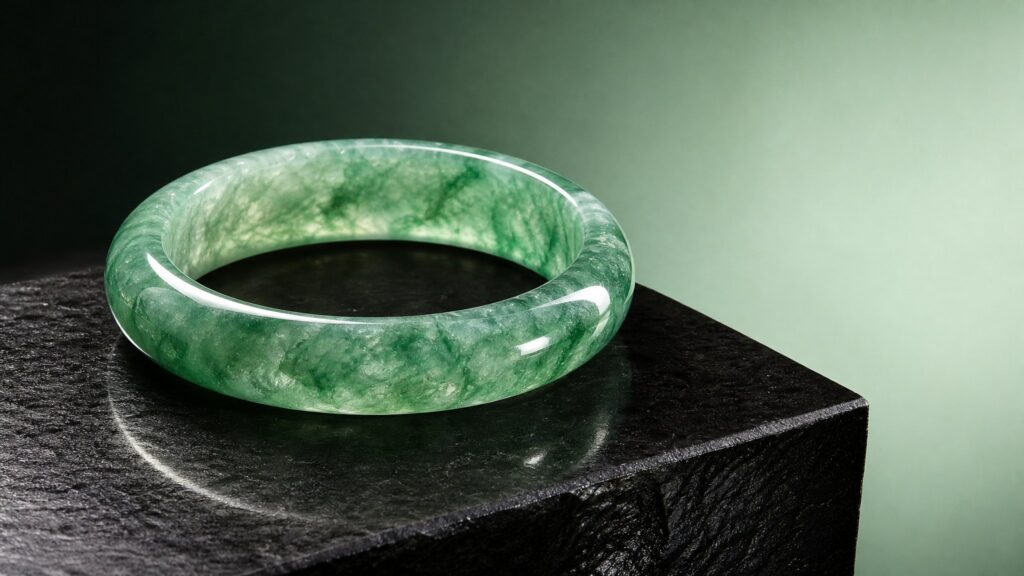
Natural jadeite usually contains visible internal features — fine grain, subtle color banding, or small natural inclusions — that look organic rather than uniform. Resin treatment can fill fractures and make a stone appear cleaner than it is, sometimes creating a slightly cloudy or blurred look inside. A useful in-person check is to rotate the piece slowly under a focused light and watch how the internal texture reads. The Natural Ice-type Jadeite Bracelet with Floating Green Patterns is described as transparent and delicate with floating green patterns blending into an icy base, an example of how natural variation presents itself.
Color and Evenness
Dyed or treated jadeite often shows color that sits too evenly or pools unnaturally in cracks. Natural color tends to vary gently across a stone. The Natural Three-Color Jadeite Bracelet illustrates this with a yellow, white, and light green combination that blends harmoniously — a natural multicolor pattern rather than a flat, painted look. For a broader framework on color, clarity, and cut, see this jadeite buying guide covering the classic Three Cs.
Types & Styles: What Natural Jadeite Looks Like Across Pieces
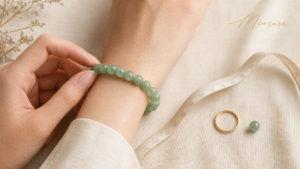
Natural jadeite appears in a wide range of styles, and comparing several pieces is one of the best ways to train your eye. Bead bracelets are a classic entry point. The Natural Jadeite Bracelet uses 19 round beads of approximately 10mm each, strung on elastic cord for a flexible fit, with a total circumference of about 18cm. Its simple stringing without additional metal settings keeps attention on the stone itself — useful when you are judging natural luster.
For a bolder look, the Natural Ice-type Jadeite Bracelet with Floating Green Patterns comprises 13 round beads of 16mm diameter and weighs 101g, giving a substantial hand feel that reflects dense, high-quality material. At the other end of the scale, the Natural Ice-type Tricolor Jade Necklace uses 3.5mm beads on a durable brown cord with traditional knotting, a lightweight 10.4g strand suited to layering.
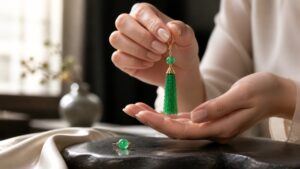
Rings and earrings round out the category. The Natural Full-Green Jadeite Saddle Ring is carved from a single piece of jadeite in a traditional saddle style at 9.5g, while the Natural Jadeite Tassel Earrings pair deep green cylindrical beads with 18K gold-plated chains. Seeing this range helps you recognize that natural jadeite is not one uniform look — it is a family of appearances.
How to Choose the Right Size & Fit
Fit matters as much as authenticity, especially with bead bracelets and rings. For bracelets, check the stated circumference against your wrist measurement. The Natural Jadeite Bracelet’s roughly 18cm circumference is described as suitable for wrists of 16–19cm, while elastic-cord designs such as the Natural Three-Color Jadeite Bracelet are adjustable for most wrist sizes. If a piece is not adjustable, measure before buying rather than guessing.
For rings, the listed ring size is the key number. The Natural Full-Green Jadeite Saddle Ring is a 24-ring size, and the Natural Jadeite Saddle Ring with Floating Green is a 26 ring size. Saddle rings have a curved top surface, so comfort depends on both the size and how the curve sits on your finger. Necklaces depend on bead diameter and strand length: smaller beads such as 3.5mm or 5.3mm suit layering, while larger beads create a more statement look.
Weight is another practical signal. A 101g bracelet feels very different from an 8g pair of earrings, and neither is inherently better — it is about the wearing experience you want. Always read the product details for exact figures rather than assuming.
Price & Value: What Drives Cost
Natural jadeite pricing reflects rarity, color, transparency, and size. Entry-level pieces in the VirtuCasa range include the Natural Three-Color Jadeite Bracelet at $668 and the Natural Jadeite Saddle Ring with Floating Green at $719, while the Natural Ice-type Tricolor Jade Necklace is $740 and the Natural Jadeite Tassel Earrings are $852. These pieces offer natural material at more accessible points.
Mid-range options include the Natural Jadeite Bracelet at $1008, the Natural Ice-type Jadeite Bracelet with Floating Green Patterns at $1517, and the Natural Ice-type Violet Jadeite Cabochon Ring Set with 18K White Gold, Sapphires, and Diamonds at $1926. Premium pieces include the Natural Full-Green Jadeite Saddle Ring at $2437 and the Natural Ice-type Violet Jade Bead Necklace at $6649, where size, transparency, and bead count drive the value.
Value is not only about price. A treated stone may look similar at first but can change over time, so paying for verified natural material is part of the long-term equation. Browse the full jadeite collection to compare pieces side by side.
Common Mistakes to Avoid
- Judging only by a photo — luster and internal structure are hard to assess on a screen.
- Assuming a high price guarantees natural material without checking the description.
- Ignoring surface feel; a plastic-like gloss can indicate resin coating.
- Skipping the size and weight details, then finding a piece does not fit.
- Overlooking color distribution — unnaturally even color can be a warning sign.
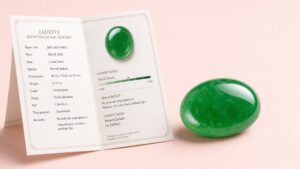
- Buying without confirming the material type and treatment status in writing.
Top Picks
Best for everyday wear: the Natural Jadeite Bracelet at $1008 offers a soft lavender-white hue and a comfortable elastic fit, ideal for daily wear.
Best for statement style: the Natural Ice-type Jadeite Bracelet with Floating Green Patterns at $1517 brings transparency and a substantial feel for those who want a focal piece.
Best for collectors: the Natural Ice-type Violet Jade Bead Necklace at $6649 is a premium strand for buyers seeking rarity and presence.
Best for gifting: the Natural Jadeite Tassel Earrings at $852 combine deep green jadeite with gold-plated chains for a refined, wearable gift.
Final Tips
Train your eye by comparing natural pieces in different styles and price points. Look for genuine vitreous luster, organic internal variation, and color that shifts naturally across the stone. Read every product description carefully and confirm the material and treatment status. For further reading, the eight essential tips for identifying natural A jade and the Burmese jade bracelet buying guide offer additional practical checks. With patience and a few in-person habits, spotting resin-coated fakes becomes far easier.
FAQ
What is jadeite Type A?
Jadeite Type A refers to natural jadeite that has not been bleached, resin-impregnated, or dyed. It is the untreated benchmark buyers look for when assessing authenticity and long-term value.
How can I spot a resin-coated fake in person?
Look for a superficial, plastic-like gloss, an oily film under strong light, and internal fractures that appear filled or cloudy. Natural jadeite usually shows a cool vitreous luster and organic internal variation.
Does a higher price guarantee natural jadeite?
No. Price reflects many factors, and you should always confirm the material and treatment status in the product description rather than assuming from cost alone.
How do I choose the right bracelet size?
Check the stated circumference against your wrist measurement. For example, the Natural Jadeite Bracelet has a circumference of about 18cm and is described as suitable for wrists of 16–19cm, while elastic designs are adjustable.