Introduction: Why Authenticity Matters
Chinese bronzes — from ancient ritual vessels to ornate scholar’s objects — are among the most coveted pieces in Asian antiques. Their deep history, intricate casting, and beautiful patina make them treasured additions to any collection. But with that demand comes a flood of modern reproductions, some so convincing that even seasoned collectors can be fooled.
This guide will walk you through seven telltale signs that a Chinese bronze is a modern fake. Whether you’re a first-time buyer or a seasoned collector, understanding these clues will help you make informed decisions and avoid costly mistakes. We’ll cover everything from patina and casting marks to weight and corrosion, giving you a practical checklist you can use when examining a piece.
Remember, while this guide is educational, for high-value pieces it’s always wise to seek a professional appraisal. For more on evaluating bronze, see our related article on spotting real vs. fake Chinese bronze patina.
Background: The Allure of Chinese Bronzes
A Brief History
Chinese bronze casting dates back over 3,000 years to the Shang and Zhou dynasties. These early vessels were used for ritual offerings and were symbols of power and prestige. The techniques developed during this period — piece-mold casting, intricate inlays, and detailed surface decoration — set a standard that later generations would strive to replicate.
Over the centuries, bronzes were also produced for daily use, religious purposes, and as works of art. The patina that develops over time — a natural layer of corrosion and oxidation — is one of the most valued characteristics of antique bronzes. It tells the story of the piece’s age and burial environment, and it’s the first thing experts examine.
Why Fakes Are So Common
The high value of authentic Chinese bronzes has created a thriving market for forgeries. Modern workshops use traditional techniques or advanced methods like lost-wax casting to produce pieces that mimic ancient styles. Some even artificially age their creations to fool buyers. As a result, learning to distinguish genuine antiques from modern reproductions is essential for anyone in the market.
For a deeper dive, check out our guide to identifying real Chinese bronze patina.
The 7 Signs Your Chinese Bronze Is a Modern Fake
1. Patina That Looks Painted or Uneven
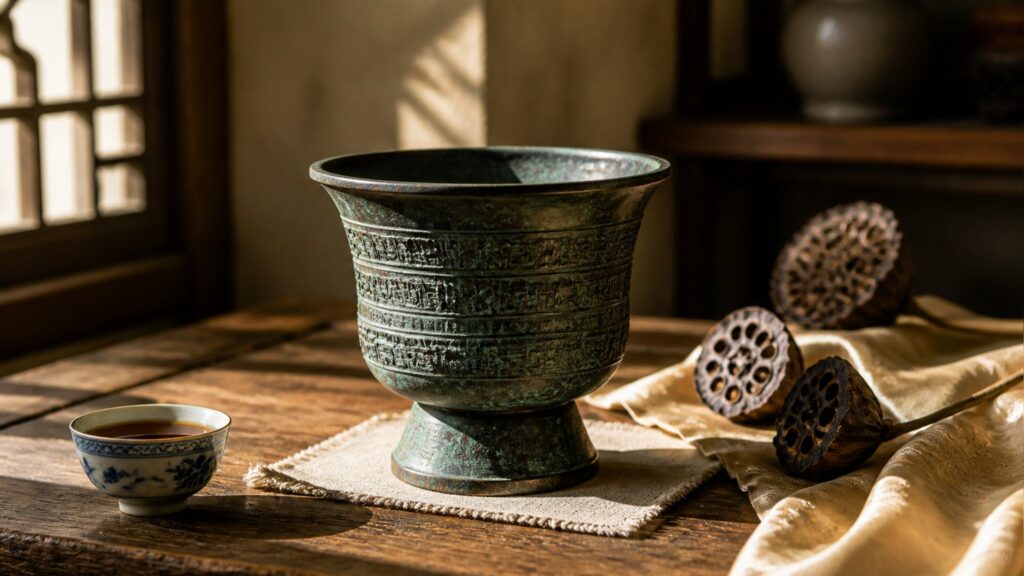
Genuine bronze patina develops over decades or centuries through natural oxidation. It’s usually uneven, with variations in color and depth, and it follows the contours of the object. Modern fakes often have a patina that looks too uniform or has been applied with paint or chemicals. According to Bob Atchison’s guide to bronze patinas, chemical patinas can be unpredictable, and a second application over the first may cause a reaction, ruining the piece. If the patina seems to sit on the surface rather than being part of the metal, it’s likely artificial.
Also, look for patina in recessed areas. On genuine bronzes, corrosion often collects in crevices and under rims. A fake might have patina only on the surface, with bare metal visible in the recesses.
2. Casting Marks That Are Too Clean or Too Rough
Ancient Chinese bronzes were cast using piece-mold techniques, leaving distinct seams and sprue marks. Modern fakes may be cast using lost-wax or sand casting, which leave different marks. On a genuine piece, casting lines are often sharp and may show signs of hand finishing. On a fake, they might be overly smooth or, conversely, too rough and unfinished.
Examine the interior of the vessel or the underside of a base. Genuine bronzes often have rough interiors with visible mold marks, while fakes may have smooth interiors from a different casting process. Look for evidence of tool marks that suggest the piece was filed or scraped after casting — a common practice on fakes to remove casting seams.
3. Inconsistent Lead Distribution
Ancient Chinese bronzes often contain lead, which aids in the casting process. The lead distribution in a genuine piece is typically uneven due to the primitive alloying methods. Modern reproductions, however, are often cast in electric furnaces using carefully controlled alloys, which can result in a more homogeneous distribution. This doesn’t mean all fakes are homogeneous, but inconsistent lead distribution is a strong indicator of age. As noted in discussions on authenticating archaic bronze, visual inspection alone is often insufficient; professional analysis can reveal alloy composition. If you suspect a piece, consider having a metallurgical test done.
4. Weight That Feels Wrong
Bronze is a heavy metal, and an authentic piece should feel substantial for its size. Modern fakes might be lighter if they’re made with a different alloy or have a hollow core. Conversely, some fakes are made of iron or other metals and then coated with bronze, making them heavier than expected. Pick up the piece and get a sense of its heft. Compare it to other bronzes you’ve handled or to known dimensions of similar pieces.
Also, tap the metal gently. A genuine bronze will ring with a clear, metallic tone, while a fake with a different composition might sound dull or tinny.
5. Corrosion That Is Too Localized or Too Perfect
Natural corrosion on ancient bronzes often appears in patches, with a crusty texture and a mix of green, blue, and red tones. It’s usually uneven and may be accompanied by pitting or flaking. On a fake, corrosion might be applied to look aged, but it often appears in unnatural patterns — for example, only on the outside of the piece, or in a perfect circle. Look for corrosion inside the piece as well; genuine pieces often have corrosion on the interior that matches the exterior.
According to expert clues for identifying antique Chinese bronze, genuine corrosion layers are often deep and integrated with the metal, while fake corrosion sits on the surface and can be scratched off.
6. Tool Marks That Reveal Modern Techniques
Ancient bronze casters used hand tools to finish their pieces, leaving behind specific marks. Modern fakes might show evidence of power tools, such as rotary sanders or electric drills, which leave distinct patterns. Look for uniform, parallel scratches that suggest machine finishing. Also, check for the use of modern cutting tools on the base or rim.
If you see tool marks that are too regular or too perfect, that’s a red flag. Genuine antique bronzes often have slight irregularities that reflect the hand-crafting process.
7. An Unnatural ‘Too Good to Be True’ Appearance
While this is a general collecting tip, it’s especially relevant for bronzes. A piece that looks almost perfect — with crisp details, no wear, and a beautiful patina — might be too good to be true. Ancient bronzes have naturally worn edges, scratches, and signs of use. A modern fake might be made to look perfect, but the details may be slightly off, such as an inscription that’s too sharp or a design that’s too symmetrical.
Trust your instincts. If a piece looks ‘brand new’ despite being claimed to be centuries old, it’s worth a closer look.
Practical Tips for Buyers
- Always ask for provenance or documentation. A reputable dealer should be able to provide some history or a certificate of authenticity.
- Bring a magnifying glass to examine surface details, tool marks, and patina up close.
- Compare the piece to known examples in museums or reference books.
- If the price seems too good to be true, it probably is. Genuine antique bronzes are valuable.
- Consider consulting a professional appraiser or a lab for metallurgical testing if you’re serious about a high-value piece.
- When in doubt, walk away. There will always be other opportunities.
Common Mistakes to Avoid
- Relying solely on visual inspection. As one expert notes in an authentication forum, ‘Visual inspection is for amateurs; data is for pros.’
- Assuming that a heavy piece is always genuine. Weight can be manipulated.
- Ignoring the interior of the piece. Many fakes are only finished on the outside.
- Being swayed by a dramatic patina. Fake patinas can be very convincing.
- Not doing research on the specific style or period before buying.
Conclusion / Key Takeaways
Identifying a modern Chinese bronze fake requires a keen eye and a good understanding of ancient casting techniques. By examining the patina, casting marks, lead distribution, weight, corrosion, tool marks, and overall appearance, you can significantly reduce your risk of buying a reproduction.
Remember, this guide is a starting point, not a definitive test. For valuable pieces, always seek professional advice. And if you’re looking to expand your collection, explore our range of Chinese antiques and jadeite jewelry — both curated for quality and authenticity.
Happy collecting!
FAQ
What is the most reliable sign of a fake Chinese bronze?
The most reliable sign is often the patina. Genuine patina is uneven, integrated with the metal, and may have a crusty texture. Fake patinas often look painted or sit on the surface. However, for absolute certainty, metallurgical testing is recommended.
Can a modern bronze be made to look antique?
Yes, modern workshops use chemical patinas, artificial corrosion, and aging techniques to make new bronzes look old. That’s why it’s important to look for other signs, such as tool marks, casting seams, and lead distribution.
Is it possible to authenticate a bronze without professional help?
You can use the signs in this guide as a preliminary check, but for high-value pieces, professional appraisal is strongly advised. Experts can perform metallurgical analysis and compare the piece to known examples.