Malachite: The Captivating Green Gemstone – A Complete Guide
How to distinguish real malachite from dyed imitations?
Introduction
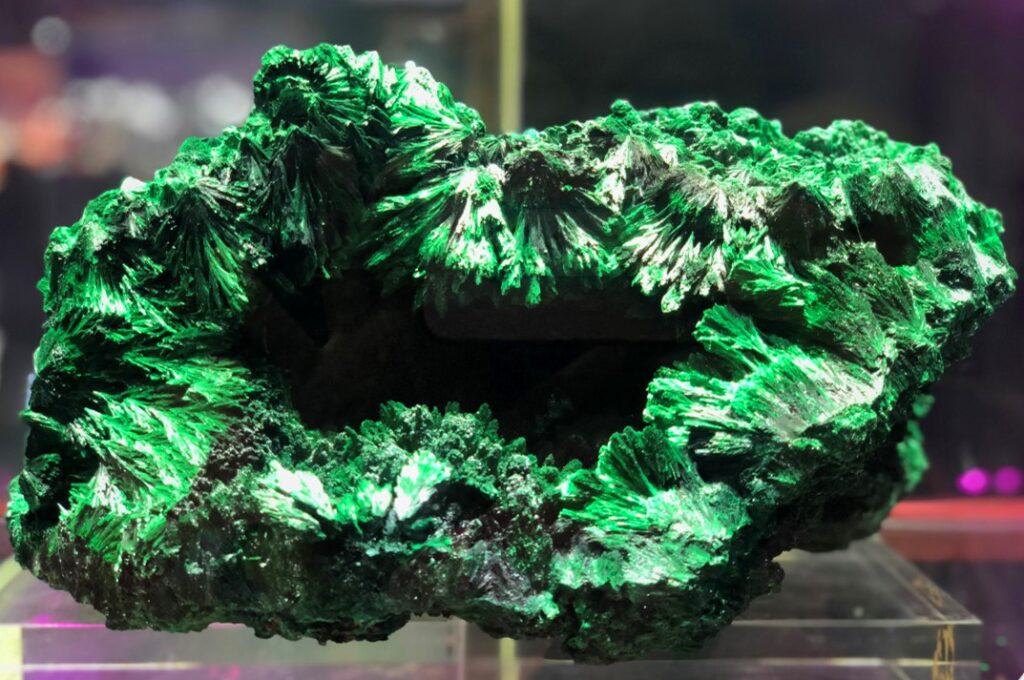
Malachite, known as ‘孔雀石’ (Kǒngquè Shí) in Chinese, is a striking copper carbonate mineral celebrated for its vivid green color and concentric banding. Its name comes from its resemblance to the iridescent feathers of peacocks. Historically called ‘綠青’ (Lǜqīng) or ‘石綠’ (Shílǜ) in ancient China, malachite has been used since the Neolithic period, with examples found at the Zhengzhou Luodamiao site (Longshan Culture, 3000–1900 BCE). Later artifacts from the Yin Ruins (Shang Dynasty) further highlight its deep-rooted significance in Chinese art and culture.
Physical and Chemical Properties
Malachite is a secondary copper mineral with the chemical formula Cu₂(CO₃)(OH)₂. Key characteristics include:
- Hardness: 3.5–4 on the Mohs scale (relatively soft).
- Density: 3.6–4.0 g/cm³.
- Luster: Vitreous to silky in fibrous varieties; dull in earthy forms.
- Structure: Monoclinic system, typically forming botryoidal (grape-like) or stalactitic aggregates with concentric bands.
- Transparency: Opaque, but may exhibit translucency at thin edges.
Color Varieties & Classification
Malachite’s rich green palette comes from its high copper content, with shades ranging from bright emerald to deep forest green. Its unique banding patterns arise from varying oxidation states during formation.
Types of Malachite
- Gem-Grade Malachite:
- Features: Dense, crack-free, with vivid alternating light/dark bands.
- Uses: Cabochons, beads, and high-end carvings.
- Azurite-Malachite (青孔雀石):
- Features: Intergrowths of deep blue azurite and green malachite.
- Value: Highly prized for contrasting colors.
- Silk-Malachite (貓眼孔雀石):
- Features: Fibrous structure that produces a cat’s-eye effect when polished.
- Pseudomorphs:
- Features: Replaces other minerals (e.g., cuprite), retaining their original shapes.
Grading Criteria (China)
- Premium: Uniform color, intricate banding, no cracks, >5 kg.
- Grade 1: Minor inclusions, clear patterns, >1 kg.
- Grade 2: Faint banding, small fissures.
- Grade 3: Pale color, porous texture (used for decorative stones).
Historical & Cultural Significance
- Ancient Egypt: Ground into eye shadow and amulets for protection.
- Imperial Russia: Lavishly decorated the Malachite Room in the Winter Palace.
- Chinese Art: Carved into scholar’s objects (e.g., brush holders) and deity statues during the Ming-Qing periods.
Global Sources
- China: Guangdong (Yangchun), Hubei (Tonglüshan).
- Others: Democratic Republic of Congo (richest deposits), Russia (Ural Mountains), Australia.
Craftsmanship & Modern Uses
Malachite’s softness demands careful handling:
- Carving: Large blocks are sculpted into vases, figurines, or tabletops.
- Jewelry: Often stabilized with resin for durability; set in silver to offset its bold color.
- Decorative Arts: Sliced into veneers for inlay work (e.g., Fabergé eggs).
Design Tips:
- Banding Emphasis: Carvers align motifs with natural stripes for dramatic effects.
- Azurite Pairing: Combines with lapis lazuli in ‘landscape’ jewelry.
Why Malachite?
- Aesthetic: Unmatched green intensity and organic patterns.
- Historical Weight: A bridge between ancient rituals and modern design.
- Metaphysical Lore: Believed to absorb negative energy (use with caution—toxic if powdered).
FAQ
How to distinguish real malachite from dyed imitations?
Real malachite feels cool to the touch, exhibits natural banding with soft transitions, and will not leave a green mark on unglazed porcelain. Dyed imitations often have unnaturally uniform color and may show dye concentrated in cracks. Always purchase from reputable sources like VirtuCasa.
Is malachite toxic?
Malachite contains copper carbonate and can be toxic if inhaled as dust or ingested. Avoid grinding or cutting it without protection. Polished malachite pieces are safe for handling and wear.
How to distinguish real malachite from dyed imitations? Explore malachite’s legacy at VirtuCasa.com.
- Jadeite: The King of Jade – A Complete Guide
- Turquoise: A Comprehensive Guide
- Serpentine Jade: A Comprehensive Introduction
- Dushan Jade: China’s Forgotten Gemstone
- Hetian Jade (Nephrite): The Imperial Gem of China
- Agate: Nature’s Kaleidoscope – A Complete Guide
- Malachite: The Captivating Green Gemstone – A Complete Guide
- Lapis Lazuli: The Celestial Stone – A Comprehensive Guide
- Quartzite Jade: A Guide to Earth’s Crystalline Treasures
- Lantian Jade: The Enigmatic Gem of Ancient China
- Rock Crystal: Nature’s Transparent Treasure – A Complete Guide
- Tourmaline: The Rainbow Gemstone – A Comprehensive Guide
- Ruby & Sapphire: The Royal Gemstones – A Complete Guide
- Peridot: The Sun-Kissed Gem – A Comprehensive Guide
- Topaz: The Fire Gem – A Complete Guide
- Jet: The Ancient Black Gem – A Comprehensive Guide
- Amber: The Golden Window to Prehistory – A Complete Guide
- Coral: The Ocean’s Sacred Jewel – A Comprehensive Guide
- Pearl: The Queen of Gems – A Comprehensive Guide