Amber: The Golden Window to Prehistory – A Complete Guide
How to test real amber vs. copal or plastic?
Introduction
Amber (琥珀 Hǔpò), known in ancient China as “Light Pearl” or “Beast’s Soul”, is fossilized tree resin that has captivated civilizations for millennia. Archaeological finds, such as Shang Dynasty (1600–1046 BCE) beads from Shanxi and Han Dynasty ornaments from Inner Mongolia, reveal its early use in rituals and adornments. The New Treatise on Curiosities (《新增格古要论》) poetically described it as “the essence of maple trees transformed over centuries.” Today, amber remains a beloved gemstone for collectors and jewelry enthusiasts alike, offering a tangible link to Earth’s distant past.
Physical & Chemical Properties
- Composition: C₁₀H₁₆O (succinic acid contributes to its “electrifying” static charge).
- Hardness: 2–2.5 on Mohs scale (so soft it can be scratched by a fingernail).
- Density: 1.05–1.10 g/cm³ (it floats in saltwater).
- Optical Traits:
- Refractive Index: 1.54 (similar to glass, but with a warmer luster).
- Fluorescence: Baltic amber glows blue under UV light.
- Unique Features:
- Inclusions: Preserved insects or gas bubbles (called “虫珀” Chóng pò).
- Aroma: A pine-like scent when heated (a classic authenticity test).
Color Varieties & Value
1. Golden Amber (金珀)
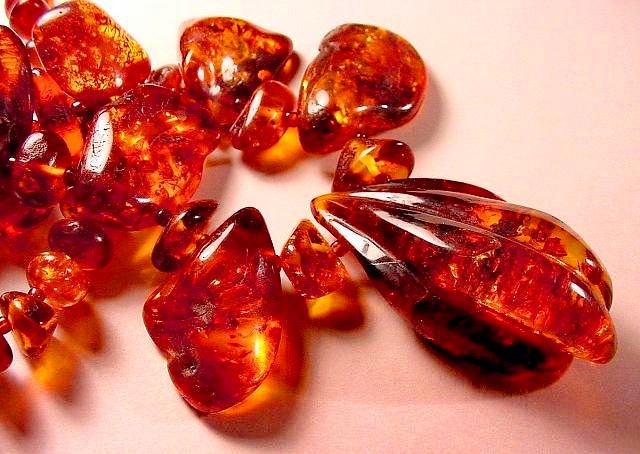
- Color: Transparent honey-yellow.
- Value: Highly prized in Chinese history (e.g., Liao Dynasty princess burial artifacts).
2. Cherry Amber (血珀)
- Color: Deep red (from surface oxidation).
- Rarity: Found in Myanmar’s Hukawng Valley.
3. White Amber (白珀)
- Color: Creamy and opaque (known as “royal amber” in Poland).
Grading Criteria:
- Clarity: Insect inclusions increase value if well-preserved.
- Size: Pieces larger than 50g that are carveable are rare.
Historical & Cultural Significance
- Ancient Trade:
- Silk Road: Baltic amber reached China as early as 200 BCE.
- Han Dynasty: Used in bi discs (璧) for afterlife protection.
- European Lore: Called “Northern Gold” by Vikings.
Global Sources
- Baltic Region: 90% of the world’s supply (45 million years old).
- China: Fushun coalfields yield insect-rich amber from the Eocene epoch.
- Notable Deposits:
- Dominican Republic (blue amber).
- Myanmar (red amber containing Cretaceous insects).
Craftsmanship & Modern Uses
- Carving:
- Traditional: Motifs like “lucky bats” (福 Fú) and cicadas (复活 Fùhuó).
- Modern: Laser-engraved pendants.
- Jewelry:
- Cabochons: Best for fragile pieces.
- Warning: Avoid alcohol and perfume to prevent cracking.
Did You Know?
Amber’s electrostatic property inspired the word “electricity” (Greek ēlektron).
Why Amber?
- Scientific Value: A time capsule for prehistoric ecosystems.
- Aesthetic Appeal: Warm glow unmatched by plastics.
- Cultural Resonance: A gemstone that bridges ancient traditions and modern elegance.
FAQ
How can you tell real amber from copal or plastic?
Real amber floats in saltwater (density ~1.08 g/cm³), produces a pine-like scent when heated, and feels warm to the touch. Copal, a younger resin, may soften in acetone, while plastic often drips or has a chemical odor. For a reliable test, consult a gemologist or use UV light—Baltic amber glows blue.
What is the most valuable color of amber?
Clear golden amber (金珀) has historically been prized in China, while deep red cherry amber (血珀) and rare blue amber from the Dominican Republic command high prices. White amber (白珀) is also highly valued for its creamy opacity.
How should I care for amber jewelry?
Amber is soft (Mohs 2–2.5) and can scratch easily. Store pieces away from other jewelry, avoid contact with alcohol, perfume, and heat, and clean with a soft cloth and mild soap. Never use ultrasonic cleaners.
Why does amber sometimes contain insects?
Insects became trapped in sticky tree resin millions of years ago. The resin hardened and fossilized, preserving the creatures in exquisite detail. These “虫珀” (insect amber) are prized by collectors for their scientific and aesthetic value.
How to test real amber vs. copal or plastic? Explore amber’s journey at VirtuCasa.com.
- Jadeite: The King of Jade – A Complete Guide
- Turquoise: A Comprehensive Guide
- Serpentine Jade: A Comprehensive Introduction
- Dushan Jade: China’s Forgotten Gemstone
- Hetian Jade (Nephrite): The Imperial Gem of China
- Agate: Nature’s Kaleidoscope – A Complete Guide
- Malachite: The Captivating Green Gemstone – A Complete Guide
- Lapis Lazuli: The Celestial Stone – A Comprehensive Guide
- Quartzite Jade: A Guide to Earth’s Crystalline Treasures
- Lantian Jade: The Enigmatic Gem of Ancient China
- Rock Crystal: Nature’s Transparent Treasure – A Complete Guide
- Tourmaline: The Rainbow Gemstone – A Comprehensive Guide
- Ruby & Sapphire: The Royal Gemstones – A Complete Guide
- Peridot: The Sun-Kissed Gem – A Comprehensive Guide
- Topaz: The Fire Gem – A Complete Guide
- Jet : The Ancient Black Gem – A Comprehensive Guide