Why a Jadeite Lab Report Deserves Your Attention
Buying jadeite is unlike buying most gemstones. Two stones can look nearly identical on a screen yet differ enormously in value, because the difference often lies in treatments that are invisible to the naked eye — polymer impregnation, dyeing, or a combination of both. A jadeite lab report is the document that tells you, in standardized language, what a gemological laboratory concluded about a stone after examining it with instruments rather than eyes alone. For a buyer shopping online, where you cannot hold the piece under different lights or weigh it in your hand, that document is one of your few objective anchors.
Yet many shoppers treat a lab report as a single yes-or-no stamp: certified or not certified. In reality these reports are structured documents with distinct fields, and each field answers a different question. The treatment classification tells you whether the jade is natural or altered. The color and transparency descriptions set expectations about appearance. The measurements and weight help you judge proportion and confirm identity. The lab’s identity and report number determine whether the document can be verified at all.
This guide walks through a typical jadeite report field by field, explains what each entry means, flags the details that deserve extra scrutiny, and shows how to connect what the paper says with what you see in photographs. By the end you should be able to read a report with the same calm, methodical eye a gemologist uses — and to ask better questions before you commit to a purchase.
Background: What a Jadeite Report Actually Is
Certification versus appraisal
It helps to separate two documents that are often confused. A gemological report, sometimes called a certificate, is an identification and disclosure document: it states what the material is and whether it has been treated. An appraisal is a valuation document that assigns a monetary figure, usually for insurance or resale purposes. As guidance on jade jewelry appraisal explains, a certified report gives potential buyers confidence in a stone’s authenticity, which is a different service from estimating what it is worth. When you are evaluating a purchase, the report is the more fundamental document.
The Type A, B, C framework
Most jadeite reports describe treatment using a letter system that has become standard in the trade. Type A refers to natural jadeite that has not been treated beyond traditional polishing — no bleaching, no polymer impregnation, no dye. Type B denotes jadeite that has been bleached and impregnated with resin to improve clarity and stability. Type C indicates dyed material, and B+C describes jadeite that has been both bleached, impregnated, and colored. This framework is the backbone of the report, and it is the first field you should locate. Our own explainer on Jadeite Type A vs treated resin-coated fakes covers the visual side of this distinction in more detail.
Why laboratories use instruments
Resin filling and dye are designed to be hard to spot. Laboratories use infrared spectroscopy to detect polymer residues, ultraviolet fluorescence to screen for dyes, and refractive index and specific gravity measurements to confirm the material’s identity. A report is essentially a summary of those tests. Understanding that the conclusions rest on instrument work — not opinion — is what gives the document its weight.
Reading the Report Field by Field
Header: laboratory name, report number, and date
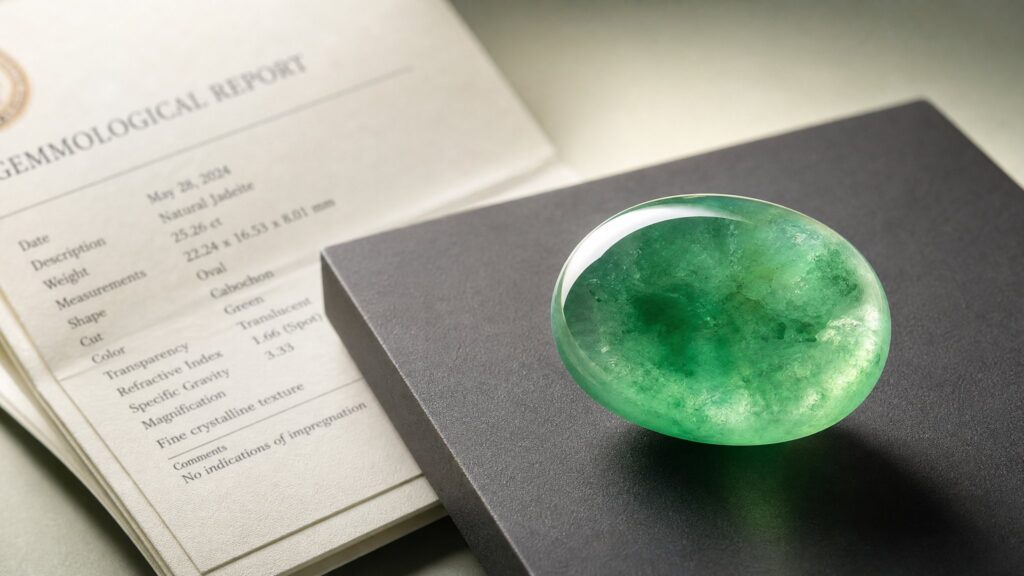
Start at the top. The laboratory’s name and logo tell you who is making the claim, and reputable labs publish verification tools on their websites. A comprehensive jade certification guide recommends a practical checklist for evaluating appraisal labs, beginning with whether the lab is independent and whether its reports can be checked online. The report number is your key: enter it on the lab’s site to confirm the document matches the stone. The issue date matters too — an older report may predate a re-polish or a re-setting, so ask whether the stone has been altered since.
Identification and treatment classification
This is the heart of the document. Look for an explicit statement of species — natural jadeite — followed by the treatment classification. Be careful with wording. Phrases such as ‘natural jadeite, Type A’ or ‘no evidence of treatment’ are what you want. Vague language like ‘jadeite’ without qualification, or ‘jade’ used as a broad term, tells you much less. A good explanation of certified jade notes that understanding how to interpret common information on jade reports is as important as having one, because the same words can carry different weight depending on how they are arranged.
Color, transparency, and cut descriptions
Reports typically describe color in trade terms — green, lavender, white, yellow — sometimes with modifiers for tone and saturation. Transparency is usually graded along a scale from opaque through translucent to transparent. Remember that these are descriptive categories, not value judgments; a report will not tell you a stone is ‘beautiful.’ It will tell you what the lab observed under controlled conditions. This is also where you should expect the report to differ slightly from photographs, since lighting changes how jadeite appears. Our article on jadeite color under different light explains why a bracelet can shift tone between daylight and indoor lamps.
Measurements, weight, and shape
Dimensions and carat or gram weight serve two purposes. First, they let you confirm that the report belongs to the exact stone you are considering — a mismatch in measurements is a red flag. Second, they help you judge proportion. A pendant’s thickness relative to its face, or a bracelet’s bead diameter, affects how the piece wears and how much material it contains. If you are comparing bracelets, our jadeite bead size and color matching guide explains how diameter and color consistency interact.
Photographs, remarks, and signatures
Most reports include a photograph of the stone, sometimes with a scale. Compare it carefully with the seller’s images. The remarks section may carry important caveats — for example, notes about minor surface features or the limits of testing on set stones. Finally, check for an authorized signature or seal. A report without one is difficult to verify and should be treated with caution.
Practical Tips for Using a Report Before You Buy
- Verify the report number directly on the laboratory’s website rather than relying on a screenshot supplied by the seller.
- Match the measurements and weight on the report to the listing; small discrepancies can indicate a different stone.
- Read the treatment field twice — look for the words ‘Type A’ or an explicit statement of no treatment, not just the word ‘certified.’
- Ask whether the report covers the stone only or the finished piece, since testing set jewelry can be more limited.
- Keep the report with your purchase records; it supports resale and insurance conversations later.
- Browse with a checklist in mind — our jadeite bracelet buying guide pairs well with a report when you are comparing several pieces.
Common Mistakes to Avoid
- Treating ‘certified’ as a synonym for ‘Type A’ — the certificate may confirm treatment rather than exclude it.
- Accepting a photocopy or screenshot without verifying the report number at the source.
- Ignoring the issue date and assuming the stone has not been altered since testing.
- Confusing an appraisal’s dollar figure with a gemological identification; they answer different questions.
- Over-reading color descriptions as quality grades rather than neutral observations.
- Skipping the remarks section, where important limitations are often disclosed.
Conclusion: A Report Is a Tool, Not a Verdict
A jadeite lab report is most useful when you read it as a structured set of answers rather than a single stamp of approval. The header tells you who is accountable and whether the document can be verified. The identification and treatment fields tell you what the material is and whether it has been altered. The descriptive fields set expectations about appearance, while measurements and photographs let you confirm identity. Read in that order, the report becomes a practical buying companion.
Combine the document with your own observation. Ask for additional photographs in natural light, compare proportions against the measurements, and let the report guide your questions rather than end them. Whether you are exploring natural jadeite jewelry or considering a piece from the Chinese antiques collection, a report you can read confidently is one of the best protections a remote buyer has.
FAQ
Does a jadeite lab report tell me what my jade is worth?
No. A gemological report identifies the material and discloses treatment; it does not assign a monetary value. Valuation is the job of a separate appraisal, usually prepared for insurance or resale purposes.
What does ‘Type A’ mean on a jadeite report?
Type A indicates natural jadeite that has not been bleached, polymer-impregnated, or dyed beyond traditional polishing. It is the classification most buyers look for when seeking untreated jade.
How can I check that a report is genuine?
Use the report number and the laboratory’s name to verify the document on the lab’s own website. Compare the photograph, measurements, and weight on the report with the piece being offered.
Why does the jade look different from the report photo?
Jadeite’s apparent color and transparency shift with lighting conditions. Reports describe observations under controlled conditions, while seller photos may use different light, so some variation is normal.