Why Jadeite Investment Deserves a Careful Look
Few gemstones carry as much cultural weight as jadeite. In Chinese tradition it symbolises purity, protection and longevity, and it has been carved, worn and collected for centuries. That deep cultural attachment, combined with limited supply of fine material, is why many buyers approach jadeite as more than jewellery — they see it as a store of value. If you are considering a jadeite investment, though, the subject rewards patience and precision rather than enthusiasm alone.
The phrase ‘jadeite investment’ can be misleading. Jadeite is not a financial instrument with a quoted price, a guaranteed yield or an easy exit. It is a physical, heterogeneous gemstone whose value depends on a long list of visible and measurable qualities — and on whether a buyer can verify what they are holding. Understanding those qualities is what separates a considered purchase from an expensive lesson.
This article explains what ‘Type A’ actually means, which characteristics collectors watch, how certification fits in, and where the real risks lie. By the end you should be able to judge a piece on its merits, ask better questions of any seller, and decide whether jadeite belongs in your collection on your own terms.
Background: The Fundamentals Behind Jadeite Value
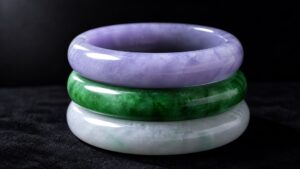
Jadeite is one of two minerals commonly called jade; the other, nephrite, is tougher but generally less translucent and less vividly coloured. Jadeite is a pyroxene mineral prized for its range of colours — from near-white through green, lavender, yellow and more — and for the glassy translucency that fine stones can show. It is also notably durable, which is part of why carved and polished jadeite survives across generations.
What ‘Type A’ Really Means
In the trade, jadeite is conventionally sorted into Type A, B and C categories. Type A refers to natural jadeite that has not been subjected to chemical bleaching or polymer impregnation; it may still have been cut and polished, which is normal for any gemstone. Type B usually denotes jadeite that has been bleached and impregnated with polymer to improve clarity, and Type C denotes dyed material. These are trade conventions rather than a single global statute, so the exact definitions can vary between laboratories. For a fuller breakdown of the categories, see our guide to Jade A, B, C grades explained.
Because treatments can be difficult to detect by eye, credible laboratories issue reports describing what they observed. The Gemological Institute of America (GIA), a widely respected authority, publishes educational material on jade and on the importance of disclosure and laboratory identification; you can review its GIA jade reference pages for background on the material and its treatments. Reading such material before you shop is one of the cheapest forms of due diligence available.
The Qualities Collectors Actually Watch
Experienced buyers tend to assess jadeite on several interlocking dimensions: colour (hue, saturation and evenness), translucency (often described in the trade as ‘water’), texture and grain, clarity, size, and the quality of the carving or setting. A stone can be superb in one dimension and ordinary in another. The point is that value is cumulative — a piece needs several strengths together, not one standout feature, to be considered fine.
The Main Body: How Type A Jade Earns and Keeps Its Standing
Why Untreated Material Commands a Premium
Type A jadeite occupies the top of the market largely because it is the material collectors regard as natural and stable. Treated stones may look attractive at first, but polymer fillings can change over time and dye can fade, and treated material generally resells at a steep discount. Buyers who care about long-term desirability therefore gravitate toward untreated stones. Our comparison of Type A versus treated jadeite walks through the practical differences.
It is worth being precise here: ‘natural’ does not mean ‘indestructible’. Even untreated jadeite can be affected by abrasion, harsh chemicals, sudden heat, impact and aggressive cleaning. A Type A bangle worn daily will gradually acquire surface wear. The realistic expectation is not that a stone looks identical decades later, but that its colour and structure have not been altered by artificial treatment at the outset.
Scarcity, Craftsmanship and Provenance
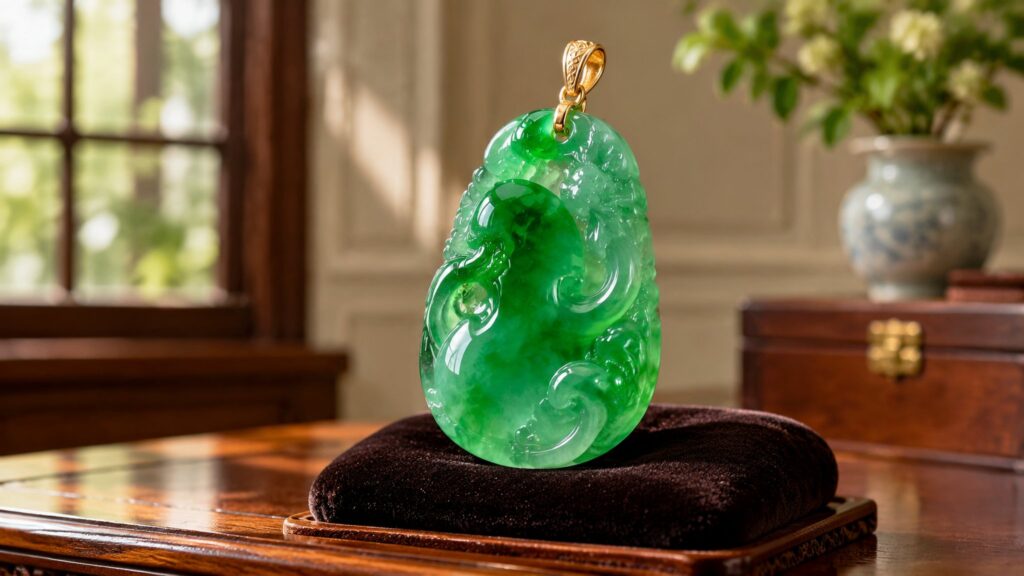
Fine jadeite is genuinely scarce. Material that combines strong colour, good translucency and clean texture is a small fraction of what is mined, and large, well-cut pieces are rarer still. Craftsmanship compounds this: a well-proportioned bangle, a finely carved pendant or a harmoniously matched necklace reflects skill that cannot be replicated by machine alone. Provenance — a documented history, a recognised report, or a distinguished collection — can add further confidence.
These factors explain why some pieces retain desirability across decades. They do not, however, guarantee appreciation. Scarcity supports value only when demand persists, and demand for jadeite is concentrated in particular cultural markets. Liquidity can be thin: selling a fine piece may take time, may require an auction house or specialist dealer, and may involve commissions. Anyone treating jadeite as an investment should assume they may hold it for years.
Certification and Report Reading
Certification is central to any serious jadeite purchase. A laboratory report should identify the stone, describe the testing performed and state whether treatment was detected. But a report is only as good as the laboratory that issued it and the care taken to match the report to the specific stone. Check the laboratory’s reputation, read the scope of the report, and confirm that the item in front of you corresponds to the item described. Our guide to spotting a fake jade certificate lists the red flags worth knowing.
It also helps to remember that Type A/B/C labels are conventional trade shorthand, not an international standard enforced identically everywhere. Two laboratories may describe similar material in slightly different language. What matters is the underlying observation — treated or not, dyed or not — and the credibility of the body making it.
Practical Tips for a Sounder Jadeite Purchase
- Buy the stone, not the story: assess colour, translucency, texture and clarity in person or through clear, well-lit, unedited photographs.
- Insist on a report from a recognised laboratory and verify it independently rather than relying on a photocopy.
- Compare several pieces at the same budget to calibrate your eye before committing.
- Consider how you will wear or store the piece; a jadeite bracelet worn daily will show wear differently from a pendant kept in a case.
- Keep purchase records, reports and photographs together so future buyers can verify the piece.
- Ask about the seller’s return policy and whether they will stand behind the described grade.
Common Mistakes to Avoid
- Assuming ‘Type A’ automatically means ‘investment grade’ — grading and investment potential are related but not identical.
- Treating any jadeite purchase as guaranteed to appreciate; markets can be illiquid and demand can shift.
- Buying on colour alone without checking translucency, texture and clarity.
- Accepting a certificate without confirming the laboratory’s reputation or that the report matches the stone.
- Ignoring care: heat, chemicals and knocks can damage even untreated jadeite.
- Overlooking the setting and craftsmanship, which affect both wearability and resale appeal.
Conclusion: Weighing Jadeite on Its Merits
Type A jadeite holds its standing in the market because it is natural, culturally resonant and genuinely scarce at the finest grades. Those qualities can support desirability over time, but they do not promise appreciation or easy resale. Certification, craftsmanship, condition and provenance all shape what a piece is worth — and so does the depth of the market when you eventually choose to sell.
The soundest approach is to buy what you love, verify what you buy, and treat any investment thesis as a secondary consideration. Explore our jadeite collection to see how these qualities present in real pieces, and keep learning — the more you understand the material, the better your judgment becomes.
FAQ
Is Type A jadeite a guaranteed investment?
No. Type A jadeite can retain desirability because it is natural and scarce at fine grades, but appreciation and liquidity are not guaranteed. Market demand, certification, craftsmanship, condition and provenance all affect resale.
What does Type A mean compared with Type B and C?
Type A generally refers to natural jadeite without chemical bleaching or polymer impregnation. Type B usually denotes bleached and polymer-impregnated material, and Type C denotes dyed jadeite. These are trade conventions, so definitions can vary between laboratories.
How important is a laboratory certificate?
Very important. A report from a recognised laboratory helps confirm whether treatment was detected. Check the laboratory’s reputation, read the report’s scope, and make sure it matches the specific stone you are buying.
Will untreated jadeite stay exactly the same over time?
Not necessarily. Even untreated jadeite can be affected by abrasion, harsh chemicals, heat, impact and cleaning practices. Careful wear and storage help preserve its appearance, but some surface wear is normal with daily use.