Why a Coordinated Jadeite Jewelry Set Matters
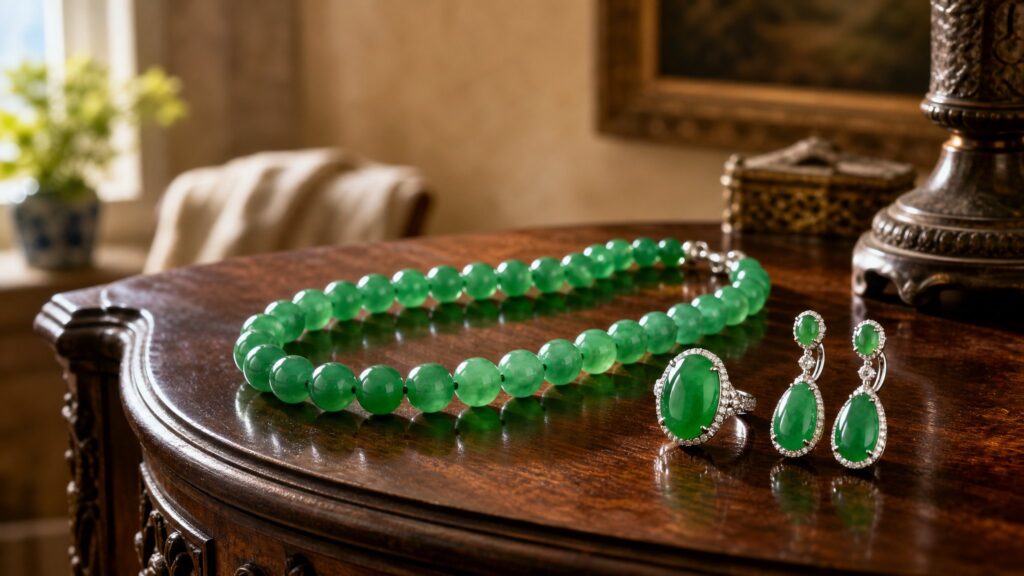
Jadeite has been treasured in Chinese culture for centuries, and its appeal has only grown as collectors and everyday wearers discover the remarkable range of colors and translucencies this stone can show. A coordinated set — necklace, ring, and earrings — lets you carry that beauty across an outfit with a sense of intention, rather than treating each piece as an isolated purchase. For buyers, the category is especially rewarding because jadeite’s natural variation means no two pieces are identical, and a well-chosen set can become a personal signature.
At VirtuCasa, the jadeite collection spans beaded bracelets, necklaces, saddle rings, and gem-set rings, each described with its own materials and measurements. This guide explains what to look for, how to match pieces across categories, and which current listings suit different wearers — without overstating what any single attribute can tell you about value.
Understanding Quality: The Factors That Matter
Jadeite quality is usually discussed in terms of color, texture, translucency, and treatment. The most important baseline is whether a piece is natural (often called Type A) jadeite, meaning it has not been bleached or polymer-impregnated. Reputable educational guides, such as this overview of how to evaluate quality and understand Type A jade, stress that treatment status should be confirmed before purchase. VirtuCasa’s listings describe each piece as natural jadeite, and the product pages give the details you need to compare.
Color and Color Distribution
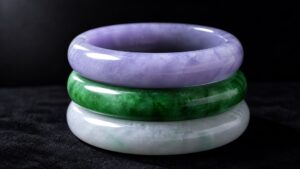
Color is often the first thing buyers notice. Jadeite ranges from near-white and lavender to deep green, and multicolor stones can show yellow, green, and orange in a single strand. What matters is evenness and harmony: a uniform lavender-white hue, as described for the Natural Jadeite Bracelet, reads very differently from the floating green patterns of an ice-type piece. Neither is inherently better; they suit different tastes and outfits.
Texture and Translucency
Texture describes how fine and smooth the stone feels, while translucency describes how light moves through it. Ice-type jadeite is prized for a transparent, glassy sheen, and several VirtuCasa pieces are explicitly described that way. A fine, compact texture with a glassy luster is generally considered desirable, but the right choice depends on whether you want a cool, ethereal look or a warmer, more opaque appearance.
Setting and Craftsmanship
Settings matter as much as the stone. Some pieces are strung simply on cord or elastic, keeping the focus entirely on the jade, while others combine jadeite with metal and gemstones. The Natural Ice-type Violet Jadeite Cabochon Ring Set with 18K White Gold, Sapphires, and Diamonds is a good example of a more formal approach, pairing an oval cabochon with a precious-metal setting. When buying online, look for clear descriptions of the setting and any metal plating, as these affect both look and care requirements.
Types & Styles: Finding Your Look
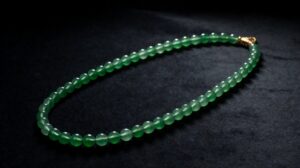
Beaded strands are the backbone of many jadeite collections. The Natural Ice-type Tricolor Jade Necklace uses 5.3 mm beads in yellow, green, and white, while the smaller Natural Ice-type Tricolor Jade Necklace uses 3.5 mm beads on a brown cord — a lighter, more delicate option. At the premium end, the Natural Ice-type Violet Jade Bead Necklace offers 68 beads in the 10–12 mm range for a substantial, luxurious presence.
Rings fall into two broad styles. Saddle rings are carved from a single piece of jadeite and have a classic, sculptural silhouette; the Natural Full-Green Jadeite Saddle Ring and the Natural Jadeite Saddle Ring with Floating Green both follow this tradition. Cabochon rings, by contrast, set a polished dome of jadeite into metal, as with the violet cabochon ring set. Earrings add movement: the Natural Jadeite Tassel Earrings pair deep green cylindrical beads with 18K gold-plated chains for a graceful swinging effect.
How to Choose the Right Size & Fit
Fit is where online jadeite buying most often goes wrong, so use the measurements on each listing. Bracelets are the clearest example: the Natural Jadeite Bracelet is composed of 19 round beads of approximately 10 mm each, forming a total circumference of about 18 cm and suited to wrists of 16–19 cm. The Natural Three-Color Jadeite Bracelet uses 16 spherical beads of approximately 12 mm on an adjustable elastic cord, while the Natural Ice-type Jadeite Bracelet with Floating Green Patterns uses 13 beads of 16 mm for a more substantial feel.
For rings, check the stated ring size rather than guessing. The full-green saddle ring is listed at size 24, the floating-green saddle ring at size 26, and the violet cabochon ring set at size 15. Because saddle rings rest on a curved top surface, fit can feel different from a standard band, so confirm your finger circumference before ordering. For necklaces, bead diameter and strand length together determine how a piece sits; smaller beads read as delicate and layer well, while larger beads make a stronger statement. Earrings are simpler: the tassel earrings are about 6 cm long and weigh 8 g for the pair, a light weight suited to extended wear.
Price & Value: What Drives Cost
Jadeite prices reflect a combination of color, translucency, texture, size, and craftsmanship. In the current VirtuCasa listings, entry-level pieces include the Natural Three-Color Jadeite Bracelet at $668, the Natural Ice-type Tricolor Jade Necklace at $740, and the Natural Jadeite Saddle Ring with Floating Green at $719. Mid-range options include the Natural Ice-type Tricolor Jade Necklace at $825, the Natural Jadeite Tassel Earrings at $852, the Natural Jadeite Bracelet at $1008, and the Natural Ice-type Jadeite Bracelet with Floating Green Patterns at $1517.
Premium pieces include the Natural Ice-type Violet Jadeite Cabochon Ring Set with 18K White Gold, Sapphires, and Diamonds at $1926, the Natural Full-Green Jadeite Saddle Ring at $2437, and the Natural Ice-type Violet Jade Bead Necklace at $6649. Note that a larger bead does not automatically mean a higher price — the $668 three-color bracelet uses larger beads than the $1008 lavender bracelet, yet costs less, because color, translucency, and overall quality also play a role. Value is best judged by comparing the full description of each piece rather than by any single measurement.
Common Mistakes to Avoid
- Assuming treatment status: confirm that a piece is described as natural jadeite before buying.
- Buying a ring or bracelet without checking the stated size and fit range.
- Judging value by bead diameter alone — color, translucency, and craftsmanship matter just as much.
- Ignoring the setting: metal plating and gemstone accents affect both appearance and care.
- Matching pieces by color only, without considering scale and how the set will be worn together.
Top Picks for a Coordinated Set
For a soft, everyday set, start with the Natural Jadeite Bracelet at $1008. Its lavender-white hue and gentle vitreous luster pair naturally with the Natural Ice-type Violet Jade Bead Necklace at $6649, which carries a similar cool, ethereal tone in a far more substantial format. This combination suits buyers who want a cohesive, understated look and are comfortable investing at the premium end for the necklace.
For a multicolor theme, the Natural Ice-type Tricolor Jade Necklace at $825 works well with the Natural Three-Color Jadeite Bracelet at $668, since both share yellow, green, and white tones. Add the Natural Jadeite Tassel Earrings at $852 for a deep green accent that echoes the green in both pieces. This set suits wearers who prefer variety and a slightly more casual, layered style.
For a formal set, the Natural Ice-type Violet Jadeite Cabochon Ring Set with 18K White Gold, Sapphires, and Diamonds at $1926 anchors the look, paired with the Natural Ice-type Violet Jade Bead Necklace at $6649 and the tassel earrings at $852. This suits buyers dressing for occasions who want jadeite with a precious-metal finish. For a traditional, sculptural set, the Natural Full-Green Jadeite Saddle Ring at $2437 pairs well with the deep green tassel earrings and a green-accented strand.
Final Tips and Conclusion
Buying a jadeite jewelry set is a matter of matching color families, scale, and setting style while respecting your own fit measurements. Read each listing carefully, compare the full description rather than a single number, and build your set around one anchor piece — often the necklace or the ring. For further guidance on identifying natural jade and avoiding common pitfalls, see these eight expert tips for buying jade online and this guide to jade necklace significance and styling. With patience and careful comparison, a coordinated set becomes more than jewelry — it becomes a lasting part of your wardrobe.
FAQ
What does ‘natural jadeite’ mean on these listings?
VirtuCasa describes each piece as natural jadeite, meaning the stone has not been bleached or polymer-impregnated. Always confirm treatment status before purchasing, and compare the full product description.
How do I choose the right bracelet size?
Check the stated circumference and bead count. For example, the Natural Jadeite Bracelet has 19 beads of about 10 mm and a total circumference of about 18 cm, suited to wrists of 16–19 cm. Adjustable elastic-cord bracelets fit most wrist sizes.
Does a larger bead always mean a higher price?
No. The $668 Natural Three-Color Jadeite Bracelet uses larger beads than the $1008 Natural Jadeite Bracelet, but costs less because color, translucency, texture, and craftsmanship also affect value.
Can I build a set from different price tiers?
Yes. Many buyers pair an entry-level bracelet with a mid-range necklace or earrings, or anchor a set with a premium ring. Matching color family and scale matters more than matching price.