Why the Jadeite Ring Choice Matters
A jadeite ring is one of the most personal purchases in the world of jade. Unlike a bracelet or necklace, a ring sits in constant view, moving with your hand and catching light from every angle. That means the style you choose — and the quality of the stone itself — shapes not only how the piece looks, but how often you reach for it. Two of the most enduring forms are the saddle ring and the cabochon ring, and each offers a very different experience of the same beloved gem.
Jadeite is prized for its toughness, its range of color, and its cultural weight, particularly in Chinese and broader East Asian traditions. Buyers today approach it with a mix of aesthetic instinct and hard questions: Is it natural? Is the color even? Does the setting suit the stone? Understanding the difference between a traditional saddle ring and a modern cabochon ring is a practical starting point, because the two forms highlight entirely different qualities of the material.
This guide walks through the quality factors that apply to any jadeite ring, then compares the saddle and cabochon styles directly. Along the way we reference real pieces from the VirtuCasa jadeite collection so you can see how these ideas play out in actual jewelry. Whether you are buying your first jadeite ring or adding to a considered collection, the goal is the same: a piece you understand and enjoy for years.
Understanding Jadeite Quality
Before style enters the picture, quality decides value. Most reputable guidance converges on a few core factors, and gemological authorities such as the GIA’s jade quality factors note that color, clarity, cut, and treatment are assessed together rather than in isolation. For a ring, where the stone is small and closely examined, these factors are magnified.
Treatment: Type A, B, and C
The single most important question is whether the jadeite is Type A — natural and untreated — or has been bleached, polymer-impregnated, or dyed. As explained in educational buying guides on identifying natural A-jade, untreated stone commands a premium because its color and texture are stable and genuine. VirtuCasa pieces are described as natural jadeite, which is the baseline you should insist on.
Color and Hue Saturation
Color is the most visible driver of price. “Full green” with even, dense saturation is the classic ideal, while lavender, violet, and three-color combinations each have their own devoted following. What matters is evenness and liveliness: a color that looks flat or patchy under different lights is less desirable than one that glows consistently.
Clarity, Texture, and Translucency
Jadeite ranges from opaque to highly translucent. “Ice-type” describes a notably transparent, fine-textured material with a cool, glassy sheen. Internal patterns — floating green, cotton-like inclusions, or natural color banding — are not automatically flaws; in the right piece they become character. The key is that the texture reads fine and smooth rather than coarse or cloudy.
Cut and Polish
For rings, cut means the shape of the stone and the quality of its finish. A well-polished surface should show a bright, even luster. Saddle rings and cabochons are cut differently, and each demands a different kind of craftsmanship, which we explore next.
Types & Styles: Saddle vs Cabochon
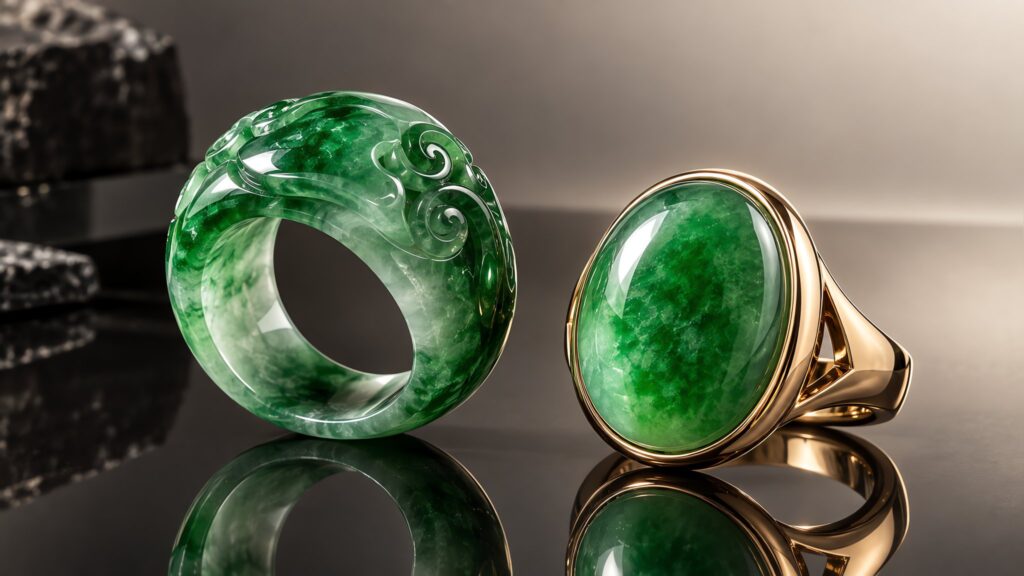
The saddle ring is a traditional form in which the jadeite is carved as a curved, arched band — the “saddle” — that rests across the finger. It is often carved from a single piece of jadeite with no separate setting, and its appeal lies in simplicity and the way the curve follows the hand. A strong example is the Natural Full-Green Jadeite Saddle Ring, which uses an even full-green coloration with a warm vitreous sheen. For a different mood, the Natural Jadeite Saddle Ring with Floating Green shows green patches drifting across a lighter base, a pattern that makes each piece unique.
The cabochon ring takes a different approach. Here the jadeite is cut into a smooth, domed oval and set into metal, often accented with other stones. This style is more overtly jewelry-like and can be dressed up or down. The Natural Ice-type Violet Jadeite Cabochon Ring Set with 18K White Gold, Sapphires, and Diamonds illustrates the form at its most refined: a vivid violet cabochon with excellent transparency, framed by white gold and gem accents.
The practical difference comes down to how the stone meets the world. A saddle ring is essentially all jade — the stone is the structure. A cabochon ring uses metal and side stones to frame and elevate the jade. Neither is inherently better; they simply suit different tastes and occasions. Traditionalists often favor the saddle for its purity and cultural continuity, while buyers who want a more contemporary, gem-set look gravitate to the cabochon.
How to Choose the Right Size & Fit
Fit is where ring buying gets practical. Saddle rings are typically sized by ring size, and because the band is carved rather than adjustable, getting the measurement right matters. The Natural Full-Green Jadeite Saddle Ring is listed at 24-ring size, while the Natural Jadeite Saddle Ring with Floating Green is listed at 26 ring size — a reminder that saddle rings come in specific sizes you should match to your finger rather than assume.
Cabochon rings are also sized, and the Violet Jadeite Cabochon Ring Set is listed at 15 ring size. Because a cabochon sits on a metal band, it can sometimes be resized by a jeweler, though this depends on the setting; a saddle ring carved from a single piece of jade generally cannot be resized at all. That single fact should shape your decision: if your finger size fluctuates or you are buying as a gift without a confirmed measurement, a cabochon with a resizable band may be the safer route, while a saddle ring rewards buyers who know their size.
Comfort is the other half of fit. A saddle ring’s curved top is designed to rest naturally on the finger, distributing contact across a wider area. A cabochon ring’s domed stone sits higher, which some wearers love for its presence and others find more prone to catching. Try to handle both forms if you can, or at minimum consider how you use your hands daily — a low-profile saddle often suits active wear better than a tall cabochon.
Price & Value: What Drives Cost
Jadeite ring prices reflect the stone far more than the metal. Treatment status, color saturation, translucency, and size of the jadeite all push cost up or down, and the two styles we are comparing sit at different points on that scale. In the VirtuCasa collection, the Natural Jadeite Saddle Ring with Floating Green is listed at $719, while the Natural Full-Green Jadeite Saddle Ring is listed at $2437 — a clear illustration of how much even, saturated full-green color adds. The Violet Jadeite Cabochon Ring Set, with its ice-type transparency and 18K white gold, sapphire, and diamond setting, is listed at $1926.
It helps to see these rings alongside other jadeite forms to calibrate value. A Natural Jadeite Bracelet is listed at $1008, a Natural Three-Color Jadeite Bracelet at $668, and a Natural Ice-type Jadeite Bracelet with Floating Green Patterns at $1517. At the higher end, a Natural Ice-type Violet Jade Bead Necklace is listed at $6649, showing how rare, highly translucent violet material scales in price. These comparisons reinforce a simple point: you are paying for the stone’s natural quality, not the style label.
When weighing a saddle ring against a cabochon ring, ask what your budget is really buying. A modest saddle ring may offer a larger, purer expanse of jade for the money, since there is no metal or accent stones to pay for. A cabochon ring at a similar price may have a smaller jadeite element but adds craftsmanship and gem accents. Neither is a better deal in the abstract — it depends on whether you value jade volume or a more elaborate setting.
Common Mistakes to Avoid
- Buying without confirming the jadeite is natural and untreated, rather than accepting vague descriptions.
- Choosing a saddle ring in the wrong size, forgetting that a single-piece carved ring usually cannot be resized.
- Judging color from a single photo or one lighting condition instead of checking how it reads in different light.
- Assuming a higher price automatically means better style fit — a $719 saddle ring may suit you better than a $2437 one if the color speaks to you.
- Overlooking the setting: a cabochon’s metal and accent stones should complement the jade, not compete with it.
- Ignoring wearability — a tall cabochon can catch on clothing, while a low saddle may feel different than expected.
- Rushing a gift purchase without a confirmed ring size, which is a common and costly error.
Top Picks
For traditionalists who want pure jade: the Natural Full-Green Jadeite Saddle Ring at $2437 suits buyers who prize even, saturated green and a classic single-piece carved form. Its 24-ring size and full-green coloration make it a statement piece for someone who knows their size.
For a more approachable saddle ring: the Natural Jadeite Saddle Ring with Floating Green at $719 is a strong entry into the style, with green patches drifting across a light base. At 26 ring size, it suits wearers who want a distinctive, natural pattern without the full-green premium.
For a modern, gem-set look: the Natural Ice-type Violet Jadeite Cabochon Ring Set with 18K White Gold, Sapphires, and Diamonds at $1926 is ideal for someone who wants a refined, contemporary ring. Its vivid violet cabochon and 15 ring size make it a natural choice for dressier occasions.
For coordinating with other jadeite: if you are building a set, pair your ring with a Natural Jadeite Bracelet at $1008 or a Natural Three-Color Jadeite Bracelet at $668. A matched palette across ring and bracelet creates a cohesive look that reads as intentional rather than accidental.
Final Tips
Choosing between a jadeite saddle ring and a cabochon ring is ultimately a question of how you want to wear jade. The saddle ring honors tradition, puts the stone front and center, and rewards buyers who know their size. The cabochon ring brings metal, accent stones, and a more contemporary silhouette, and it often offers more flexibility in fit. Both can be excellent, provided the jadeite itself is natural and well chosen.
Before you buy, confirm treatment status, study the color in more than one light, and be honest about your ring size. Compare pieces side by side — as guides on assessing jade quality and craftsmanship suggest, the more you compare, the clearer the differences become. With those habits, you will choose a ring that fits your hand, your taste, and your budget — and that you will still be glad to wear years from now.
FAQ
Is a jadeite saddle ring or a cabochon ring better?
Neither is universally better. A saddle ring is carved from a single piece of jadeite and highlights the stone itself, while a cabochon ring sets a domed jadeite in metal, often with accent stones. Choose the saddle for a traditional, all-jade look and the cabochon for a more contemporary, gem-set style.
Can a jadeite saddle ring be resized?
Generally no. A saddle ring carved from a single piece of jadeite cannot be resized, which is why matching your ring size matters. Cabochon rings with metal bands may sometimes be resizable depending on the setting, so confirm with the seller before purchase.
What should I check before buying any jadeite ring?
Confirm the jadeite is natural and untreated, examine the color under more than one type of light, check the texture and translucency, and verify your ring size. These factors affect both value and how the ring will look and feel in daily wear.
How much do jadeite rings cost at VirtuCasa?
Prices depend on the stone’s quality and the style. In the VirtuCasa collection, the Natural Jadeite Saddle Ring with Floating Green is listed at $719, the Violet Jadeite Cabochon Ring Set at $1926, and the Natural Full-Green Jadeite Saddle Ring at $2437.