Why Jade in Chinese Culture Still Matters Today
Few materials carry as much cultural weight as jade. In China, it has been valued for thousands of years not merely as a beautiful stone but as a physical embodiment of virtue, status, and spiritual protection. For anyone shopping for jadeite jewelry or collecting Chinese antiques, understanding this background transforms a purchase from a purely aesthetic decision into a richer, more informed one.
This article explains what jade has symbolized across Chinese history, how those meanings show up in the shapes and colors of modern jewelry, and how to apply that knowledge when you are evaluating a piece. You will learn the difference between the two minerals commonly called jade, why certain forms and motifs recur, and the practical questions to ask before you buy. Along the way we will point to reliable references so you can verify claims independently.
Whether you are drawn to a carved pendant, a bangle, or an antique object, the goal is the same: to recognize quality and authenticity with confidence rather than guesswork.
Background and Key Concepts
Two Minerals, One Name
What English speakers call “jade” actually refers to two distinct minerals: nephrite and jadeite. Nephrite is the softer, more historically widespread material used in ancient Chinese carving, while jadeite is harder, denser, and prized for the vivid greens and other colors it can display. Much of the jadeite in the market today is associated with sources outside China, yet it is deeply embedded in Chinese jewelry traditions.
This distinction matters because the two behave differently in terms of durability, color range, and value. Understanding it is the first step toward reading any label or certificate accurately. For a deeper comparison of the treatment categories you will encounter, see our guide to Type A vs B vs C jade and what those labels really mean.
Jade as a Symbol of Virtue
In Chinese thought, jade was associated with moral qualities — harmony, respect, integrity, and cultural continuity. As one educational overview notes, jade in Chinese culture has long been linked with virtue, harmony, respect, and cultural heritage. This is why jade was worn by scholars and officials, not only by the wealthy: it was a statement of character as much as of taste.
Jade and Imperial Power
Jade also served as an instrument of authority. According to the gemological institution Gem-A, jade tablets called gui were used by the emperor in rituals and became a symbol of power when worn. Over centuries, jade became intertwined with the court, ritual, and the idea of legitimate rule. If you are curious how this hierarchy played out, our article on why Chinese emperors valued jade above gold explores the theme in detail.
The Main Body: Reading Symbolism, Meaning, and Quality
Color and What It Communicates
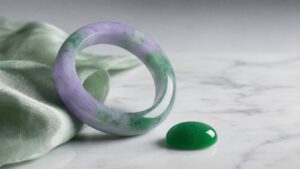
Color is one of the most emotionally loaded features of jadeite. Green is the most famous, ranging from pale mint to deep, saturated tones, but lavender, white, red, yellow, and near-colorless material also appear. In traditional Chinese associations, green is often tied to vitality and prosperity, while lavender is admired for its softer, more subtle character.
Importantly, color and clarity interact. A stone with striking color but heavy internal inclusions may be less desirable than a quieter stone with a clean, translucent body. Our explainer on jadeite bracelet color versus clarity walks through how buyers weigh these two factors against each other.
Forms, Motifs, and Their Meanings
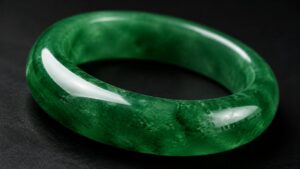
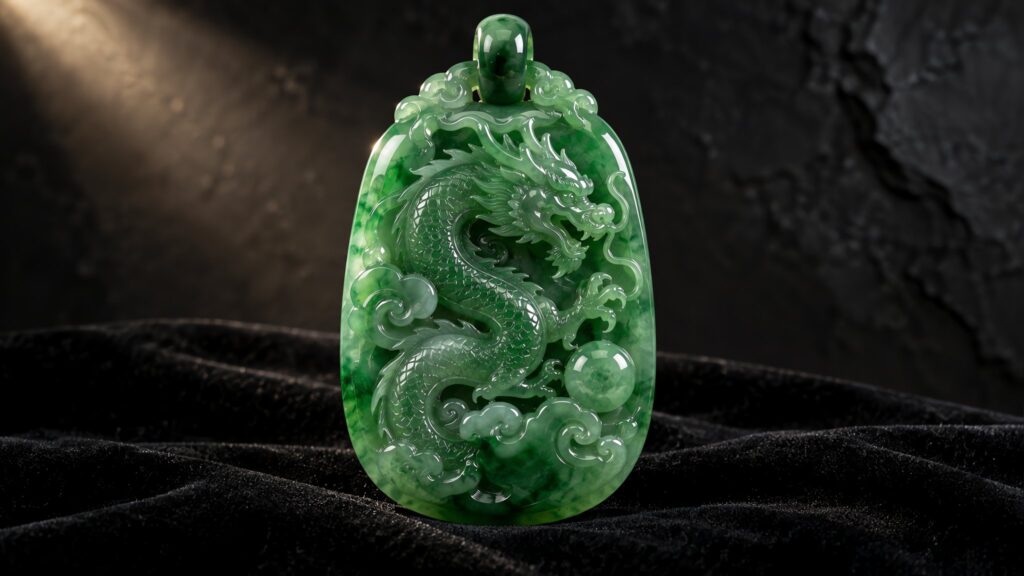
Carved motifs carry specific meanings. The bangle, or bangle bracelet, is perhaps the most traditional form, often given as a gift to mark milestones and worn as a protective talisman. Pendants may feature the Buddha, coins, gourds, or floral designs, each with its own symbolism. A pendant shaped like a magnolia, for example, evokes purity and resilience; you can read more in our guide to magnolia jadeite pendant meaning and buying tips.
When evaluating a carved piece, look at how well the carving uses the natural color of the stone — a skilled carver will “release” the best color into the most visible part of the design. Rough, mechanical carving that ignores the stone’s natural patterning is a sign of lower craftsmanship.
Treatments, Grades, and Certification
Because demand is high, the market includes treated and imitation material. Type A refers to jadeite that has not been chemically bleached or dyed (beyond polishing), while Type B and Type C involve treatments. These categories are described in more detail in our articles on Jade Grade A vs B vs C and on verifying Type A jadeite with lab reports and tests.
A credible lab report from a recognized testing laboratory is the single most useful document when buying. Learn how to scrutinize it using our checklist on how to verify a jade certificate is real. Reputable sellers provide certificates and are transparent about origin and treatment.
Practical Tips for Buyers and Collectors
Use these guidelines to make sound decisions whether you are buying new jewelry or evaluating an antique object.
- Start with the certificate. Confirm the laboratory is recognized and that the report states “natural jadeite” or “Type A” where applicable. Cross-check the item’s weight and dimensions against the report.
- Examine in natural light. Color can look dramatically different under warm indoor lighting versus daylight. Ask for photos or video taken in daylight.
- Feel the surface. Jadeite is cool to the touch and feels dense. Imitations such as glass or plastic often feel lighter or warmer.
- Look at the carving. Fine, deliberate carving that follows the stone’s natural color suggests higher quality than rushed, uniform work.
- Ask about treatments. A seller who can explain Type A, B, and C clearly is more likely to be trustworthy than one who avoids the question.
- For antiques, verify provenance and construction details. Our guide to signs a Chinese bronze is antique illustrates the kind of detail-oriented inspection that applies across antique categories.
Common Mistakes to Avoid
- Buying on color alone. Vivid color with heavy inclusions or treatment is not the same as fine natural material. Balance color against clarity and treatment status.
- Ignoring the difference between nephrite and jadeite. They are different minerals with different properties and markets; a label that simply says “jade” may be imprecise.
- Trusting a certificate without checking it. Verify the laboratory and the report details rather than assuming any document is valid.
- Assuming all green stones are jade. Other green materials can resemble jadeite; testing is the only reliable way to confirm identity.
- Overlooking cultural context. Motifs and forms carry meanings that affect desirability and gifting etiquette, so understand what a piece represents.
- Rushing a high-value purchase. Take time to compare, ask questions, and request additional images before committing.
Conclusion and Key Takeaways
Jade in Chinese culture is far more than a decorative stone. It represents virtue, harmony, and continuity, and it has served as a marker of imperial authority and personal protection for millennia. That layered history is precisely why jadeite jewelry and Chinese antiques remain so compelling to collectors and gift-givers today.
The practical takeaway is straightforward: appreciate the symbolism, but buy with evidence. Understand the difference between nephrite and jadeite, learn the treatment categories, insist on a verifiable lab report, and evaluate craftsmanship in good light. When you combine cultural literacy with careful verification, you can choose pieces you will value for years.
Ready to explore further? Browse our curated collections of natural jadeite jewelry and Chinese antiques, and use the guides linked throughout this article to make a confident, well-informed choice.
FAQ
What does jade symbolize in Chinese culture?
Jade has long been associated with virtue, harmony, respect, and cultural heritage in Chinese culture, and it has also served as a symbol of power and ritual authority. It is traditionally worn for protection and good fortune.
Is jadeite the same as nephrite?
No. They are two different minerals both commonly called jade. Nephrite is softer and historically widespread in ancient Chinese carving, while jadeite is harder and denser and is prized for its vivid colors.
How can I tell if jadeite is natural or treated?
The most reliable method is a lab report from a recognized testing laboratory that states whether the material is natural (Type A) or has been treated. You can also ask the seller directly about treatments and examine the stone in natural light.
Why is a certificate important when buying jade?
A certificate from a reputable laboratory confirms the identity and treatment status of the stone, which directly affects value. You should verify the laboratory and check that the report details match the item you are buying.