Why Ice-Type Jadeite Bracelets Deserve a Buyer’s Attention
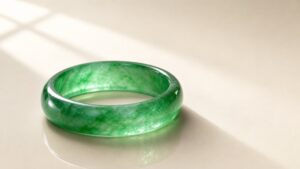
Among all the forms of jadeite jewelry, the ice-type jadeite bracelet occupies a special place. Its name describes the material’s defining quality: a translucent, cool, glassy character that lets light travel through the stone, creating a luminous depth that opaque jade simply cannot match. When that icy base is interrupted by drifting patches of green — the phenomenon known as floating green — the result is a piece that feels alive, with color that seems to move beneath the surface as the light changes. For buyers, this combination of transparency and natural pattern is one of the most compelling reasons to invest in jadeite.
Understanding what you are looking at matters, because jadeite quality varies enormously. Two bracelets of similar size can differ dramatically in clarity, color saturation, and internal structure, and those differences drive both beauty and value. A knowledgeable buyer who can read the signs of natural, untreated jadeite — and who understands how floating green is evaluated — is far less likely to overpay or to be disappointed after purchase.
This guide walks through the quality factors that define a superior ice-type jadeite bracelet, the styles available, how to choose the right fit, and what actually drives price. You can browse the full range of natural jadeite jewelry to see these principles applied to real pieces.
Understanding Quality in Ice-Type Jadeite
When evaluating any jadeite, gemologists and experienced dealers look at several interacting factors rather than a single number. The most authoritative framework comes from the Gemological Institute of America, whose jadeite jade quality factors explain how color, clarity, and cutting decisions combine to determine a stone’s desirability. For ice-type material specifically, transparency is the headline quality, but it must be paired with the right internal structure.
Transparency and the Icy Sheen
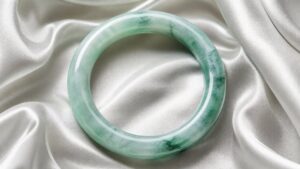
The term ice-type refers to jadeite whose texture is fine enough and whose internal grains are aligned closely enough that light passes through with relatively little scattering. The best examples present a cool, lustrous, glassy sheen — often described as crystalline — rather than a flat, milky opacity. When you hold such a piece to the light, you should sense depth and a subtle glow, not a cloudy blur. This transparency is what allows floating green patterns to appear suspended within the stone rather than painted on its surface.
Floating Green Patterns
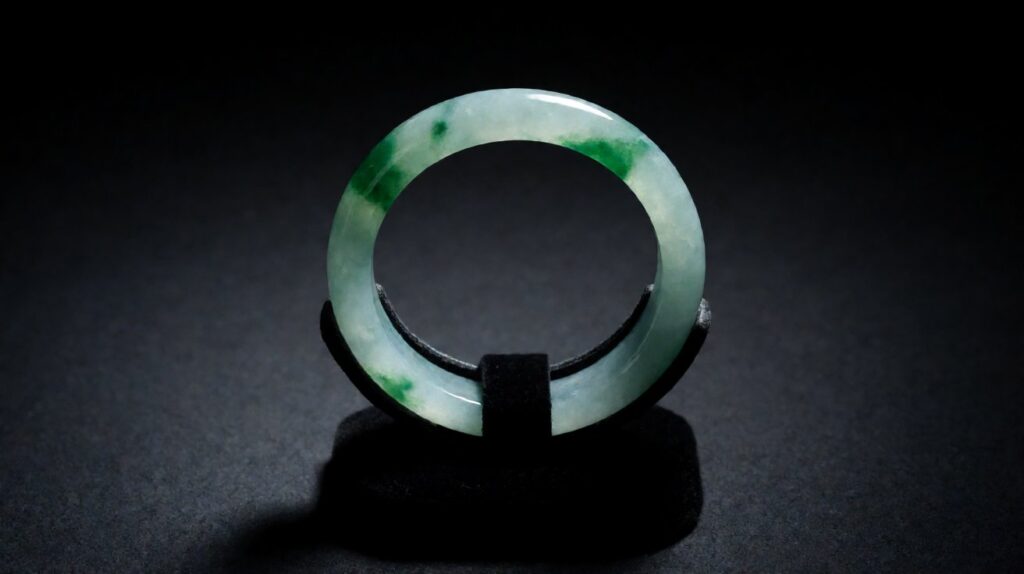
Floating green describes patches or veins of green color that drift across a lighter, more transparent base. The appeal is aesthetic and structural at once: the green appears to float because the surrounding ice-type material is clear enough to create that illusion of depth. Quality here is judged by how naturally the color integrates with the base, whether the green is vivid or muted, and whether the pattern feels harmonious rather than blotchy. A bracelet with well-distributed floating green across its beads is generally more desirable than one where color is concentrated in a single spot.
Type A, B, and C: Treatment Matters
One of the most important distinctions in jadeite is whether the stone is Type A (untreated), Type B (bleach-and-polymer treated), or Type C (dyed). As reputable buying guides explain, Type A untreated jadeite is the standard for collectors and long-term value, because treatments can fade, alter over time, or mask natural imperfections. When a listing describes jadeite as natural, that is the signal to look for.
Texture and Surface Finish
Fine, compact texture is a mark of quality. Run your eye along the surface of a bead: it should be smooth and free of visible cracks, coarse grain, or dull patches. A gentle vitreous luster — the soft shine of polished stone — indicates good material and good craftsmanship. Beads that are uniformly polished and evenly matched create a harmonious appearance that elevates the whole bracelet.
Types and Styles of Jadeite Bracelets
Ice-type jadeite appears in several bracelet formats, and the format you choose affects both the look and the wearing experience. Round-bead bracelets are the most classic, and bead size plays a major role in presence. The Natural Ice-type Jadeite Bracelet with Floating Green Patterns is a striking example: it comprises 13 round beads, each with a diameter of 16mm, offering a flexible fit suitable for various wrist sizes. At 101g, it has a substantial and stable hand feel that reflects the dense, high-quality nature of the beads. This is a statement piece in the truest sense.
For buyers who prefer a lighter, more everyday scale, smaller beads offer a subtler look. The Natural Jadeite Bracelet is composed of 19 round beads, each approximately 10mm in diameter, forming a flexible bracelet with a total circumference of about 18cm — suitable for wrists with a circumference of 16-19cm. At approximately 30g, it is lightweight yet substantial, with a soft lavender-white hue and a gentle vitreous luster.
Color variation is another axis of style. While floating green on an icy base is the classic combination, some buyers are drawn to multi-color jadeite. The Natural Three-Color Jadeite Bracelet features a unique combination of yellow, white, and light green, with 16 spherical beads each approximately 12mm in diameter and an adjustable elastic cord. At approximately 35g, it offers a balanced, substantial feel. If you are exploring beyond bracelets, ice-type jadeite also appears in necklaces and rings, and the same quality logic applies across all of them.
How to Choose the Right Size and Fit
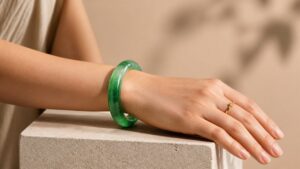
Fit is where many online jadeite purchases go wrong, because a bracelet that is too tight is uncomfortable and one that is too loose risks damage. The good news is that the product data gives you concrete guidance. For the Natural Jadeite Bracelet, the total circumference of about 18cm is designed for wrists measuring 16-19cm, which covers a wide range of adult wearers. Always measure your wrist circumference with a soft tape before ordering, and compare it against the stated fit range rather than guessing.
Bead diameter is the second fit variable. Larger beads — 16mm, for instance — create a bolder, heavier bracelet that sits more prominently on the wrist, while 10mm beads feel lighter and more delicate. Weight follows bead size: a 101g bracelet feels very different from a 30g one over the course of a day. If you wear jewelry continuously, a lighter piece may be more comfortable; if you want a focal piece for special occasions, the extra heft can be an advantage.
Elastic cord construction, used in several of these bracelets, adds flexibility and makes sizing more forgiving. It also means the bracelet slips on and off easily. When a listing notes an adjustable circumference, that is a sign the piece will accommodate most wrist sizes comfortably. For rings, the stated ring size is the key measurement — for example, the Natural Full-Green Jadeite Saddle Ring is a 24-ring size, while the Natural Jadeite Saddle Ring with Floating Green is a 26 ring size. Match those numbers to your known ring size before buying.
Price and Value: What Drives Cost
Jadeite pricing is not arbitrary — it reflects measurable qualities. The most significant drivers are transparency, color quality, the presence and distribution of green, bead size, and overall weight of material. A bracelet made of large, highly transparent beads with vivid floating green requires far more rare rough stone than a bracelet of small, more opaque beads, and that scarcity is reflected in price.
Within the current selection, you can see this spectrum clearly. Entry-level and mid-range pieces include the Natural Three-Color Jadeite Bracelet at $668, the Natural Jadeite Saddle Ring with Floating Green at $719, the Natural Ice-type Tricolor Jade Necklace at $740, the Natural Ice-type Tricolor Jade Necklace (the finer 3.5mm strand) at $825, the Natural Jadeite Tassel Earrings at $852, and the Natural Jadeite Bracelet at $1008. These offer accessible ways to own natural jadeite with appealing color and craftsmanship.
Moving into premium territory, the Natural Ice-type Jadeite Bracelet with Floating Green Patterns is priced at $1517, reflecting its large 16mm beads, 101g weight, and high transparency. Statement and collector pieces sit higher still: the Natural Ice-type Violet Jadeite Cabochon Ring Set with 18K White Gold, Sapphires, and Diamonds at $1926, the Natural Full-Green Jadeite Saddle Ring at $2437, and the exceptional Natural Ice-type Violet Jade Bead Necklace at $6649, a 158g strand of 68 beads ranging from 10mm to 12mm. When comparing, weigh price against transparency, color, and material volume — not against price alone.
Common Mistakes to Avoid
- Buying on color alone without checking transparency — a vivid green can still be opaque and less valuable than a subtler floating green on an icy base.
- Ignoring treatment status. Untreated Type A jadeite holds its beauty and value; treated material may not.
- Guessing your size instead of measuring your wrist or confirming your ring size against the stated figure.
- Overlooking bead diameter and weight, then finding the bracelet too heavy or too delicate for daily wear.
- Assuming all floating green is equal — distribution and integration with the base matter as much as the color itself.
- Failing to compare multiple pieces side by side, which is the single best way to calibrate your eye for color, clarity, and value.
Top Picks for Different Buyers
If you want the definitive floating-green statement, the Natural Ice-type Jadeite Bracelet with Floating Green Patterns at $1517 is the clear centerpiece — 13 beads of 16mm each, 101g, with the cool glassy sheen that defines ice-type material. It suits collectors and anyone who wants a bracelet that commands attention.
For everyday elegance, the Natural Jadeite Bracelet at $1008 offers a soft lavender-white hue, 19 beads of about 10mm, and a comfortable 30g weight for wrists of 16-19cm. It is an excellent first serious jadeite purchase.
If you love color variety, the Natural Three-Color Jadeite Bracelet at $668 brings yellow, white, and light green together in 12mm beads with an adjustable cord — a versatile, approachable choice.
For a coordinated look, consider the Natural Ice-type Tricolor Jade Necklace at $740, whose green, yellow, and orange transitions pair beautifully with a floating-green bracelet.
And for a truly exceptional investment, the Natural Ice-type Violet Jade Bead Necklace at $6649 represents the pinnacle of ice-type material — 68 translucent beads in a soft lavender hue, weighing 158g.
Final Tips Before You Buy
Buying an ice-type jadeite bracelet is ultimately about training your eye and trusting verified details. Prioritize transparency and natural, untreated material; confirm fit using the stated measurements; and compare several pieces before deciding. As one artisan guide advises, comparing color, clarity, imperfections, and price across multiple pieces is the most reliable way to develop judgment. With the right knowledge, a floating-green ice-type bracelet becomes not just a purchase but a lasting piece of wearable art.
FAQ
What does ‘floating green’ mean in an ice-type jadeite bracelet?
Floating green describes patches or veins of green color that appear suspended within a transparent, icy jadeite base. Because the surrounding material is highly translucent, the green seems to drift beneath the surface, creating a sense of depth and movement that is prized by collectors.
How do I know if jadeite is natural and untreated?
Look for listings that explicitly describe the jadeite as natural. Untreated jadeite is classified as Type A, as opposed to Type B (bleach-and-polymer treated) or Type C (dyed). Natural, untreated material is the standard for long-term beauty and value.
What wrist size fits the Natural Ice-type Jadeite Bracelet with Floating Green Patterns?
That bracelet comprises 13 round beads of 16mm each and offers a flexible fit suitable for various wrist sizes. Because bead diameter and weight affect how a bracelet sits, measure your wrist circumference and consider whether you prefer a bold, substantial feel or a lighter one.
Why do ice-type jadeite bracelets vary so much in price?
Price reflects transparency, color quality, the presence and distribution of green, bead size, and the total weight of rare material used. Larger, highly transparent beads with vivid floating green require more scarce rough stone, which is why pieces range from entry-level to premium and collector-level pricing.