
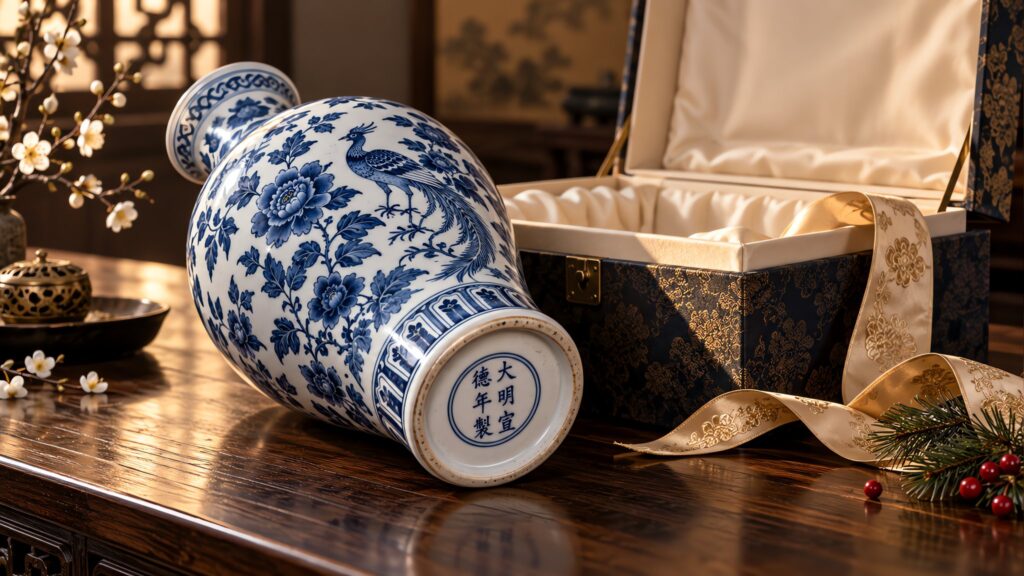
Why Ming Dynasty Reign Marks Matter to Collectors
A reign mark is the single most scrutinised detail on a piece of Chinese porcelain. It is the potter’s declaration of when and for whom an object was made, and on Ming wares it usually appears as a small cartouche of characters painted in underglaze blue on the base. For anyone buying antique Chinese ceramics, being able to read that mark — and to judge whether it is trustworthy — is the difference between a considered purchase and an expensive guess.
This guide explains what a Ming dynasty reign mark actually says, how the characters are arranged, which scripts and borders were standard, and why so many genuinely old pieces carry the mark of an emperor who died long before they were potted. It is written for collectors, decorators and gift-buyers who want a working method rather than a memorised list.
If your interests run across the whole field of Chinese decorative arts, it helps to see porcelain marks as one strand of a broader collecting tradition — the same tradition that shaped the imperial taste for jade over gold and the symbolism that still attaches to carved stone today.
Background: What a Reign Mark Actually Is
Reign marks versus other base inscriptions
Not every inscription on a base is a reign mark. Specialists generally group base marks into four families: reign marks naming an emperor’s reign period, hall marks naming a studio or pavilion, maker or artist signatures, and auspicious phrases or symbols. A guide to the four families of Chinese porcelain marks is a useful way to sort what you are looking at before you try to date it. Only the first family — the reign mark — claims a specific emperor.
The six-character formula
The classic Ming reign mark is six characters read in two vertical columns, right column first. The pattern is: Da Ming (Great Ming), then the emperor’s reign name, then nian zhi — literally ‘year made’ or ‘period made’. A Xuande mark, for example, reads Da Ming Xuande nian zhi. Four-character versions exist, usually dropping the Da Ming prefix, and these are common on earlier Ming pieces.
Script, colour and border
Ming marks are normally written in underglaze blue in regular script (kaishu), a clear, upright calligraphy quite different from the seal-script squares favoured in parts of the Qing period. The characters sit inside a defined border — most often a double circle, sometimes a double square, occasionally a single line or none at all. Christie’s specialists note that the reading of reign marks alongside the piece’s body, glaze and shape is what supports an attribution, not the mark alone.
How to Read and Assess a Ming Mark Step by Step
Step 1 — Identify the characters in order
Turn the piece over in good light and read right to left, top to bottom within each column. Confirm the first two characters are Da Ming. Then identify the reign name. The principal Ming reign names you will meet, in order, are Hongwu, Jianwen, Yongle, Xuande, Zhengtong, Jingtai, Tianshun, Chenghua, Hongzhi, Zhengde, Jiajing, Longqing, Wanli, Taichang, Tianqi and Chongzhen. A mark naming an emperor outside this list is not a Ming mark at all.
Step 2 — Check the script quality
Genuine Ming characters are confident and slightly irregular, with visible brush rhythm and natural variation in the blue. Later copies tend to be either mechanically neat — as though printed — or awkwardly clumsy, with strokes of even thickness and no sense of a moving brush. Look at how the characters sit in relation to the border: on good Ming pieces the spacing is balanced but not perfectly symmetrical.
Step 3 — Examine the border and the blue
The double circle should be drawn with the same cobalt as the characters, and it should show the same firing characteristics. If the ring is crisp, thin and grey while the characters are deep and slightly blurred, they may not be contemporary with one another. On Ming blue-and-white the cobalt often shows ‘heaping and piling’ — a darker, slightly mottled concentration where pigment pooled.
Step 4 — Read the mark against the object
A mark is one data point. Compare it with the paste, the foot rim, the glaze surface, the palette and the decorative style. A Chenghua mark on a piece with a nineteenth-century foot rim tells you the mark is apocryphal, not the piece. This is why experienced buyers handle the whole object before reading the base.
Step 5 — Understand apocryphal marks
Ming emperors’ marks were copied in enormous numbers during the Qing dynasty and again in the nineteenth and twentieth centuries, often as a mark of respect or simply as a marketing convention rather than an intent to deceive. A Xuande or Chenghua mark on a later piece is therefore extremely common and does not by itself prove fraud. It does mean the mark cannot be used to date the object.
Practical Tips for Reading Marks with Confidence
- Use a loupe and raking light — oblique light reveals brush texture and glaze depth that flat light hides.
- Photograph the base square-on and enlarge it; comparing your image with published mark charts is far easier on screen than in the hand.
- Learn the reign names in chronological order first, then the individual character forms; sequence prevents most misreadings.
- Compare the mark’s blue with the blue of the decoration on the same piece — a mismatch is a warning sign.
- Keep a simple notebook of marks you have seen in person, with your own sketch and notes on the object.
- Treat any single feature, however convincing, as one clue among many rather than a verdict.
- For high-value pieces, budget for a specialist opinion; the cost is small next to the risk.
Collectors who enjoy this kind of close visual analysis often find the same discipline useful elsewhere — the methodical checks in our guide to verifying a jade certificate follow a similar logic of cross-checking one claim against several independent signals.
Common Mistakes to Avoid
- Assuming an old mark means an old piece. Apocryphal marks are the norm, not the exception.
- Reading left to right. Chinese marks are read right column first; reversing them produces nonsense.
- Confusing reign marks with hall marks or reign titles used as decoration. A phrase on the body is not a base mark.
- Ignoring the border. A mismatched ring or square is one of the clearest signs of a later addition.
- Judging from photographs alone. Colour, glaze and paste rarely survive a screen accurately.
- Over-relying on one reference chart. Script forms vary between kilns and periods; compare several sources.
- Letting the mark override condition. A damaged piece with a ‘good’ mark is still a damaged piece.
Key Takeaways
Reading a Ming dynasty reign mark is a structured skill, not a lucky guess. Learn the six-character formula, read right column first, and fix the sequence of Ming reign names in your memory. Then train your eye on script quality, border consistency and the behaviour of the cobalt, and always read the mark in the context of the whole object — paste, foot, glaze and decoration together.
Above all, treat the mark as evidence to be weighed rather than proof to be accepted. That habit will serve you whether you are looking at porcelain, at carved stone, or at the wider world of Chinese antiques where provenance, material and craftsmanship all have to agree before a piece earns its place in a collection.
Frequently Asked Questions
What does a typical Ming reign mark say?
Most read Da Ming [reign name] nian zhi — ‘Made in the [reign] period of the Great Ming’ — in six characters arranged in two vertical columns, read right column first.
Does a Xuande or Chenghua mark mean the piece is that old?
No. Marks of admired Ming emperors were copied extensively in later periods, so the mark alone cannot date a piece. It must be assessed alongside the body, glaze, foot rim and decoration.
What script are Ming marks written in?
Ming reign marks are usually written in underglaze blue in regular script (kaishu), often enclosed in a double circle or double square border.
Can I date porcelain without a reign mark?
Yes. Many pieces were made without marks, and dating then relies on shape, paste, glaze, foot rim, palette and decorative style — the same criteria used to test a mark’s reliability.
FAQ
What does a typical Ming reign mark say?
Most read Da Ming [reign name] nian zhi — ‘Made in the [reign] period of the Great Ming’ — in six characters arranged in two vertical columns, read right column first.
Does a Xuande or Chenghua mark mean the piece is that old?
No. Marks of admired Ming emperors were copied extensively in later periods, so the mark alone cannot date a piece. It must be assessed alongside the body, glaze, foot rim and decoration.
What script are Ming marks written in?
Ming reign marks are usually written in underglaze blue in regular script (kaishu), often enclosed in a double circle or double square border.
Can I date porcelain without a reign mark?
Yes. Many pieces were made without marks, and dating then relies on shape, paste, glaze, foot rim, palette and decorative style — the same criteria used to test a mark’s reliability.