Why Knowing How to Spot Treated Jade Matters
Jadeite is one of the most imitated and most altered gem materials in the world, and the difference between a natural, untreated stone and a treated one is not a small technicality — it affects value, durability and how the piece ages in your jewelry box. A stone that has been bleached, impregnated with polymer or dyed can look vivid and glassy on a shop shelf, yet behave very differently over years of wear. For buyers, understanding the treatment question is the single most useful skill you can develop before spending money.
This guide walks through the practical clues that help you recognize treated jade: what bleach, polymer and dye actually do to a stone, how each treatment leaves visible or tactile traces, and how to build a calm, methodical inspection routine. The aim is not to turn you into a gemologist overnight, but to give you a working vocabulary and a set of checks you can apply with a loupe, good light and a little patience.
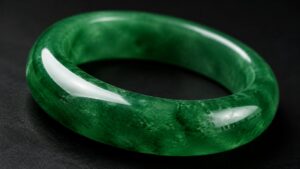
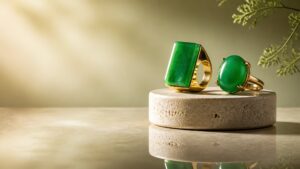
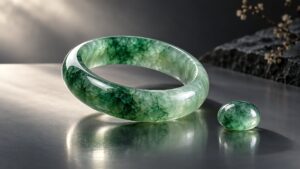
Because jadeite is sold across a wide range of quality and price, being able to separate natural from treated material also helps you compare stones fairly. The same logic applies whether you are looking at a carved pendant, a bangle or a cabochon ring — the treatment question comes first, and everything else follows.
Background: What Treatments Are and Why They Exist
Jadeite forms under high pressure and temperature, and much of what comes out of the ground is not gem-grade on its own. It may be heavily veined, cloudy, or pale. The trade has long used treatments to improve appearance, and the industry has developed a grading shorthand — commonly Grade A, B and C — to describe what has been done to a stone.
Grade A: Natural and Untreated
Grade A refers to jadeite that has not been bleached, polymer-impregnated or dyed. It may still have been cut and polished, which is normal and expected; what matters is that the color and internal structure are the stone’s own. Natural jadeite can absolutely contain inclusions, clouds and color variation — in fact, those features are often evidence of authenticity rather than flaws. For a deeper comparison of how natural and treated material differ in practice, see this investor’s checklist on telling Type A jadeite from treated jade.
Grade B: Bleached and Polymer-Treated
Grade B jadeite has been chemically bleached to remove brownish or muddy staining, then impregnated with a polymer resin to fill the microscopic gaps the bleaching opened up. The result can look cleaner and more translucent than the original rough, but the resin changes how the stone behaves: it can yellow, dull or become more brittle over time. The treatment is not always obvious to the naked eye, which is why careful inspection under magnification is so important.
Grade C: Dyed for Color
Grade C jadeite has had color added, usually by dyeing, sometimes combined with bleaching and polymer treatment (often loosely called B+C). Dye tends to concentrate in cracks, grain boundaries and surface-reaching fissures, so the giveaway is often a color that looks slightly too even, too saturated, or that sits in lines rather than floating naturally inside the stone. Recognized buying guidance emphasizes that color, clarity, treatments and authenticity should all be evaluated together rather than in isolation, as summarized in this jade buying guide covering color, clarity and treatments.
The Main Body: Reading the Clues
Clue 1: Color That Sits in the Wrong Places
Natural jadeite color usually develops in soft patches, bands or zones that follow the stone’s internal structure, with gradual transitions. Dyed color often behaves differently: it pools in fine surface cracks, looks unnaturally uniform across a large area, or appears to sit on top of the stone rather than inside it. Under a loupe, look for a faint web or vein of concentrated color — a classic dye signature. Also be suspicious of a saturated green or lavender that seems to stop abruptly at a facet edge or carving line.
Clue 2: Surface Texture and the ‘Bleached’ Look
Bleaching removes staining but can leave the surface looking slightly etched, chalky or overly dry in patches, especially where the stone meets a setting. Natural jadeite typically takes a smooth, even polish; a bleached stone sometimes shows a faint orange-peel or pitted texture under raking light. Run a fingernail gently across the surface and look at the reflection at a low angle — inconsistencies in the polish can be a hint that the material has been chemically worked.
Clue 3: The Polymer Tell
Polymer impregnation fills the spaces left by bleaching, and it can show up as a slightly waxy or plastic-like sheen that differs from the vitreous luster of natural jadeite. Under magnification, resin-filled areas may look smoother and more uniform than the surrounding crystal structure, or show tiny bubbles or a faint ‘flow’ pattern. A resin-treated stone may also feel slightly warmer or lighter than expected, and it can sound less crisp when tapped — though these are supporting clues, not proof on their own.
Clue 4: Internal Structure Under a Loupe
Natural jadeite is an interlocking aggregate of crystals; it has grain, texture and a certain lively depth. Treated stones can look flatter or more ‘frozen’ inside, with a hazy or milky quality where the resin has filled the gaps. Look for the characteristic fibrous or granular structure and for natural inclusions that cross the stone — if the interior looks suspiciously clean and uniform, slow down and inspect more closely.
Clue 5: Fluorescence and Other Testing
Some dyes and polymers fluoresce under ultraviolet light, so a UV lamp can be a useful screening tool — though not every treatment will react, and some natural stones can fluoresce too. Treat UV as one clue among many rather than a verdict. For high-value pieces, laboratory testing by a recognized gemological body remains the most reliable route to certainty. The same principle of building a layered case from multiple clues applies to antiques; our guide to natural versus artificial bronze patina shows how several small observations combine into a confident judgment.
Practical Tips for Inspecting Jade
- Use a 10x loupe and a bright, diffused light — raking light reveals surface texture that direct light hides.
- Compare the stone against a known natural piece of similar color; side-by-side comparison sharpens your eye faster than any checklist.
- Look at the stone from several angles, including the back and the area around the setting, where treatments are often most visible.
- Ask directly whether the piece is natural, bleached, polymer-treated or dyed, and ask for documentation for expensive items.
- Be cautious with unusually vivid color at a low price — treat it as a prompt to inspect more carefully, not as automatic proof of dye.
- For bangles, check the inside of the ring and the drilling; for beads, examine the holes where dye often collects. Our guide to comparing jadeite bead sizes also covers what to look for at the drill holes.
Common Mistakes to Avoid
- Assuming a certificate alone settles the question — read what the certificate actually says about treatments.
- Judging only by color; treated stones are often chosen precisely because their color looks impressive.
- Relying on a single test such as UV fluorescence, which can miss some treatments or mislead on natural stones.
- Ignoring the setting — treatments can hide under prongs, bezels or the inside of a bangle.
- Confusing natural inclusions with damage; clouds and grain are often signs of authenticity.
- Buying in poor lighting; vivid shop lights can mask a waxy polymer sheen or a chalky bleached surface.
Conclusion: Build a Layered Judgment
Spotting treated jade is less about a single magic test and more about assembling several small observations into a coherent picture. Color that pools in cracks, a surface that looks etched or waxy, an interior that seems too clean, or a sheen that differs from natural vitreous luster — each is a clue, and together they tell a story. Natural, untreated jadeite has grain, depth and a certain liveliness that treated material struggles to imitate.
Use these checks as a screening routine, and for anything expensive, confirm with a reputable laboratory. If you are still building your eye, start by studying natural examples across different colors and qualities, and read widely — our overview of jadeite color, clarity, cut and size is a good next step. With practice, the treatment question becomes a quick, confident part of how you look at every stone.
FAQ
Can I tell treated jade apart from natural jade by eye alone?
Sometimes, but not reliably. Experienced buyers use a loupe, good lighting and multiple clues — color distribution, surface texture, luster and internal structure. For high-value pieces, laboratory testing is the most dependable confirmation.
What does Grade B jade mean?
Grade B generally refers to jadeite that has been bleached and then impregnated with polymer resin to improve clarity and appearance. It is not the same as natural, untreated Grade A jadeite.
Does dyed jade fade or change over time?
Dyes and polymer treatments can change with wear and exposure. Colors may dull or shift, and resin can yellow or become brittle. Natural, untreated jadeite tends to hold its appearance far more consistently.
Is UV light a reliable test for treated jade?
UV can be a useful screening clue because some dyes and polymers fluoresce, but it is not definitive. Some treatments do not react, and some natural stones can fluoresce too, so treat UV as one piece of evidence among several.