Why Bronze Patina Matters to Collectors
Bronze patina is one of the most important signals of age and authenticity on a Chinese antique. The surface crust that develops over decades or centuries can tell you whether a vessel, mirror, or sculpture has genuinely aged or whether it has been chemically treated to look old. For buyers, that distinction affects both value and how you care for an object.
Artificial patina is common because it is fast and cheap to produce. A convincing green surface can make a modern casting look like an archaeological piece, and it can mislead anyone who has not learned what to inspect. The good news is that natural and artificial patina behave differently in observable ways — in their color variation, their texture, how they sit in recesses, and how they respond to light and moisture.
This guide explains the fundamentals of bronze corrosion, walks through the practical checks collectors use, and highlights the mistakes that lead people to misjudge a piece. The same careful eye you develop for metal also helps when you browse Chinese antiques and collectibles, where condition and surface honesty matter as much as form.
Background: How Bronze Patina Forms
What bronze actually is
Bronze is an alloy of copper with tin and sometimes other metals. Because copper is chemically active, it reacts with oxygen, moisture, sulfur compounds, and salts in its environment. Over time these reactions build a surface layer of corrosion products — the patina — that can range from a thin brown film to thick green encrustations.
Natural patina develops slowly and unevenly
Natural patina is a record of the object’s environment. Areas exposed to air and handling corrode differently from areas that stayed buried, sheltered, or in contact with other materials. That is why genuine patina is rarely uniform: it shows layering, gradation, and a relationship to the object’s shape. Recognized guidance on reading bronze patina on Asian sculpture emphasizes distinguishing natural age from artificial coloring by looking at how the surface developed rather than at color alone.
Artificial patina is applied or accelerated
Artificial patina is produced by chemical washes, paints, waxes, or accelerated corrosion. These methods can create green or brown color quickly, but they tend to sit on the surface rather than integrate with the metal. The result often looks painted-on, with color pooling in low spots and skipping over high spots in ways that do not match natural weathering.
Comparing Natural and Artificial Patina
Color and variation
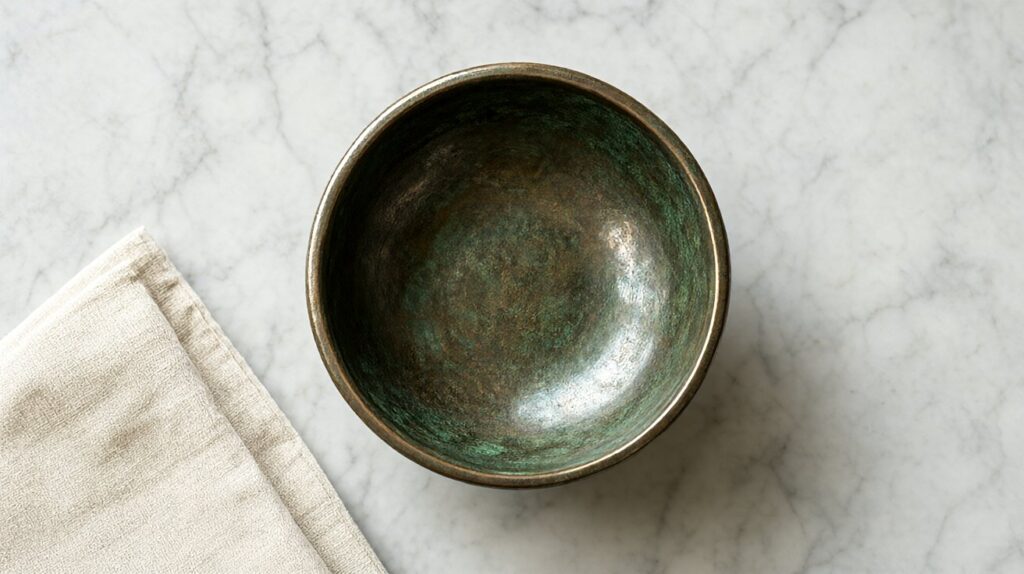
Natural patina usually shows a range of tones — brown, black, green, and occasionally blue — that transition gradually across the surface. Artificial patina often relies on a single dominant green or a flat brown, and the transitions can look abrupt or repetitive. Examine the object under different light angles; genuine patina shifts subtly, while applied color can appear chalky or uniform.
Texture and depth
Natural corrosion has depth. It may feel slightly rough, granular, or crusty, and it can build up in recesses and around details. Artificial patina is often thin and superficial, sometimes powdery or waxy to the touch. A useful check is to compare the surface of a raised area with a recessed one: natural patina usually shows a logical relationship between exposure and buildup.
How it sits on the metal
Natural patina is part of the metal’s surface history. It does not flake off in clean sheets, and where it is worn, the underlying metal shows its own age. Artificial coatings can chip, peel, or dissolve unevenly when lightly rubbed with a soft cloth. Experts who authenticate Chinese bronzes look at patina in combination with other factors, as outlined in this guide to identifying antique Chinese bronze.
Smell, residue, and stability
Artificial treatments sometimes leave a chemical or paint-like odor, or a residue that transfers to a cloth. Natural patina is stable and largely odorless. If a piece has been recently treated, you may notice a sheen or tackiness that does not match an aged surface. Always test in an inconspicuous area and avoid aggressive cleaning.
Practical Tips for Buyers and Owners
- Inspect under natural daylight and again under a warm lamp; artificial color often looks different under changing light.
- Use a soft, dry cloth on an inconspicuous spot to check whether color transfers.
- Compare raised details with recessed areas — natural patina follows the object’s geometry.
- Look for layering and gradual transitions rather than a single flat tone.
- Ask about provenance and any restoration or cleaning history before buying.
- Handle with clean hands and avoid harsh cleaners that can strip natural patina.
For a structured checklist, see this guide to real vs fake Chinese bronze patina, which pairs well with the visual checks above. If you also collect stone, the same principle of honest surface and condition applies when you explore natural jadeite jewelry.
Common Mistakes to Avoid
- Judging authenticity by color alone — green does not automatically mean old.
- Cleaning or polishing a bronze before evaluation, which can remove evidence.
- Assuming uniform patina is a good sign; natural patina is usually uneven.
- Ignoring smell, residue, and tackiness that suggest a recent treatment.
- Relying on a single photo instead of inspecting in person or requesting detailed images.
- Skipping provenance questions when the surface looks convincing.
Conclusion: Read the Surface, Then Verify
Natural and artificial bronze patina differ in color variation, texture, depth, and how the surface relates to the object’s form. No single clue is conclusive, so combine several observations and ask about provenance. For more red flags, read how to spot fake patina on Chinese bronze, and browse responsibly when comparing pieces in our antiques collection.
FAQ
Can artificial patina look exactly like natural patina?
It can look convincing in photos, but artificial patina usually lacks the layering, depth, and logical relationship to the object’s shape that natural corrosion develops over time. Inspect in person and under different lighting.
Does green patina always mean a bronze is old?
No. Green color can be applied chemically or with paint. Age is judged from the combination of color variation, texture, depth, wear patterns, and provenance.
Should I clean patina off a bronze antique?
Generally no. Aggressive cleaning can remove evidence of age and damage the surface. Consult a conservator before any treatment, and avoid harsh cleaners.
What is the quickest check for artificial patina?
Compare raised and recessed areas and gently rub an inconspicuous spot with a soft dry cloth. Color transfer, tackiness, or a chemical smell can indicate a recent artificial treatment.