Why Chinese Bronze Patina Matters to Collectors
Chinese bronzes are among the most admired and most reproduced objects in the antique market. From ritual vessels and incense burners to mirrors, bells, and figures, bronze has been cast in China for millennia, and the surface of a genuine old piece carries a record of that time. That surface layer — the patina — is one of the most useful things a buyer can learn to read. It is also one of the easiest things for a faker to imitate, which is why collectors need more than a single glance to judge a piece.
Understanding patina helps you in three practical ways. It protects you from paying antique prices for a modern casting, it helps you appreciate why an authentic aged surface looks the way it does, and it gives you a vocabulary for asking better questions of any seller. This guide walks through the fundamentals of bronze corrosion, then lays out seven clues you can use to separate a naturally aged Chinese bronze patina from an artificial one. It is written for curious buyers and new collectors, not for laboratory conservators, and it should be treated as a starting point rather than a certificate of authenticity.
If you also collect other Chinese decorative arts, the same patience and close looking pay off across categories — you can browse our Chinese antiques collection to see how surface, form, and age are described on well-documented pieces.
Background: What Patina Actually Is
Corrosion, not just dirt
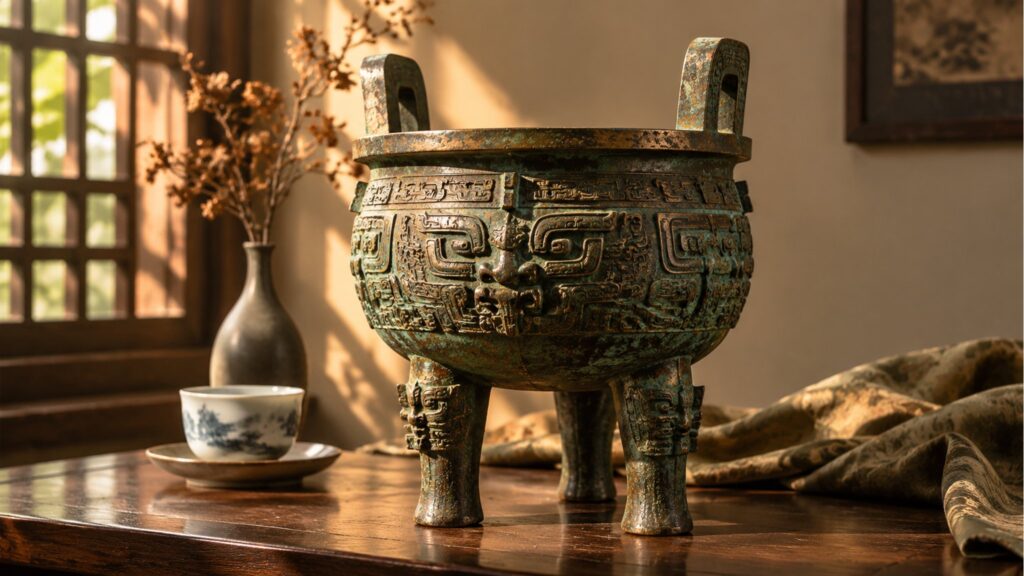
Bronze is an alloy of copper with tin and often lead or other metals. When copper is exposed to air, moisture, and salts over long periods, it reacts chemically and forms corrosion products on the surface. These compounds — copper carbonates, chlorides, oxides, and sulfides — are what we collectively call patina. The color depends on the chemistry and the environment: buried bronzes may develop green, blue, or grey crusts, while pieces kept indoors for centuries often show a smooth brown or blackish surface. Reputable guides to bronze patinas explain that many bronze objects, especially sculptures, also carry artificial patinas applied deliberately by the maker, so a colored surface alone never proves age (Bob Atchison’s guide to bronze patinas).
Why Chinese bronzes are a special case
Archaic Chinese bronzes were often buried for long periods, and burial conditions leave distinctive corrosion layers. Christie’s collecting guide notes that scholars and collectors pay close attention to an object’s origins, inscriptions, and purpose, and that the surface and provenance together inform how a piece is understood (Christie’s guide to collecting ancient Chinese bronzes). In other words, patina is one chapter of a larger story, not the whole book.
The faker’s problem
A modern reproduction can be given a green or brown coating in a workshop in a matter of days or weeks. What is very difficult to fake is the layered, uneven, slow way real corrosion develops, along with the wear and handling marks that accumulate over generations. Your job as a buyer is to look for consistency between the surface, the shape, the weight, and the story the seller tells.
The Seven Clues: Real vs Fake Chinese Bronze Patina
1. Color variation and layering
Genuine patina is rarely one flat color. Look for transitions: darker recesses, lighter high points, thin crusts in protected areas, and subtle shifts from brown to green to grey. Artificial patinas tend to be more uniform, sometimes with a single bright green that looks painted on. Turn the piece in raking light and see whether the color changes character across the surface.
2. Texture and depth
Real corrosion has physical depth. Under good light, genuine crusts may look slightly granular, powdery in spots, or built up in thin layers. Fakes are often thin films that follow the metal surface too closely, or thick pastes that look crusty but feel chalky and sit on top rather than growing into the metal. A loupe helps: real patina often shows fine structure, while a painted fake can show brush marks or a plastic-like sheen.
3. Where the wear is — and isn’t
Handling leaves patterns. Rims, handles, feet, and high reliefs tend to be rubbed smoother and lighter, while recesses keep more patina. A fake that has been uniformly aged often looks the same everywhere, or shows wear in places a hand would never reach. Ask yourself whether the wear matches how the object would have been used and displayed.
4. Smell and touch
This is a simple, non-destructive check. Genuine old bronze usually has a neutral, metallic, or faintly earthy smell. Some artificial finishes give off a chemical, paint-like, or vinegar odor, especially in enclosed areas. On touch, real patina is generally stable and dry; a fresh applied finish may feel slightly tacky or slick. Never rub hard or use solvents — you can damage an authentic surface.
5. Sound and weight
A bronze vessel should feel dense for its size. Very light pieces can indicate a thin modern casting or a different metal altogether. Tapping gently with a fingernail or a soft tool can reveal a clear ring in a sound casting; a dull thud may suggest cracks, repairs, or a poor cast. This clue is supportive, not decisive, and should be used gently on fragile pieces.
6. Inscriptions, casting, and tool marks
Look closely at cast details. Genuine archaic bronzes were cast with complex piece-mold techniques, and their decoration has a certain crispness and flow. Reproductions sometimes show soft details, seams, or modern tool marks. Inscriptions should be examined for consistency with the object’s style and period. A specialist guide to spotting antique Chinese bronze recommends weighing several factors together — patina, casting evidence, and provenance — rather than relying on any single test (expert clues for identifying antique Chinese bronze).
7. Provenance and documentation
The strongest clue is often off the object: a documented history. Auction records, old collection labels, published references, and a coherent account of where the piece has been all raise confidence. Be cautious when a seller offers a dramatic age story with no supporting paperwork. Provenance does not replace close looking, but it frames it.
Practical Tips for Buyers
- Examine in natural daylight and again under a warm lamp; patina can look very different under each.
- Bring a loupe and a small flashlight — raking light reveals texture that flat light hides.
- Ask specific questions: where did the piece come from, what repairs are known, and can the seller provide detail photos of the base, handles, and interior.
- Compare the object’s wear pattern with how it would have been handled and displayed.
- Treat any single dramatic feature — a bright green crust, a deep black surface — as a question to investigate, not a guarantee.
- Cross-check the seller’s description against published scholarship and reputable auction archives.
- If a piece is expensive, consider paying for an independent expert opinion before committing.
Collectors who enjoy Chinese antiques often build a broader eye by studying related materials. Our guides to why jade is so important in Chinese culture and to what makes Type A jadeite hold its value show the same principle at work: authenticity is about consistency across material, craft, and history.
Common Mistakes to Avoid
- Trusting color alone. Green does not equal old; many modern pieces are deliberately patinated.
- Cleaning or polishing. Aggressive cleaning can strip genuine patina and destroy value.
- Ignoring the base and interior. Fakers often focus on the visible front and neglect hidden areas.
- Over-relying on a single test. Smell, sound, or color can each mislead; use them together.
- Accepting vague stories. A compelling narrative without documentation is not provenance.
- Buying in poor light. Dim or colored lighting hides surface problems and exaggerates attractive tones.
Conclusion: Use the Clues Together
Real Chinese bronze patina is a slow, layered, uneven record of time, while fake patina is usually faster, flatter, and more uniform. The seven clues above — color variation, texture, wear patterns, smell and touch, sound and weight, casting details, and provenance — work best as a set. No single observation proves authenticity, but together they help you ask sharper questions and make calmer decisions. Approach every piece with curiosity, document what you see, and let reputable references and expert opinion support your judgment. Whether you are drawn to bronzes or to other Chinese works of art, the habit of careful looking will serve you well.
FAQ
Can fake Chinese bronze patina ever look completely real?
Skilled reproductions can be convincing in photographs, but under close inspection artificial patinas usually show more uniform color, thinner surface films, or wear patterns that do not match how the object would have been handled. Always combine visual checks with provenance and, for valuable pieces, independent expert opinion.
Should I clean the patina off a bronze I own?
No. Patina is part of the object’s history and value. Aggressive cleaning, polishing, or solvent use can remove authentic corrosion layers and reduce value. If you are concerned about active corrosion or stability, consult a conservator rather than treating it yourself.
Does a green patina always mean a Chinese bronze is old?
No. Green corrosion can develop naturally over time, but it can also be applied artificially by makers and restorers. Color is only one clue; texture, wear patterns, casting details, and documented history matter just as much.
What is the single most reliable sign of an authentic old bronze?
There is no single decisive sign. The most reliable approach is consistency across several factors — patina, casting and tool marks, wear, weight and sound, and documented provenance. Collectors treat these clues as a group rather than relying on any one test.