Why Patina Matters When You Buy Chinese Antiques
Whether you are a seasoned collector or a first-time buyer, the surface of an old bronze can tell you more than almost any other feature. The patina, the colored crust that develops on bronze over centuries of exposure to air, soil, and moisture, is one of the strongest signals of age and authenticity. It is also the easiest thing for a modern workshop to imitate. Every year, convincing replicas circulate through auction houses, antique fairs, and online marketplaces, many of them fitted with artificial surfaces designed to mimic the greens, blues, and browns of age. This guide gives you seven practical clues to help you spot fake Chinese bronze patina before you commit to a purchase.
Understanding patina will not just protect your wallet; it deepens your appreciation of the object itself. As with learning to read the condition of Chinese antiques more generally, the more you know about surface chemistry and wear, the more you can enjoy the genuine history written into a piece. By the end of this article you will be able to look at a bronze with a sharper eye, ask better questions, and know when to walk away.
What Is Bronze Patina, and Why Is It Faked?
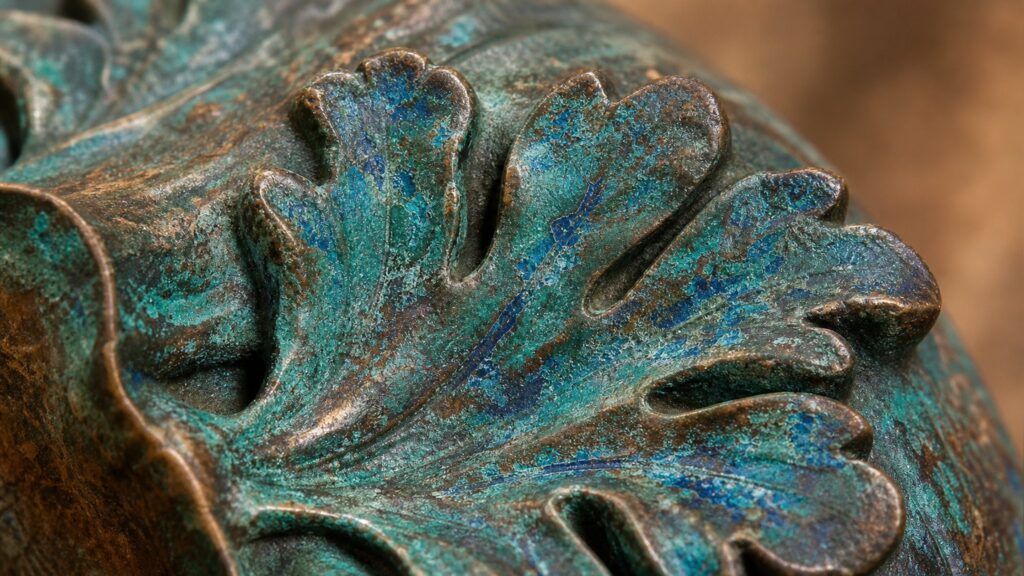
Patina is the natural result of corrosion. When bronze, an alloy of copper and tin, is exposed to oxygen, water, and salts, its surface slowly oxidizes and carbonizes, forming a complex crust. Over centuries this crust develops into the vivid mineral colors collectors prize: red-brown cuprite, green malachite, and blue azurite. The exact combination depends on the burial environment, the composition of the alloy, and how the object was used and cleaned through its life.
How Natural Patina Forms
Natural patina is built up in thin, irregular layers over a very long time. It does not appear overnight, and it does not spread evenly. It is also intimately bonded to the metal underneath; in healthy old bronze, the patina and the metal grade into one another. This layered structure, sometimes called the cuprite interface, is one of the hardest things for a faker to reproduce convincingly.
How Fake Patina Is Made
Modern fakers use several shortcuts. Some paint or lacquer a green or brown coating over a new casting. Others use chemical solutions, such as acids, salts, and ammonia, sometimes accelerated with heat, to force a corrosion-like layer in hours or days. As an experienced metalworker explains in a detailed guide to bronze patina chemistry, chemical patination is unpredictable and can easily ruin a piece. That is a revealing fact: genuine age is slow and stable, while rushed chemistry is brittle and variable.
Once you understand that contrast, slow natural growth versus forced chemical imitation, you can start applying the seven clues below with confidence. For a related example of how surface treatments can be used to deceive, compare the discipline of identifying Type A jadeite versus treated B and C jade. The same principle of looking for the unnatural evenness applies across both fields.
The 7 Clues to Spot Fake Chinese Bronze Patina
1. Uneven Natural Distribution vs. Suspicious Uniformity
Genuine patina is irregular. High points, such as the rim of a vessel, the belly of a figure, or the edges of a handle, are touched by hands, cloths, and dust, so their patina is thinner and more worn. Deep recesses, casting seams, and interior surfaces keep their crust longer. A fake patina, by contrast, tends to be too uniform. If the green looks the same everywhere, including on surfaces that would naturally be handled, pause.
2. Depth, Layering, and the Cuprite Layer
Look at a damaged or chipped area if you can. On an authentic bronze you will typically see distinct layers beneath the surface: a reddish cuprite layer closest to the metal, followed by green and blue minerals above. Fakes usually lack this stratigraphy; the coating sits on the surface like paint. Even forced chemical patina rarely reproduces the tight, thin cuprite band that separates ancient bronze from its corrosion crust.
3. The Hardness Test, Done Carefully
A genuine patina is hard, brittle, and fused to the metal. Artificial paint or lacquer is soft. On an inconspicuous spot, you can gently attempt to lift a tiny edge using a fine needle or the edge of a fingernail. Paint will flake or scrape; natural patina will resist. This test is invasive, so it is best reserved for pieces where the seller permits close inspection. Professionals routinely use physical checks of this kind, as seen in authentication discussions among Asian-art specialists.
4. Signs of Heat and Chemical Acceleration
Forced patina often leaves forensic traces. Torch-applied chemicals create bubbling, crazing, or localized burn marks where the flame was held. Solvent-based coatings may show brush strokes, drips, or tiny blisters. If the surface smells of lacquer, varnish, or sulfur compounds rather than faintly of old metal and dust, treat it with suspicion. Natural patina has an earthy, mineral character; it should not smell like a hardware store.
5. Wear Patterns That Tell a Story
Antique bronzes were used. Zones of contact, where a lid was lifted, a handle gripped, or a base stood on a table, show consistent, decades-long rubbing. The patina in those zones is compressed, polished, and often darker. In fakes, the maker has to decide where to apply and where to remove patina, and their choices are frequently plausible but wrong. Look for wear in believable, human places, not just on the most prominent surfaces.
6. Interior Surfaces and Hidden Areas
Authentic bronzes corrode from the inside as well as outside. Turn the vessel over, look inside the mouth, and check the underside of the foot. If the exterior looks impressively old but the hidden areas show raw, bright, freshly cast metal, or if the interior is painted to look old, the piece is likely a modern casting with a cosmetic finish. On genuine examples, the corrosion inside may look different but should still be present and naturally developed.
7. Consistency with the Object’s History and Style
Patina never stands alone. Ask whether the surface matches the object’s supposed age, style, and casting technology. A Han-style vessel with the untouched patina of a ritual bronze buried for two thousand years should not also display the crisp, sanded finish of a modern foundry. Cross-referencing patina with the expert clues collectors use to judge whether a Chinese bronze is genuinely antique, such as casting seams, metal thickness, iconography, and weight, gives you a far more reliable verdict than the surface alone.
Practical Tips for Buying Bronze Online and In Person
- Ask for high-resolution photos taken under natural light and under a bright lamp; flickering reflections can reveal brush strokes or lacquer.
- Request a video of the interior, the base, and the rim in motion, since fakes are harder to sustain when you can rotate the object.
- Use a jeweler’s loupe or a smartphone macro lens and look for layered structures, not just colorful surfaces.
- Ask the seller to explain the wear: where the piece was handled, how it was stored, and why certain areas have lost patina.
- Compare the piece to published museum examples of the same form or period before you buy.
- If the price feels too good for the age claimed, it almost always is.
Common Mistakes to Avoid
- Assuming heavy green means old; artificially induced greens are extremely common on modern replicas.
- Trusting a uniform patina; uniformity is the faker’s signature, not nature’s.
- Cleaning a bronze aggressively to improve it; this destroys patina and value, just as care mistakes can damage jadeite.
- Buying solely on photos without requesting detail shots of wear, interiors, and the base.
- Ignoring documentation; a certificate or provenance does not guarantee authenticity, but complete silence about history is a red flag, similar to reading jadeite certification reports.
- Being swayed by emotional storytelling about a family heirloom without examining the bronze itself.
Key Takeaways
Spotting fake Chinese bronze patina is a learnable skill. Remember the fundamentals: genuine patina is irregular, layered, and bonded to the metal; fake patina is uniform, superficial, and produced quickly. Check the hidden areas, respect the evidence of wear, and always consider the surface together with the object’s style, weight, and casting quality. Because authentication is a matter of probability rather than certainty, it pays to combine several clues instead of relying on any single feature.
If this detective work appeals to you, you will likely enjoy building an educated collection. Browse the antiques collection at VirtuCasa to see how old objects are presented in today’s market, and apply the same scrutiny to every piece you consider. And if you also collect natural jadeite, the same discipline will protect you there; review common jadeite buying mistakes to see how rushed decisions cost collectors.
FAQ
What does genuine Chinese bronze patina look like?
Genuine patina develops irregularly over centuries and typically shows multiple layers: a reddish-brown cuprite layer nearest the metal, with green malachite and blue azurite minerals above. It is hardest on raised, handled areas and deeper in recesses, and it is fused to the metal rather than sitting on the surface like paint.
Can fake patina be detected without damaging the piece?
Yes, in most cases. Closely inspect distribution, color depth, and wear patterns; check the interior and underside with magnification; smell for lacquer or chemicals; and cross-reference the surface with the object’s style and casting technology. Destructive tests are rarely needed.
Is a green patina always a sign of an old bronze?
No. Artificial green patinas are common on modern replicas. They are created with chemical solutions and heat, or with paint and lacquer. A heavy green surface can appear overnight, so color alone is never proof of age.
Why do some genuine antique bronzes have almost no patina?
Objects kept in dry indoor conditions, or cleaned in past centuries, may retain only a thin, dark brown patina. The lack of heavy green corrosion does not mean an object is fake; the patina must be judged together with wear, casting style, and documentation.